Fractions before middle school usually describe parts of a whole, like a slice of pizza or a section of a number line.
In probability, they take on a new role. Instead of describing pieces, they describe chances or how likely something is to happen out of all the possibilities.
With that transition exactly, we see that students, otherwise confident with fractions, start to lose footing.
Today, Mathnasium tutors explain why probability fractions may trip students up and how to calculate probability accurately without getting confused.

What Is Probability?
Probability is a way of measuring how likely something is to happen.
In everyday life, we often talk about probability using words like “certain,” “likely,” “unlikely,” or “impossible.” In math, though, we use numbers to show that chance more precisely.
We write probability as a fraction that compares the favorable outcomes against every outcome that's possible.
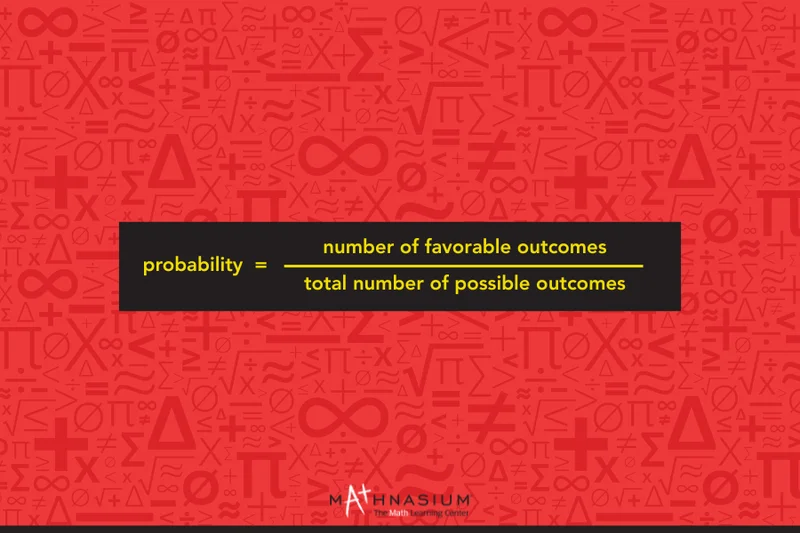
We can break down every probability fraction into two parts:
Let’s illustrate this with an example. Two friends flip a coin to see who picks the movie tonight. Heads is the only outcome that counts as a win. Out of two possible outcomes, one works in their favor, so the probability comes out to \(\Large\frac{1}{2}\)
Aside from a fraction (\(\Large\frac{1}{2}\)), we can write that same probability as:
This fraction works like a scoreboard. The bottom number holds every possible play, and the top number tracks how many of those plays get us the win we’re after.
📕 You May Also Like: How to Find the Probability of Two Events Happening
Why Do Fractions Cause Confusion When Calculating Probability?
In our experience, three changes cause this confusion, and none of them comes from how well students think about math. Each one changes a rule that used to feel solid.
1. Fractions Start Meaning Something New
Up to the point when students start learning probability, a fraction has always described one object split into pieces, like a pizza or a chocolate bar.
Probability hands that same symbol a new job. It no longer tracks pieces of one thing and starts tracking a set of separate outcomes that haven't happened yet.
Let’s illustrate the difference.
Joe has a single chocolate bar divided into 6 equal squares, and he eats 2 out of 6. He can also physically hold the chocolate bar, point to the pieces, and write \(\Large\frac{2}{6}\). The fraction tracks concrete parts of a whole object sitting right in front of him.
Then, probability shows up, and that same \(\Large\frac{2}{6}\) symbol does a completely new job.
Now, Joe is playing a board game and needs to roll a 5 or a 6 on a standard six-sided die to win. His probability of winning is \(\Large\frac{2}{6}\). But the difference is that the die in his hand isn't sliced into sixths like a candy bar. It is a solid, unbroken plastic cube.
The 6 on the bottom now represents six different paths the future could take the moment Joe tosses the die. The 2 simply counts how many of those potential futures mean he wins.
2. Simplifying Probability Fractions Erases the Real-World Picture
Students learn to treat a simplified fraction as progress because teachers often ask for “answers in simplest form.. If we simplify \(\Large\frac{2}10}\) into \(\Large\frac{1}{5}\), that makes the numbers cleaner and the answer easier to read.
However, probability breaks that habit. The numbers in probability fractions describe outcomes we can count, instead of just a value to simplify.
Let’s visualize it. Diego buys a raffle ticket at a school fundraiser, where a box holds 20 tickets, and 4 of them win a prize. His probability comes down to \(\Large\frac{4}{20}\), but the moment he reduces that to \(\Large\frac{1}{5}\), the box in front of him still holds 20 tickets, not 5.
That mismatch is the whole point. Fractions \(\Large\frac{4}{20}\) and \(\Large\frac{1}{5}\) keep the value the same on paper, but the actual box, the tickets, and the prize count all stay exactly where they started.
📕 You May Also Like: Simplifying Fractions: Quick Steps to Reduce and Compare
3. Bigger Numbers Don't Mean Higher Probability
In almost every other area of math, a bigger number signals a bigger value. When we transition to probability, however, our brains fall into a classic trap called denominator neglect.
Normally, we know that a bigger bottom number makes a fraction smaller (for example, \(\Large\frac{1}{10}\) of a pizza is way smaller than \(\Large\frac{1}{2}\)). But in probability, our eyes play tricks on us. We get so focused on the bigger number on top that we completely ignore the size of the total pool on the bottom.
For example, let's look at Jayden's basketball stats. On Tuesday, he made 6 out of 8 free throws. On Thursday, he made 7 out of 10.
If his coach wants to calculate the probability of Jayden making his next shot based on Tuesday's practice, the probability of picking a basket is \(\Large\frac{6}{8}\) or 75%. If the coach does the same for Thursday, the probability of picking a basket is \(\Large\frac{7}{10}\) or 70%.
Even though both his total attempts and his total went up on Thursday, the probability of picking a successful shot actually dropped.
Because we got excited seeing the 7 instead of the 6 we almost ignored the fact that Thursday's total pool was bigger, making it harder to randomly pick a winner.
📕 You May Also Like: How to Turn a Fraction into a Percent: A Kid-Friendly Guide
How to Calculate Probability Without Getting Tripped Up by Fractions (Solved Examples)
To master calculating probability without getting confused by fractions, let's solve a few real-life scenarios and walk through the logic together.
1. How to Simplify the Probability Fraction Without Losing the Real-World Picture
Mia is at a school bake sale, where 24 cupcakes are laid out on the table, and 4 of them have a hidden golden sprinkle underneath the frosting that wins a free drink coupon. Let's calculate her probability of picking a winning cupcake.
Step 1: Write the Probability in the Form of a Fraction
Before we write anything down, we look at the numbers in the story. There are 24 cupcakes in total, and that is our total number of outcomes (denominator). There are 4 cupcakes with a hidden golden sprinkle, which are favorable outcomes (numerator). Now, we write the fraction \(\Large\frac{4}{24}\).
Step 2: Reduce the Fraction
We now want to make the fraction easier to read while still keeping track of the original denominator of the story (24).
To simplify \(\Large\frac{4}{24}\), we divide both the numerator and denominator by the biggest number, which is 4.
\(\Large\frac{4÷4}{24÷4} = \Large\frac{1}{6}\)
Our simplified fraction is now \(\Large\frac{1}{6}\).
Step 3: Understand the Answer
Out of 24 cupcakes, the probability for Mia to get a hidden cupcake is \(\Large\frac{4}{24}\) or \(\Large\frac{1}{6}\). Even though we simplified the probability fraction to \(\Large\frac{1}{6}\), nothing in the story changed. The total amount of cupcakes did not mysteriously drop from 24 to 6.
The simplified fraction tells us the same probability, only in a simpler number, which is 1 in 6.
2. How to Tell When Bigger Numbers Don't Mean Higher Probability
Owen competes in a school trivia tournament with two rounds. In the first round, he answers 21 questions correctly out of 25 attempts. In the second round, he answers 27 correctly out of 34 attempts.
Step 1: Look at the Raw Numbers First
Both Owen's correct answers and his total attempts went up in round two, climbing from 21 and 25 to 27 and 34. At a glance, that looks like an improvement.
Step 2: Turn Each Round Into a Probability
Round one gives us \(\Large\frac{21}{25}\), which works out to 84%. Round two gives us \(\Large\frac{27}{34}\), which works out to about 79%.
Step 3: Compare the Actual Probabilities, Not the Raw Numbers
Even though both his total questions and his total correct answers went up in round two, Owen’s probability of getting a question right actually dropped, and that drop is easy to miss if we only look at the 27 instead of the fraction of successes.

When probability turns familiar fractions unfamiliar, Mathnasium tutors help students find their footing again step-by-step.
How Mathnasium Helps Students Master Probability (and Any Other Math Concept)
Mathnasium is a math-only learning center dedicated to helping K-12 students of all skill levels excel in math.
Whether your student is looking to rebuild foundational skills like fractions or keep up with the demands of middle school curriculum, we can support them.
To help students build a deep understanding of any math concept, including probability, we use a proprietary teaching approach called the Mathnasium Method™.
Here’s how it works.
Each student begins with a diagnostic assessment that shows us where they are on their math journey and where the knowledge gaps are. From there, we build a personalized learning plan tailored to their needs, pace, and goals.
Our specially trained tutors follow the plan closely, delivering face-to-face math instruction in a caring and fun small-group environment.
We teach math for understanding, using natural language and a combination of mental, verbal, visual, tactile, and written techniques.
If a concept feels tricky, we break it down into manageable steps, showing students both the how and the why behind the answer. In time, they develop problem-solving skills and critical thinking tools to use in math and beyond.
Fun is an important part of the Mathnasium Method™. Our activities are often game-based and hands-on. We let students earn their rewards and celebrate each step of progress together, so their confidence grows with each session.
The results speak for themselves:
-
94% of parents report an improvement in their child's math skills and understanding
-
93% of parents report an improved attitude toward math
-
90% of students saw an improvement in their school grades
Mathnasium operates over 1,100 learning centers, bringing our top-rated math instruction close to your community.
For students and families based in or near Richardson, TX, Mathnasium of Richardson West is a trusted local resource with a proven record of building confident math thinkers.
In addition to over 100 five-star Google reviews, our center has been recognized by Living Magazine’s Best of Richardson and Murphy Reader’s Choice Awards, including:
Whether your student is looking to catch up, keep up, or get ahead in math, our local team is happy to help!
Ready to get started?
📅 Schedule a Free Assessment at Mathnasium of Richardson West
Not located near Richardson?
📍Find a Mathnasium Learning Center Near You


 (972) 231-6284
 (972) 231-6284