

Alexandria City
4605 Duke Street
Alexandria, VA 22304
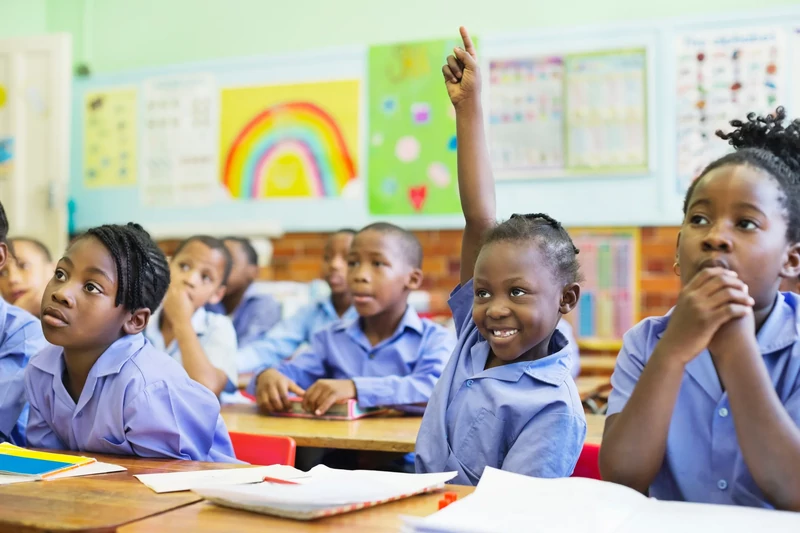
As students progress in math, they often discover there’s more than one way to reach the same answer, and each method reveals something new.
In the U.S., students often learn math through written algorithms, standard pencil-and-paper methods, and, by high school, tools like graphing calculators that are almost a rite of passage.
But around the world, different countries have different ways of thinking about math. In China, students might use the abacus to picture numbers. In India, quick mental tricks called Vedic methods help solve problems faster. Every approach is shaped by culture, history, and the way people live.
In that same spirit, today we turn to Ethiopia and Eritrea, where math understanding begins not with textbooks, but with lived experience.
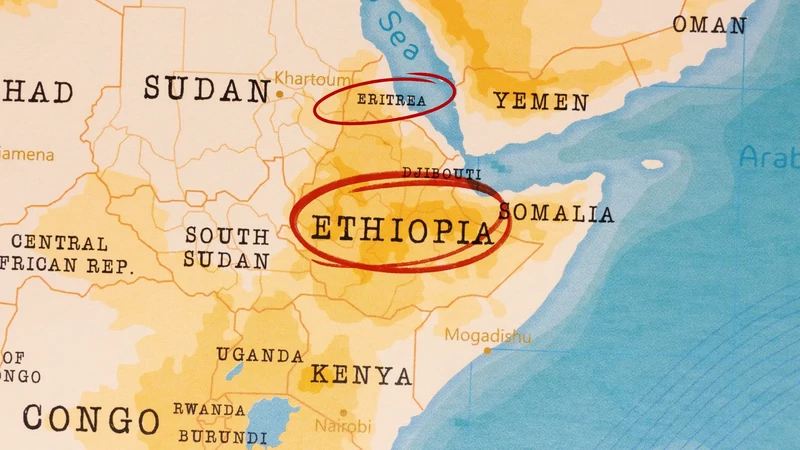
Ethiopia and Eritrea are two neighboring countries in East Africa, in the northeastern corner of the continent near the Middle East, a region known as the Horn of Africa.
They share more than a border.
For centuries, their languages, religions, and customs have followed a similar path. But their shared roots go even deeper. For centuries, both have used the ancient Ge’ez script, celebrated the same holidays, and passed down knowledge through generations.
In both cultures, learning often begins at home. Children grow up listening to stories, repeating prayers, and learning from the people around them. Lessons are spoken, sung, or acted out, not always written down. Memory, rhythm, and observation help knowledge stick.
This prepared students to understand many things, including math. Before schools introduced formal lessons, children picked up math through farming, trading, and sharing resources.
Let's take a closer look at how these early foundations shaped the region's most lasting math traditions.
Ethiopia and Eritrea: neighbors with a shared story, shared roots, and smart ways to learn.
Across the Horn of Africa, math has never lived only in classrooms. Long before formal instruction, mathematical thinking was already woven into daily life through games, designs, trade, and tradition.
At Mathnasium, we connect math to real life to help students build understanding. In the Horn of Africa, it often worked the other way around. Real life taught the math long before school ever did.
Let’s see how.
In the highlands of Ethiopia and Eritrea, numbers once lived in gestures and objects.
Ge’ez numerals, an ancient system of symbolic number writing still used in church calendars and religious texts, offered more than just a way to track dates.
The system was additive, meaning each symbol represented a specific value, and numbers were formed by combining them.
For example, 437 would be written using separate symbols for 400, 30, and 7. To use it correctly, you had to break numbers into parts, group values, and think about how quantities fit together.
As researchers have noted, this additive, base-10 system encouraged an intuitive grasp of quantity, grouping, and place value.
In communities like the Opo and Ari, counting was even more tactile. People used fingers, limbs, objects, and local tools to represent numbers.
Some numbers were named through operations: in the Ari language, for example, the word for eight means “ten minus two.”
Amazing, right? Just practical math, shaped by language and lived experience.
📕 You May Also Like: What Is Number Sense & Why It Matters in Early Math Education
A handful of grain. The length of a rope. The distance you can walk before sunset. Rather than just estimates, these were everyday units, used to measure out trade, time, and territory with shared understanding.
One tradition described in ethnomathematics research is kircha, a communal practice where an ox is shared among dozens of people, sometimes sixty or more. There’s no scale involved. Instead, the meat is divided by eye, with careful attention to fairness.
Everyone knows what’s expected, and everyone trusts the outcome. It’s a lived exercise in division, comparison, and proportional reasoning.
📕 You May Also Like: Measurement Conversions: A Kid-Friendly Guide
As research shows, many rural areas of the Horn of Africa reflect geometric thinking in how people build and decorate their surroundings.
Circular tukuls made of mud and thatch help retain warmth during cool nights. Rectangular compounds organize space efficiently: one area for sleeping, another for storing grain or sheltering animals. Each shape is chosen with purpose, shaped by practical needs and local materials.

Circular tukuls in southern Ethiopia, built with purpose and geometric logic.
Designs continue inside the home and across everyday objects. Woven trays, used for serving food or hung as wall decorations, display radial symmetry. Shapes spiral outward in careful patterns, stitched in rows of triangles, diamonds, and stars.
In Orthodox churches, painted ceilings and wooden crosses feature mirrored layouts and geometric icons that represent spiritual ideas as well as mathematical ones.
Even traditional clothing beautifully shows intentional, mathematical design! When weavers create tibeb patterns, they're using rhythm, spacing, and careful sequencing to build balanced, repeating designs. These hands-on skills are actually geometric transformations in action.
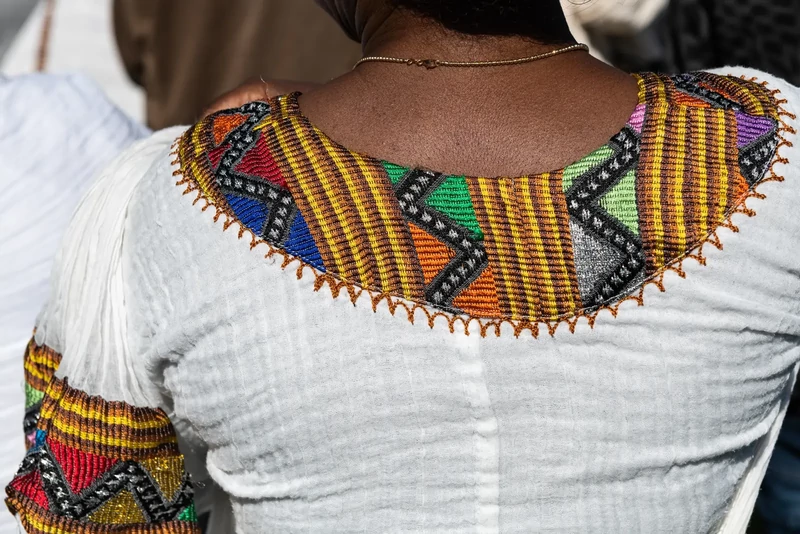
Traditional tibeb embroidery with mirrored patterns and geometric repetition.
We’ve seen it across our centers: when students hesitate with a math problem, a simple game can change everything. The pressure eases, and answers start to come more naturally.
In Ethiopia and Eritrea, a game called Gebeta has done that kind of work for generations. Played with seeds or stones and a board carved with two rows of shallow pits, Gebeta challenges players to plan ahead, count accurately, and respond to every move.
Each player controls six pits and a store. On your turn, you pick up all the pieces in one of your pits and drop them one by one into the next pits, moving counterclockwise.
If your last piece lands in an empty pit on your side, and the opposite pit holds pieces, you capture them. The game ends when one side is empty, and the player with the most captured pieces wins.
The strategy builds over time. You have to think in steps, keep track of quantities, and consider both offense and defense. Studies have highlighted Gebeta as an example of informal learning that strengthens skills in counting, grouping, subtraction, and sequential reasoning, all without a single written number.
This multiplying method, still used in parts of Ethiopia and Eritrea today, goes back thousands of years. It first appeared in ancient Egypt and likely spread through trade. In the Horn of Africa, it’s believed that merchants passed it down through practice, not paper.
Its history runs deep, but what stands out to our tutors is how practical it is. It relies on simple operations like halving, doubling, and adding numbers.
So how does it work? Let’s take it step by step.
Step 1: Put the number you want to halve (the multiplicand) on the left, and the number you want to double (the multiplier) on the right. We recommend using a T-chart to keep things organized.
Step 2: Repeatedly halve the number on the left until you get to 1, ignoring any decimals. Each time you halve, double the number on the right.
Step 3: Cross out any rows where the number on the left is an even number.
Step 4: Add up the numbers on the right to find your answer.
Ready to test this out?
Let’s try with 14 x 9.
To keep our calculations nice and tidy, we create a T-chart, put 14 on the left, and 9 on the right.
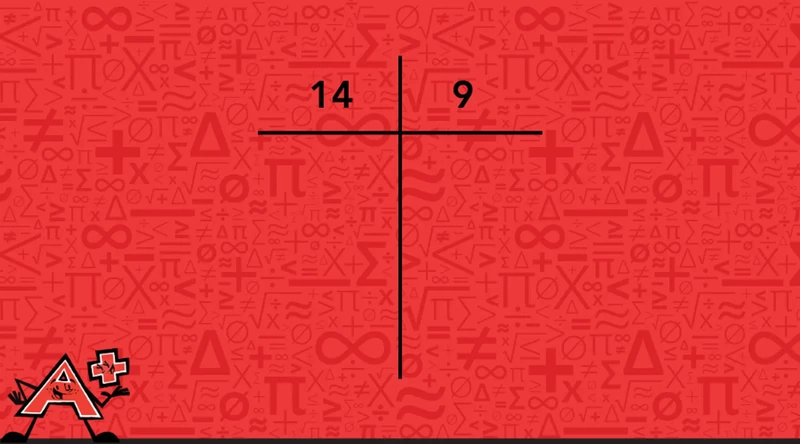
We halve the number on the right (14) until we get to 1:
14 ÷ 2 = 7
7 ÷ 2 = 3.5 (we treat this as 3)
3 ÷ 2 = 1.5 (we treat this as 1)
At the same time, we double the number on the left (9):
9 x 2 = 18
18 x 2 = 36
36 x 2 = 72
Since there are no even numbers on the left, we can skip this step.
Now, we just add up all the numbers on the right:
18 + 36 + 72 = 126
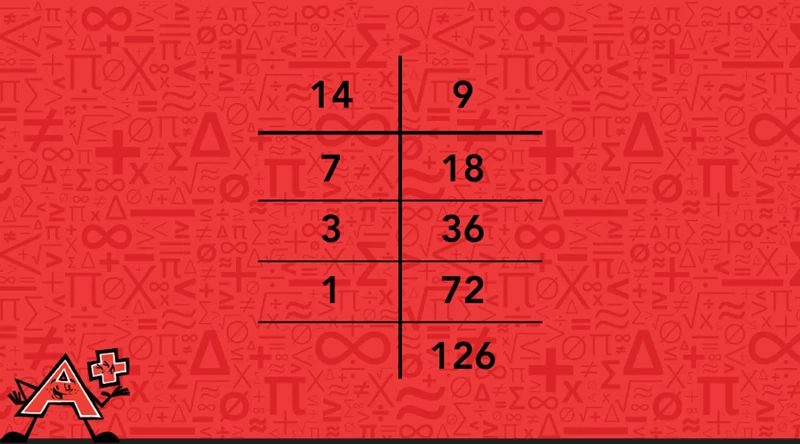
Pretty neat, right?
At Mathnasium, we love it when a method shows that understanding beats memorizing.
This one builds number sense by helping students see how multiplication works, one step, one pattern at a time.
We believe it takes much more than memorizing steps to truly understand math. Math isn’t a rigid set of rules; it’s flexible and full of patterns. Just look at the multiplication method still used across Ethiopia and Eritrea. It works through logic and structure, not memorized tables.
At Mathnasium, our goal is to grow real math thinkers, not just answer-getters. That’s the heart of the Mathnasium Method™ — a proprietary teaching approach that’s been transforming how kids learn and think about math for over 20 years.
It starts with a diagnostic assessment, which is nothing like a formal test. It’s a relaxed, one-on-one interaction that helps us identify each student’s strengths, gaps, and learning preferences, whether visual, verbal, tactile, or a combination.
From there, we create a personalized learning plan tailored to each child’s goals. That might mean rebuilding key foundations like fractions, extending number sense, or moving into advanced topics with confidence.
Instruction is always face-to-face, personalized, and led by specially trained Mathnasium tutors. We use a mix of mental, verbal, visual, written, and tactile techniques to help students truly grasp the concepts, not just follow the procedure.
During every session, we guide students to explore the why and how, so they develop lasting problem-solving skills they can apply in and out of the classroom.
And it works. Families see the difference:
94% of parents report an improvement in their child's math skills and understanding
93% of parents report an improved attitude towards math after attending Mathnasium
90% of students saw an improvement in their school grades
Whether your child needs to catch up, keep up, or get ahead, your nearest Mathnasium Learning Center is ready to help them build the confidence and understanding that lasts.
Mathnasium of Alexandria City is a math-only learning center for K-12 students in Alexandria, VA. Trusted by over a million parents, Mathnasium uses personalized learning plans and the proprietary Mathnasium Method™ to help students catch up, keep up, and get ahead on their math journey.
Our specially trained tutors deliver face-to-face instruction in a supportive and fun small-group environment, working with students to develop a deep understanding of math, build confidence, and improve academic performance.
Schedule Free Assessment
 (703) 956-5150











