What if we told you there's more than one way to multiply?
Most of us learned multiplication the same way by stacking the numbers, multiplying right to left, carrying the extras, and hoping we don't lose track halfway through. It works, but for some students, keeping all those steps in order at the same time is where things start to unravel.
The lattice multiplication method offers a different path. It breaks the same math into smaller, more manageable steps and organizes everything inside a grid, which students find much easier to follow.
Today, Mathnasium tutors walk you through exactly how the lattice method works, with step-by-step solved examples, practice problems, and common mistakes to avoid.

What Is Lattice Multiplication?
Lattice multiplication is a visual grid-based method for solving multiplication math problems. It transforms a big multiplication problem into a series of small, easy facts and simple addition.
The method has been around for centuries, as Arab and European mathematicians used it long before the standard algorithm became the norm in classrooms.
What makes it stand out today is its structure:
-
Each step has its own designated space.
-
Multiplication and addition happen separately.
-
The diagonals sections keep each part of the calculation organized and easy to follow.
📕 You May Also Like: What Is Grid Method Multiplication? A Step-by-Step Guide
How to Use the Lattice Method
Let's walk through the lattice multiplication step by step and multiply a two-digit (12) by a one-digit number (3).
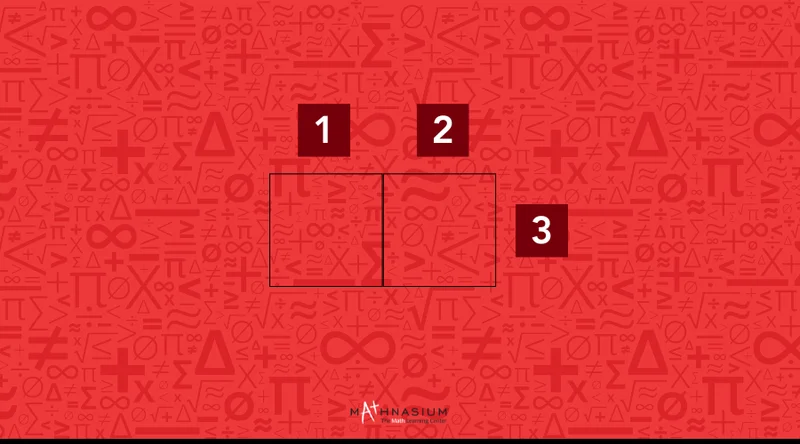
Step 1: Set up the grid
We start by drawing a 2×1 grid (two columns and one row). The digits of the first number (1 and 2) go along the top, one per column. The digit of the second number (3) goes along the right side.
Step 2: Draw the diagonals
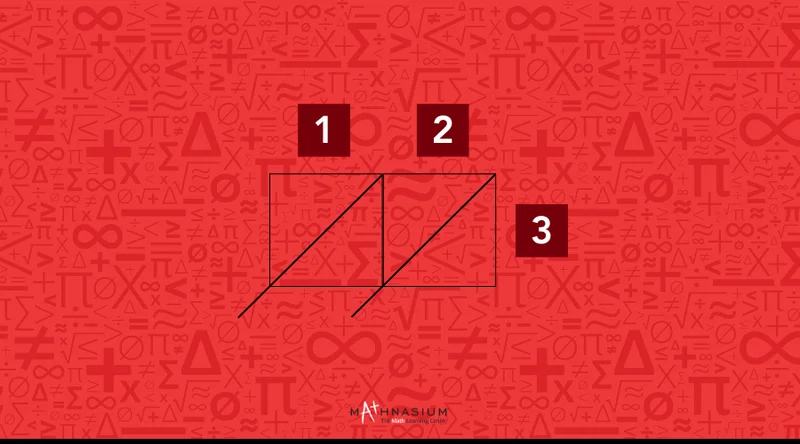
Now, let's draw a diagonal line through each cell from the top right corner to the bottom left one.
Step 3: Fill in the cells
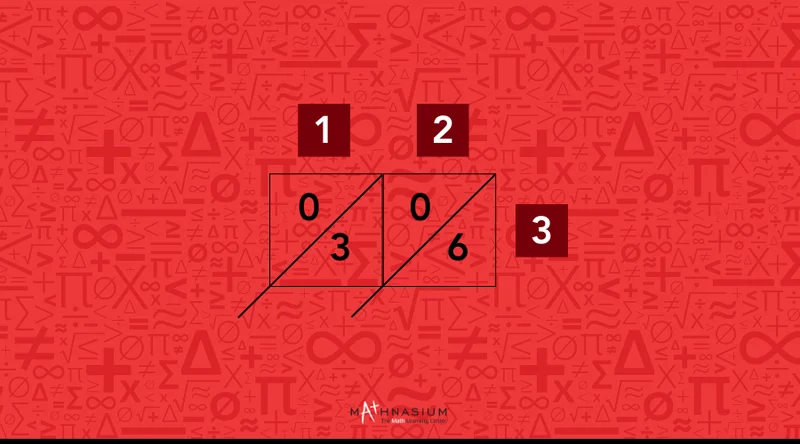
We multiply the digit at the top of each column by the digit on the right side.
The result goes in the matching cell (tens digit above the diagonal, ones digit below).
For single-digit results, we write 0 above the diagonal.
-
Left cell: 1 × 3 = 03 → 0 above, 3 below
-
Right cell: 2 × 3 = 06 → 0 above, 6 below
Step 4: Add along the diagonals
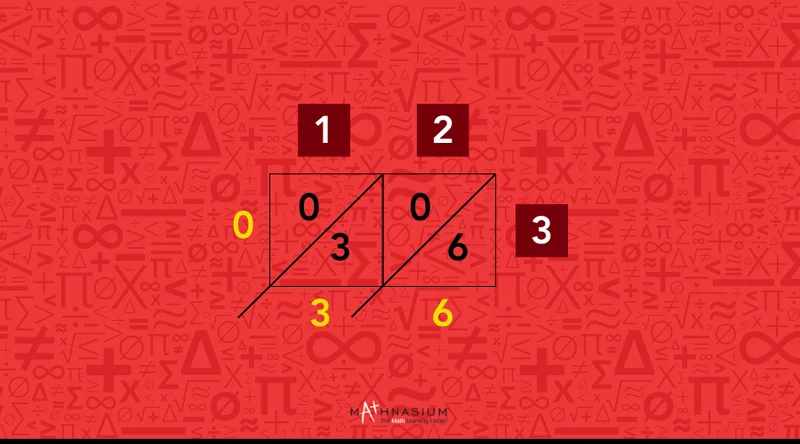
From the bottom-right corner, we add the numbers in each diagonal strip and write the sum below or to the left of the grid, working from right to left.
-
Diagonal section 1 (far right): 6
-
Diagonal section 2 (middle): 0 + 3 = 3
-
Diagonal section 3 (far left): 0
Step 5: Read the answer
We read the digits from the top-left down and then along the bottom from left to right.
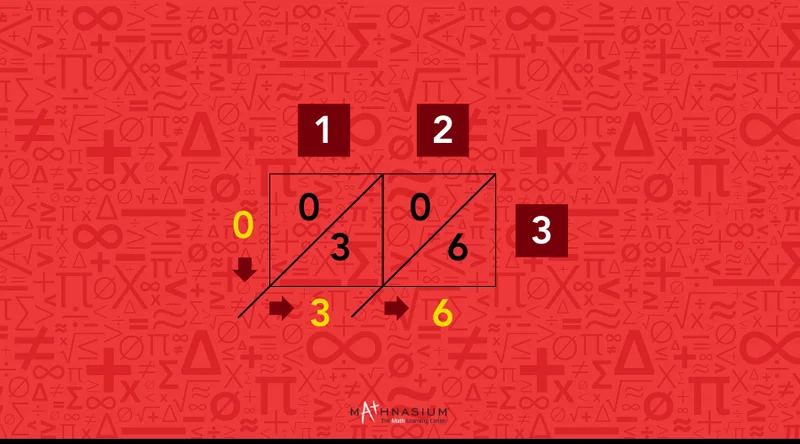
The digits tell us that the result is 036 or just 12 × 3 = 36.
Solved Examples for Lattice Multiplication
Let's put the method into practice. Here are four examples we can work through together, starting with 2-digit by 2-digit multiplication and going towards 4-digit numbers.
Example 1
Let's use the lattice method to calculate 23 × 12.
Step 1: Set up the grid
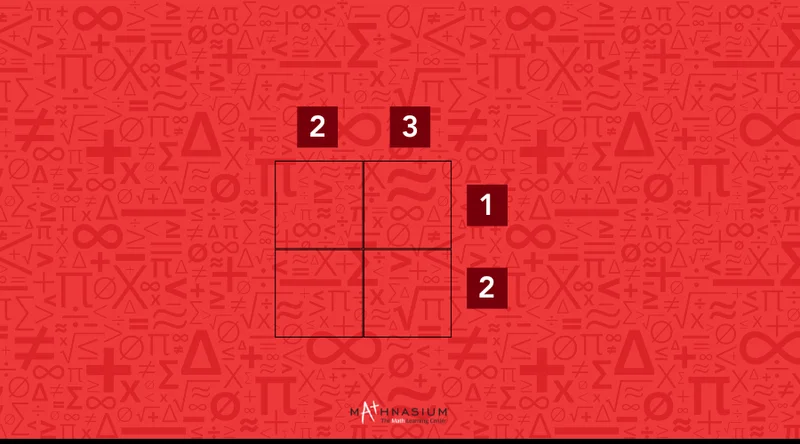
We need a grid with two columns and two rows.
Then, we write the digits of the first number along the top, one digit per column. The digits of the second number go along the right side, one digit per row.
Step 2: Draw the diagonals
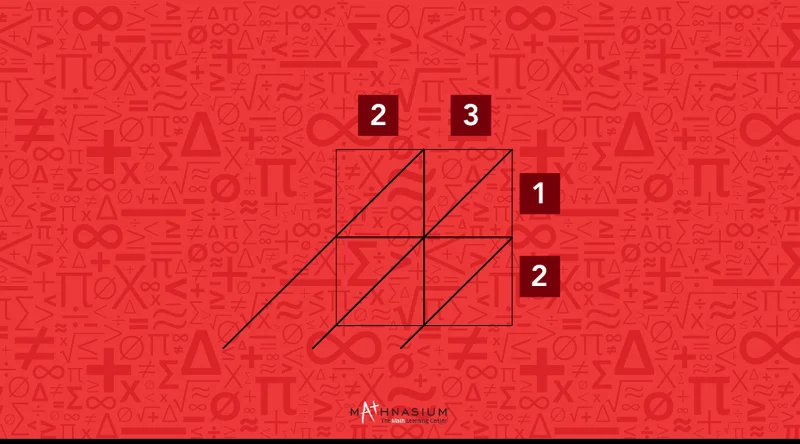
Now, let’s draw a diagonal line through each cell, running from the top-right corner to the bottom-left corner.
Step 3: Fill in the cells
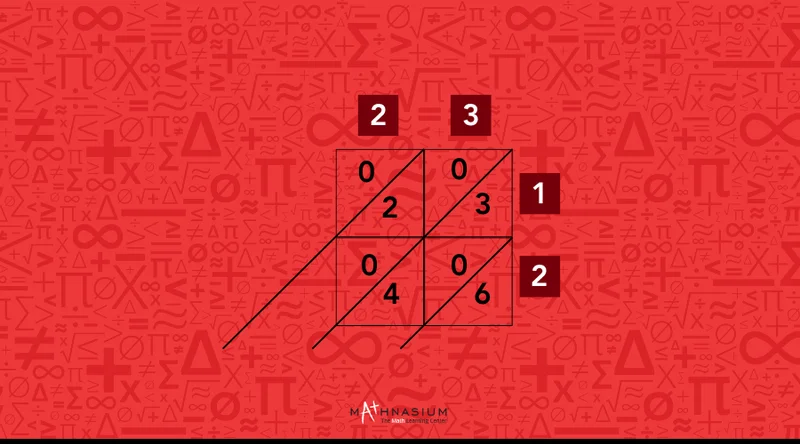
We are now multiplying the digit at the top of each column by the digit at the side of each row. Write the result in the matching cell, the tens digit above the diagonal, the units digit below. If the result is a single digit, write 0 above the diagonal.
-
Top-left cell: 2 × 1 = 02 → write 0 above, 2 below
-
Top-right cell: 3 × 1 = 03 → write 0 above, 3 below
-
Bottom-left cell: 2 × 2 = 04 → write 0 above, 4 below
-
Bottom-right cell: 2 × 3 = 06 → write 0 above, 6 below
Step 4: Add along the diagonals
Let’s now add the numbers in each diagonal strip starting from the bottom-right corner and write the sum below or to the left of the grid. Work from right to left.
-
Diagonal section 1 (far right): 6 → write 6
-
Diagonal section 2 (middle): 4 + 0 + 3 = 7 → write 7
-
Diagonal section 3: 0 + 2 + 0 = 2 → write 2
-
Diagonal section 4 (far left): 0 → write 0
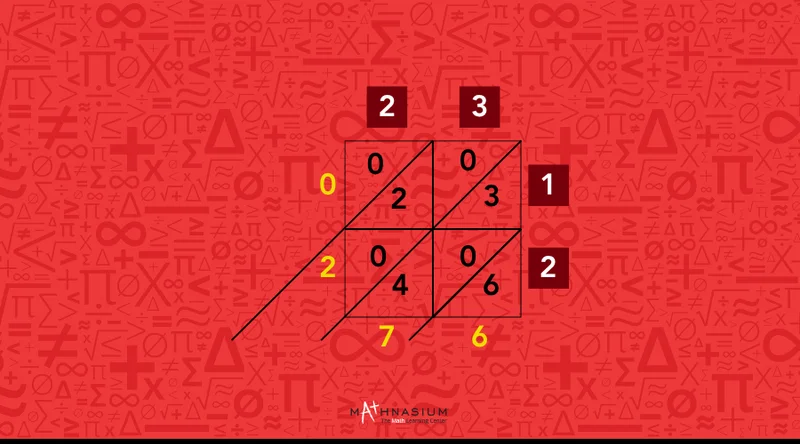
Step 5: Read the answer
To get our answer, we read the digits from the top-left down and then along the bottom from left to right.
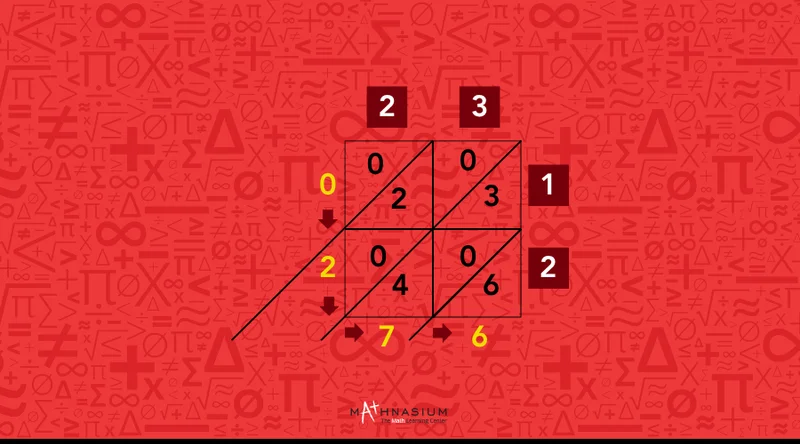
Our final answer is 276.
Example 2
Let’s see how lattice multiplication works with three-digit numbers. How much is 215 times 4?
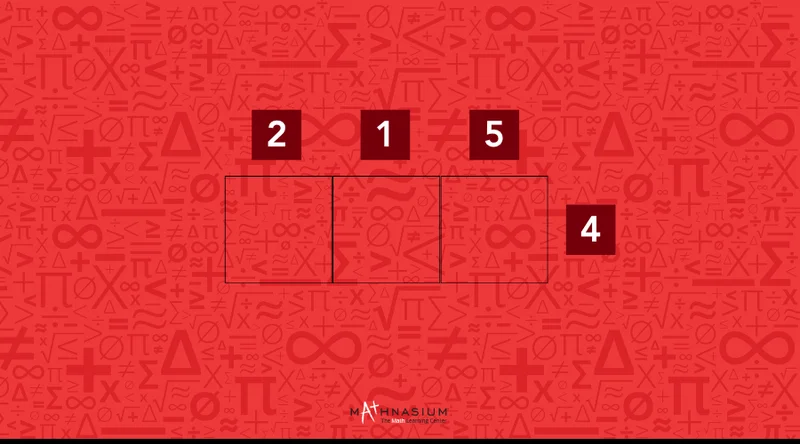
Step 1: Set up the grid
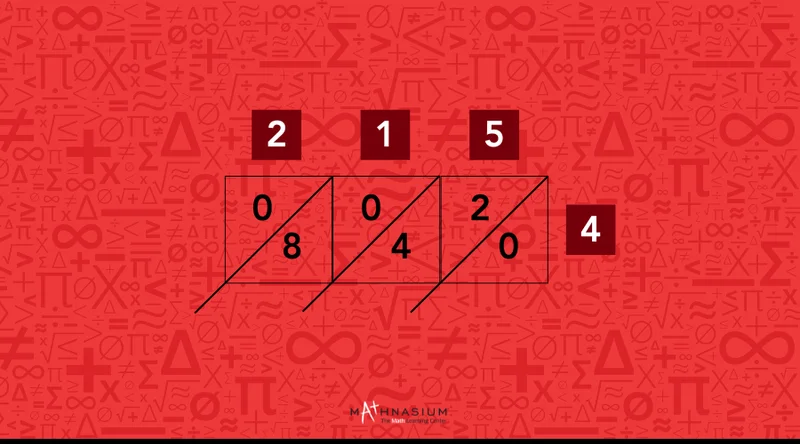
We draw a 3×1 grid. The digits 2, 1, and 5 go along the top, and 4 on the right side.
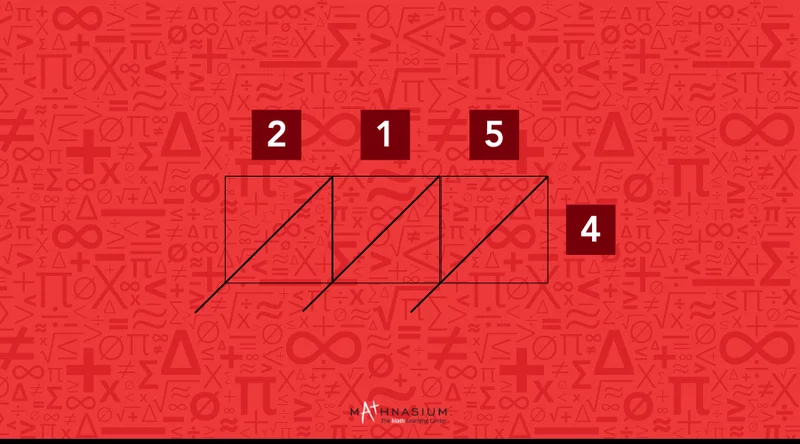
Step 2: Draw the diagonals
We draw a diagonal line through each cell.
Step 3: Fill in the cells
We multiply each top digit by 4 and fill in the results.
-
Left cell: 2 × 4 = 08 → 0 above, 8 below
-
Middle cell: 1 × 4 = 04 → 0 above, 4 below
-
Right cell: 5 × 4 = 20 → 2 above, 0 below
Step 4: Add along the diagonals
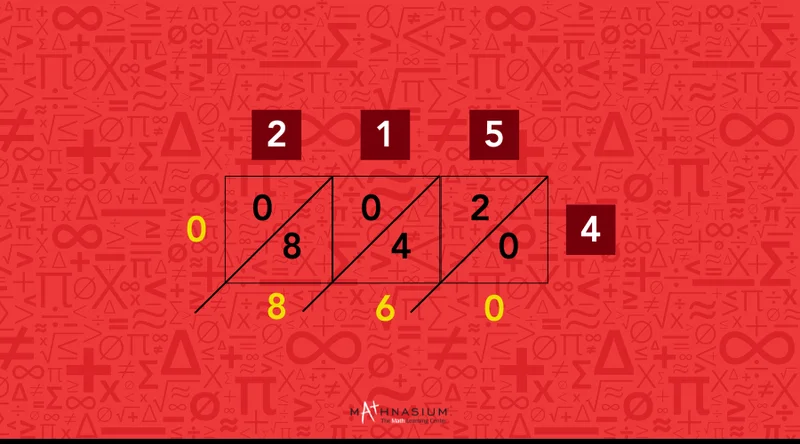
We add each diagonal strip starting from the far right.
-
Diagonal section 1 (far right): 0
-
Diagonal section 2: 4 + 2 = 6
-
Diagonal section 3: 8 + 0 = 8
-
Diagonal section 4 (far left): 0
Step 5: Read the answer
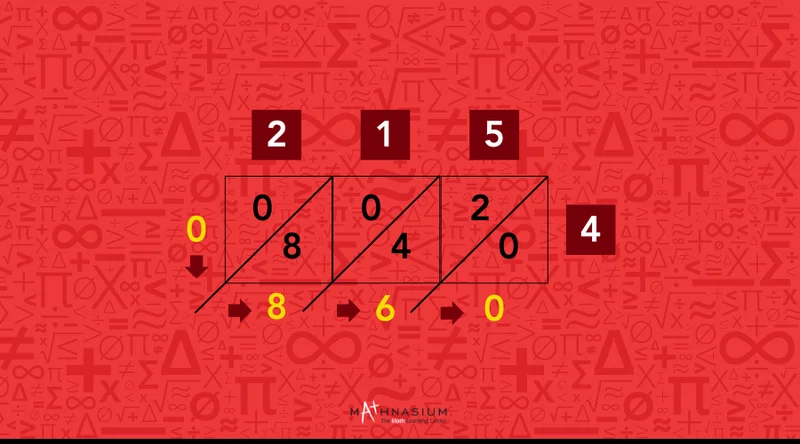
If we start reading from top-left down and along the bottom, we’ll get the final answer.
215 × 4 = 860
Example 3
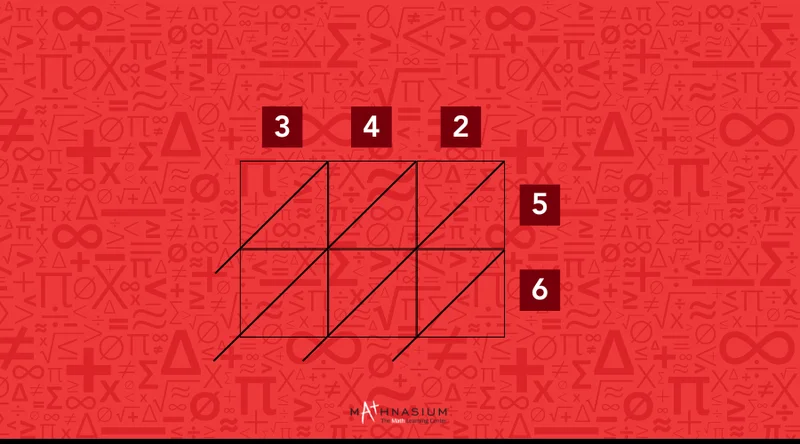
Now, let’s try with even bigger numbers. This time around, let’s multiply a 3-digit number by a 2-digit number (342 × 56).
Step 1: Set up the grid
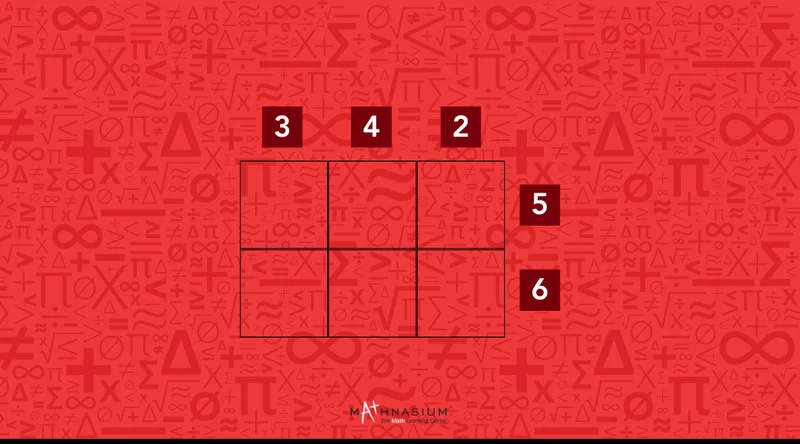
We need a 3×2 grid. The digits 3, 4, and 2 go along the top, and 5 and 6 along the right side.
Step 2: Draw the diagonals
Each cell needs a diagonal, so we draw the lines.
Step 3: Fill in the cells
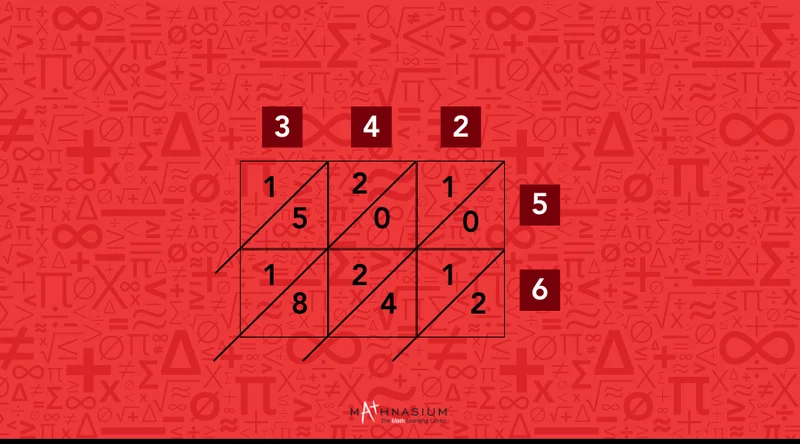
We multiply each top digit by each right-side digit and fill in the results.
-
Top-left: 3 × 5 = 15 → 1 above, 5 below
-
Top-middle: 4 × 5 = 20 → 2 above, 0 below
-
Top-right: 2 × 5 = 10 → 1 above, 0 below
-
Bottom-left: 3 × 6 = 18 → 1 above, 8 below
-
Bottom-middle: 4 × 6 = 24 → 2 above, 4 below
-
Bottom-right: 2 × 6 = 12 → 1 above, 2 below
Step 4: Add along the diagonals
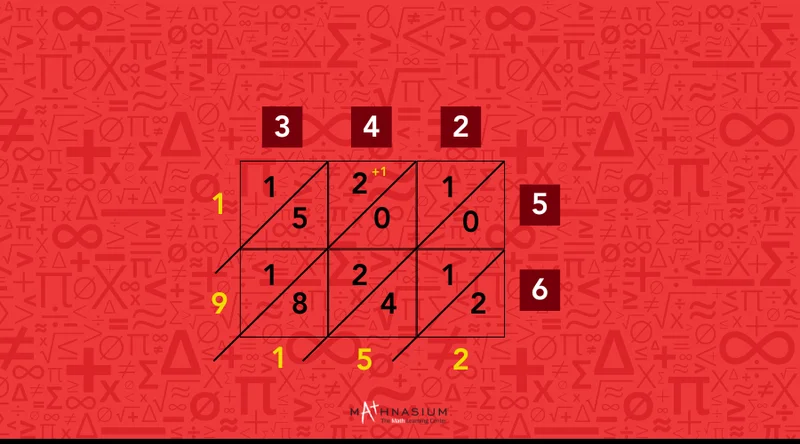
Starting from the far right, we add each diagonal strip. This time, one diagonal adds up to more than 9, so we carry the tens digit over to the next diagonal.
-
Diagonal section 1 (far right): 2
-
Diagonal section 2: 0 + 1 + 4 = 5
-
Diagonal section 3: 0 + 2 + 1 + 8 = 11 → write 1, carry 1
-
Diagonal section 4: 5 + 2 + 1 + 1 (carried) = 9
-
Diagonal section 5 (far left): 1
Step 5: Read the answer
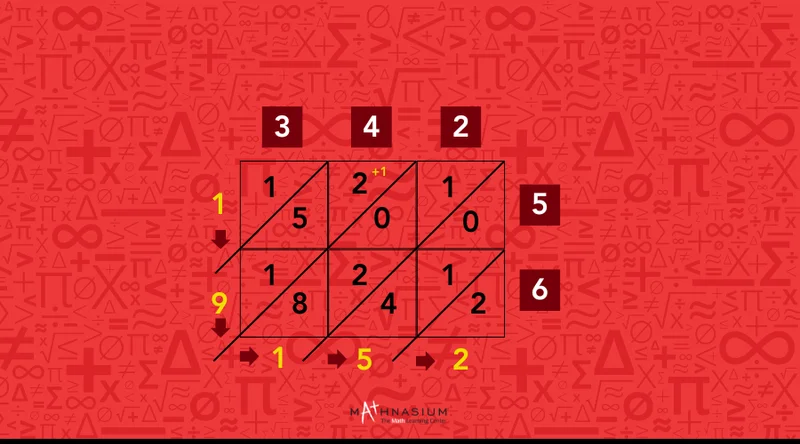
The final answer is 19,152 (read from the top left all the way to the bottom right of the grid).
Example 4
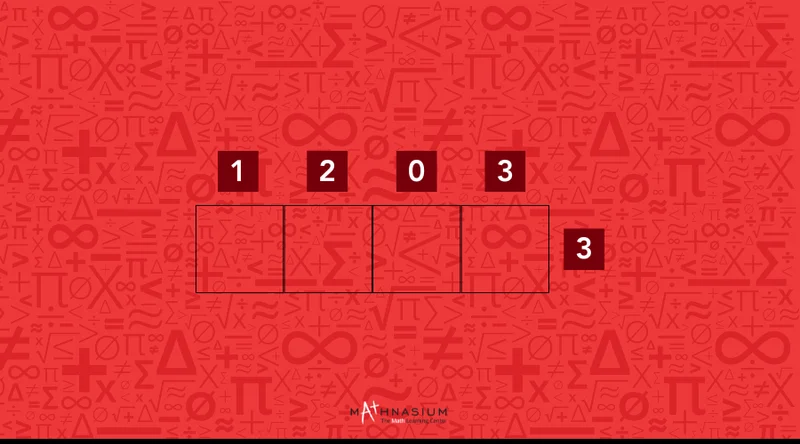
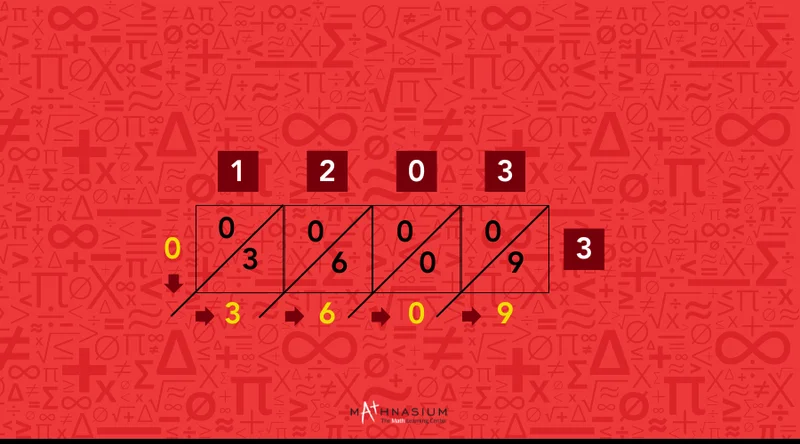
Let’s see how the method works with 4-digit numbers and multiply 1,203 by 3.
Step 1: Set up the grid
This time around, we draw a 4×1 grid and write the digits 1, 2, 0, and 3 along the top and 3 on the right side.
Step 2: Draw the diagonals
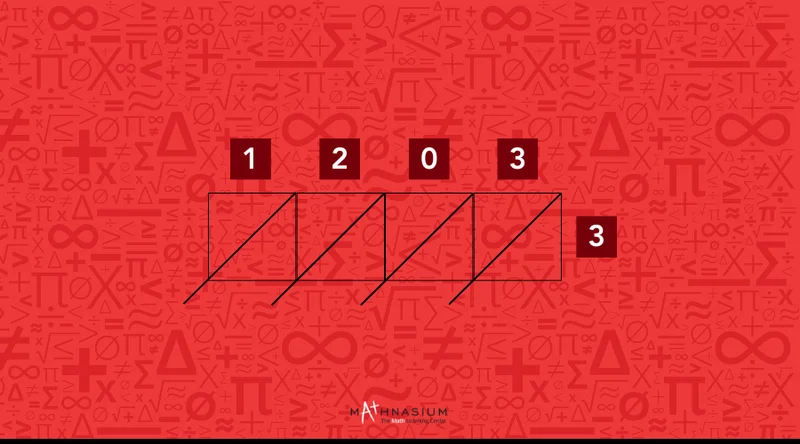
A diagonal line needs to go through each cell, so we draw it.
Step 3: Fill in the cells
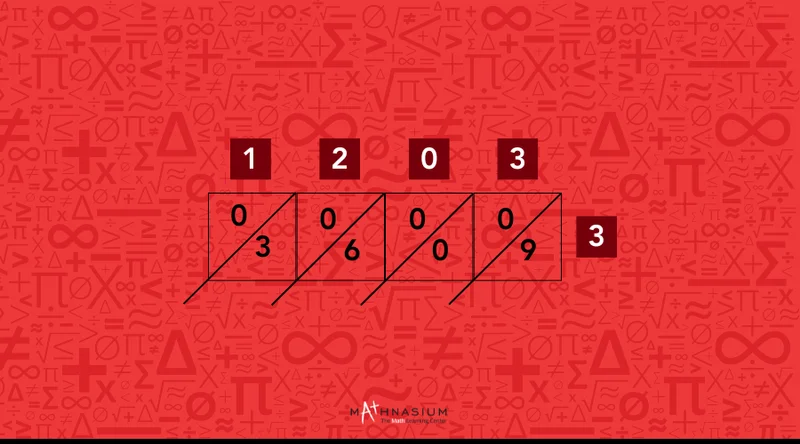
We multiply each top digit by 3 and fill in the results.
-
Left cell: 1 × 3 = 03 → 0 above, 3 below
-
Second cell: 2 × 3 = 06 → 0 above, 6 below
-
Third cell: 0 × 3 = 00 → 0 above, 0 below
-
Right cell: 3 × 3 = 09 → 0 above, 9 below
Step 4: Add along the diagonals
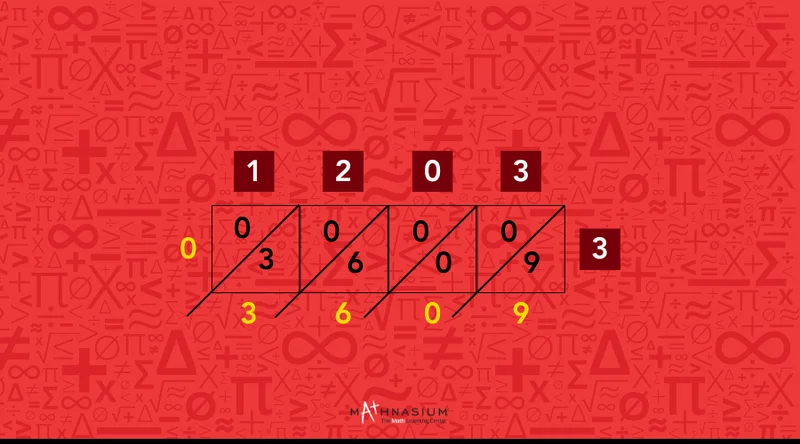
Starting from the far right, we add each diagonal strip.
-
Diagonal section 1 (far right): 9
-
Diagonal section 2: 0 + 0 = 0
-
Diagonal section 3: 6 + 0 = 6
-
Diagonal section 4: 3 + 0 = 3
-
Diagonal section 5 (far left): 0
Step 5: Read the answer
The final answer to this multiplication is 3,609.
Your Turn! Check Your Knowledge of Lattice Multiplication
Ready to practice what we’ve covered? Try these practice problems on your own by using the lattice multiplication method and check your answers at the bottom of the guide.
-
23 × 4 = ?
-
31 × 12 = ?
-
124 × 2 = ?
-
213 × 45 = ?
-
1,312 × 3 = ?
📕 You May Also Like: What Is a Product in Math? A Complete Overview

Mathnasium's specially trained tutors guide students through multiplication and its alternatives in a supportive, engaging environment.
How Mathnasium Helps Students Master Multiplication (and Any Math Concept)
Mathnasium is a math-only learning center helping K-12 students of all skill levels learn and master math.
To help students build a deep understanding of how lattice multiplication works, we use a proprietary teaching approach called the Mathnasium Method™.
Here’s how it works.
Each student starts their Mathnasium journey with a diagnostic assessment that helps us identify their current skills, knowledge gaps, and learning goals. From there, we build a personalized learning plan tailored to exactly where they are and where they need to go.
Our specially trained tutors then guide students through concepts using plain language and a combination of verbal, visual, tactile, and written techniques. This helps students see the concept from different perspectives and truly understand how it works.
When a student gets stuck, we break the problem down into smaller, manageable steps and focus on both the “how” and the “why” behind the concept. Over time, students build problem-solving skills and critical thinking tools that help them approach new math challenges independently.
Fun is an important part of how we work. Sessions often include game-based and hands-on activities that keep students engaged and learning enjoyable. Students earn rewards along the way, and every bit of progress gets celebrated, so confidence grows alongside mastery.
The results speak for themselves:
-
94% of parents report an improvement in their child's math skills and understanding
-
93% of parents report their child's improved attitude toward math after attending Mathnasium
-
90% of students saw an improvement in their school grades
We operate over 1,100 learning centers, bringing our proven approach close to your home.
For families in and near Carrollton, TX, Mathnasium of Castle Hills is a trusted local center with years of experience building confident math thinkers.
Our community recognizes our impact and has honored us with:
Whether your child is looking to catch up, keep up, or get ahead, our team is ready to help.
Ready to get started?
📅 Schedule a Free Diagnostic Assessment at Mathnasium of Castle Hills
Not near Castle Hills?
📍 Find Mathnasium Learning Centers Near You
Pssst! Check Your Answers Here
If you worked through the practice problems, here are the answers:
-
23 × 4 = 92
-
31 × 12 = 372
-
124 × 2 = 248
-
213 × 45 = 9,585
-
1,312 × 3 = 3,936
How did you do?


 (972) 939-6284
 (972) 939-6284