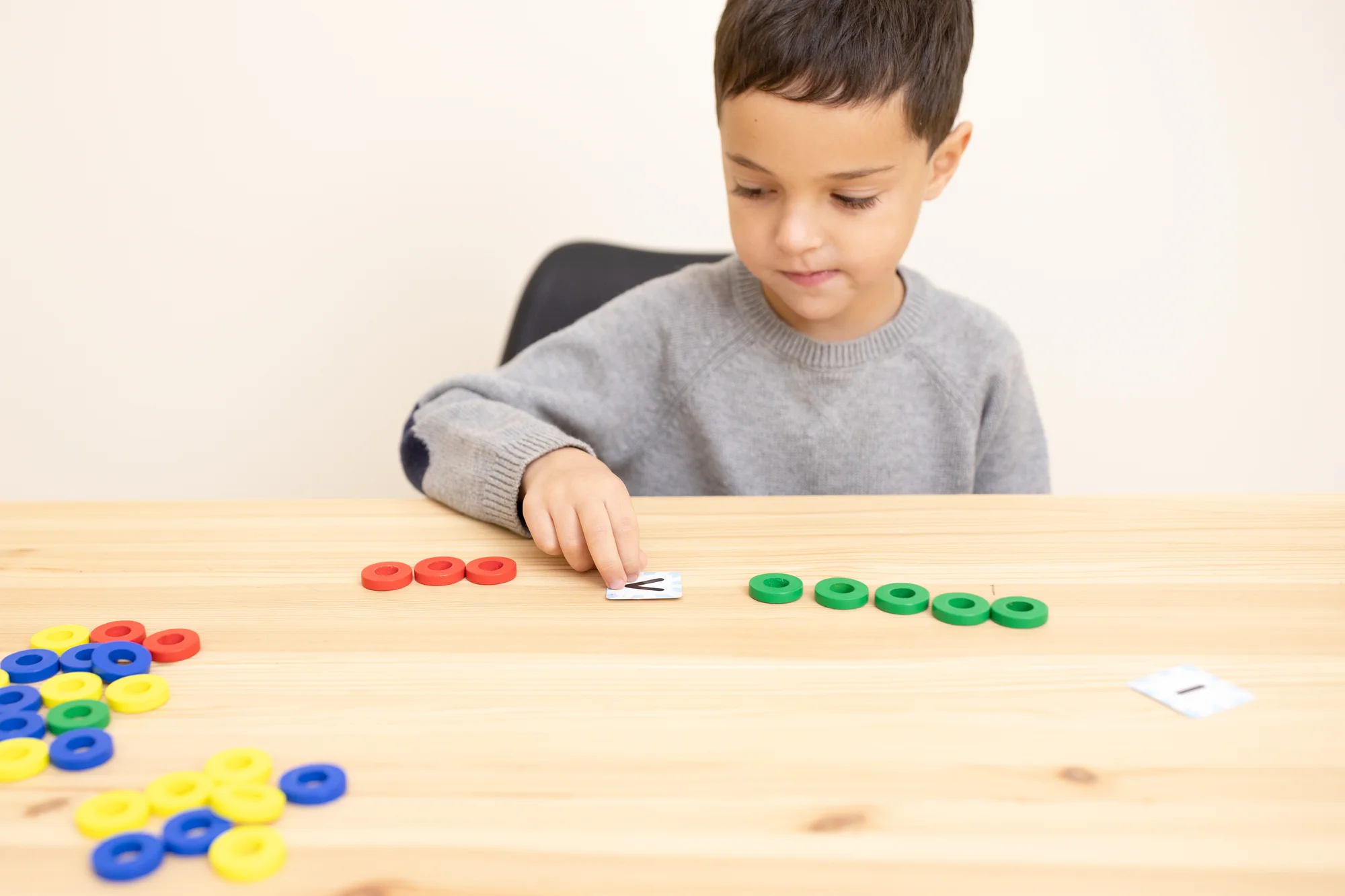
The "alligator method" is one of the most popular ways teachers introduce the greater than and less than symbols, > and <, to young learners. It is simple, visual, and, as many parents discover, surprisingly hard to forget once you have heard it.
Today, we will walk you through what the method is, how to use it at home step by step, and what to pair it with so your child builds true understanding alongside the memory trick. Because when the two work together, the concept tends to click fast and stay put.
What Are Greater Than and Less Than?
Before we get to the alligator, keep in mind that your child already understands the idea behind these symbols. They just haven't connected it to the math notation yet.
Every time your child says, "I have more!" at the snack table or insists that their sibling got a bigger slice, they are comparing quantities. That instinct to notice which is more and which is less is exactly what greater than and less than are built on. The symbols are simply math's way of writing that comparison down.
There are three basic comparison relationships:
-
Greater than (>): The number on the left is larger. 8 > 3 means "8 is greater than 3."
-
Less than (<): The number on the left is smaller. 3 < 8 means "3 is less than 8."
-
Equal to (=): Both sides are exactly the same. 5 = 5 means neither is bigger.
For now, we will focus on the first two, greater than and less than, since those are the ones that tend to cause the most confusion and the ones the ‘’alligator method’’ was made for.
📕 You May Also Like: Greater Than and Less Than: A Simple Guide for Early Math
The Alligator Method: What It Is and Why It Works
The ‘’alligator method’’ gives children a simple, visual way to remember which direction the > and < symbols point.
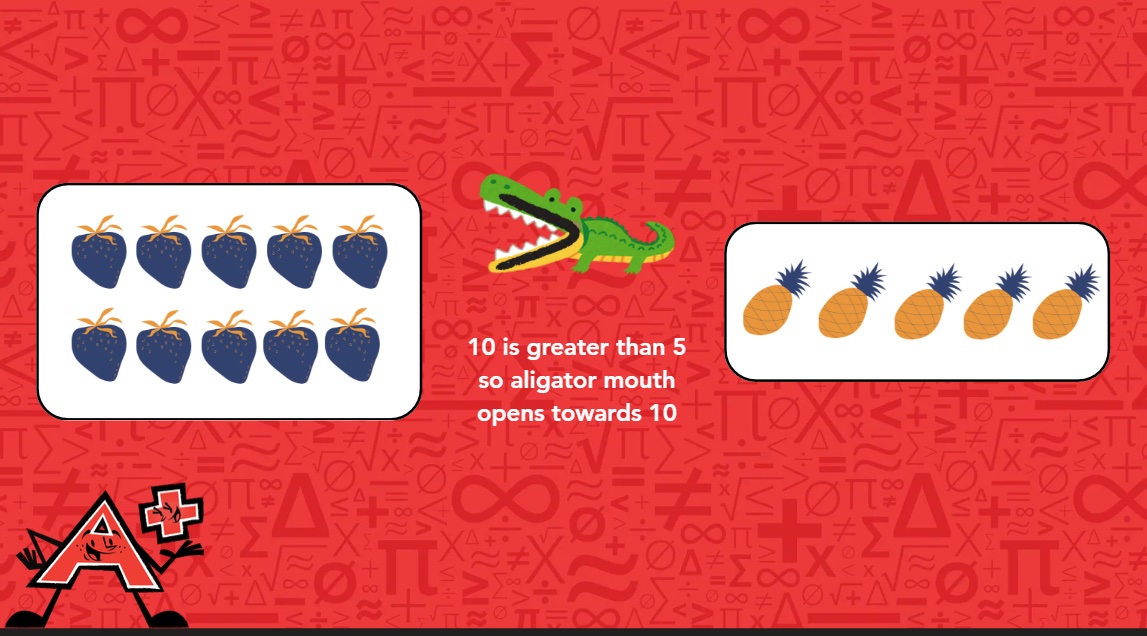
The idea is that both symbols look like an open mouth, and that mouth belongs to a very hungry alligator. The alligator always turns toward the bigger number because that is the larger meal.
So in 10 > 5, the mouth opens toward 10.
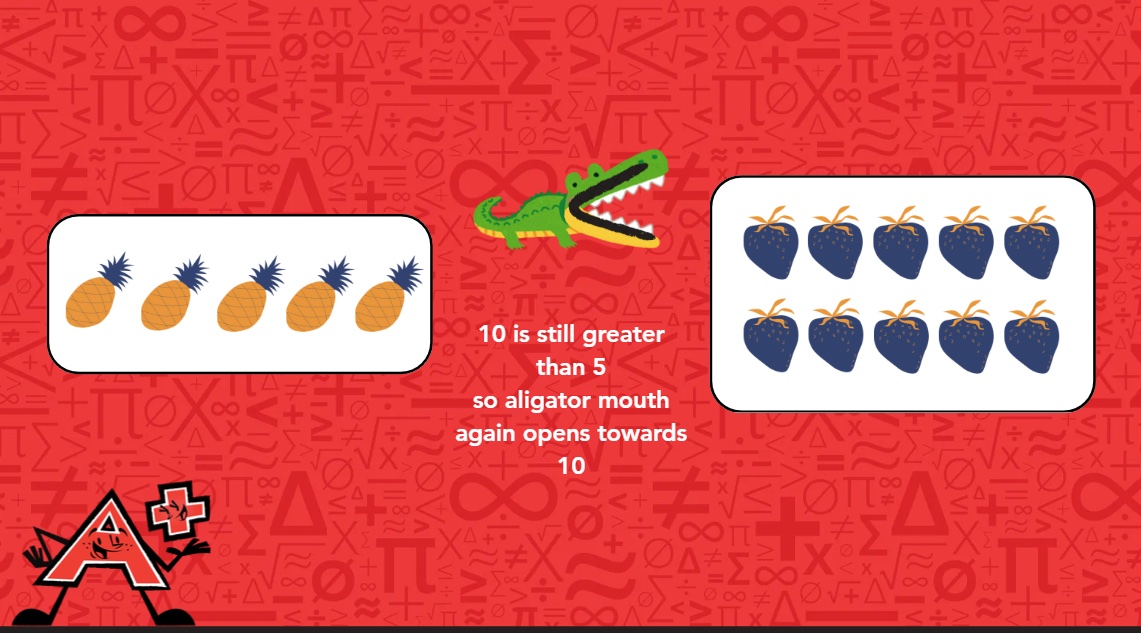
In 5 < 10, it still opens toward 10. The alligator never settles for less.
For most young learners, that image is enough to make the symbol direction click. It gives them something to picture when the abstract notation doesn't yet feel intuitive.
That said, the alligator works best when it is paired with a real comparison.
Pairing the mnemonic with hands-on comparison is truly effective. The alligator shows where the mouth points, while counting real objects tells the story behind it.
So our alligator is a great starting point, but not the whole journey.
📕 You May Also Like: 9 Math Skills Kids Use Every Day Without Realizing It
How to Teach the Alligator Method at Home: Step by Step
Everything you need is already at home. A handful of objects from around the house and a few minutes are all it takes.
Our steps below move from physical comparison to written notation, which is the order that tends to build the most lasting understanding in young learners.
1. Compare First, Symbol Second
One trick we like to use is to start with objects instead of numbers. This will help your child start to connect the math concept to something they can recognize and relate to.
Gather two unequal groups of anything you have nearby: grapes, coins, crayons, or building blocks all work well.
Place both groups in front of your child and ask, "Which pile has more?"
Let them count. Let them point. Establish "more" and "fewer" in plain language before any symbol appears. Do not rush past this step. The symbol should always represent a comparison your child has already made, not a rule they are trying to remember.

Exploring math together at home helps young learners connect symbols to ideas they already understand.
2. Introduce the Alligator
Once your child can reliably identify the bigger group, draw the > or < symbol between the two quantities and introduce the hungry alligator. The mouth opens toward the bigger pile because that is what the alligator wants to eat.
Let them trace the symbol with their finger and then draw it themselves.
We noticed that some children enjoy using their hands to form the shape, opening their index finger and thumb wide toward the larger group. The physical act of making the symbol, rather than just reading it, helps it stick.
📕 You May Also Like: What Is Kinesthetic Math Learning? A Parent's Guide
3. Write the Comparison Together
Now move from objects to numbers. Write the quantities on paper and ask your child to draw the alligator's mouth between them.
At this point, they are writing their first inequality, even if it does not feel like a math lesson at all.
4. Flip It and Check
Swap the numbers and ask whether the symbol needs to change. This step builds flexibility. It shows your child that the symbol's direction depends on the numbers in front of it, not on habit or position.
If your young learner is able to flip a comparison and adjust the symbol, they are already thinking relationally, which is exactly the habit you want to build at this stage.
One thing to keep in mind throughout: the goal here is not speed or a completed worksheet. It is the habit of comparing, reasoning about which is more, and then recording that thinking with a symbol. Five unhurried minutes will serve your child better than twenty rushed ones.
Everyday Moments to Practice Greater Than and Less Than
The most efficient practice happens when it does not feel like practice at all.
Greater than and less than are comparison ideas, and comparison comes up naturally all day long. Here are five moments you can use without any preparation, just a quick observation and a simple question.
1. Snack Time
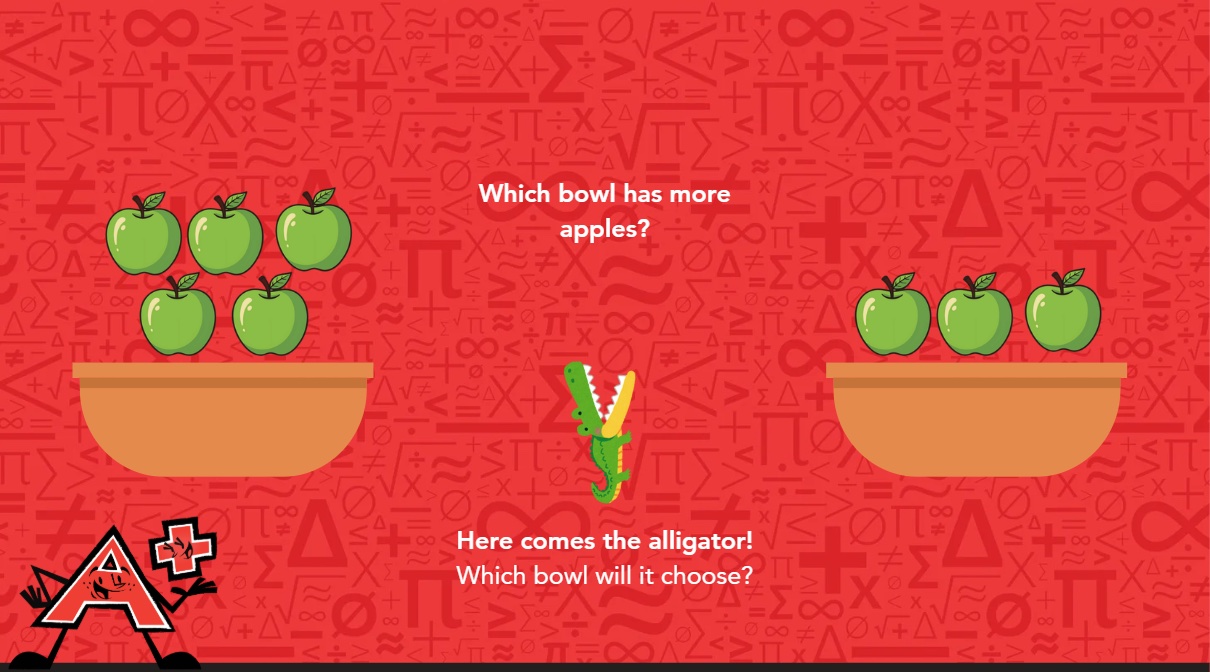
Put two different amounts of apples, crackers, grapes, or any other food into two bowls. Ask your child: "Which bowl has more?"
Once they answer, write the numbers side by side and ask them to draw the alligator's mouth between them.
Let them eat the bigger bowl as a reward if you like. The alligator would approve.
2. A Card Game
Deal two cards face up, one for each of you. Ask your child: "Whose card is bigger?" Write the numbers down and place the symbols together.
Even a single round of this between other activities is enough to reinforce the concept without it feeling like schoolwork.
📕 You May Also Like: 5 Math Games That Help Kids Rediscover the Joy of Learning
3. Counting Steps
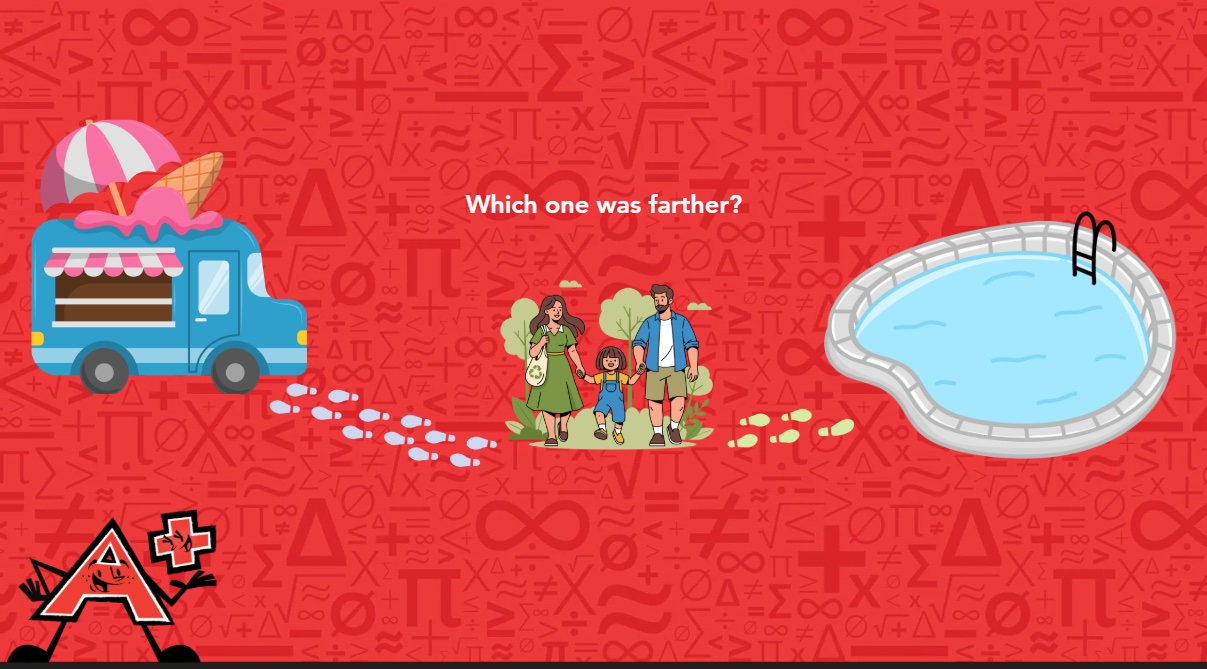
Next time you are walking somewhere together, count the steps to two different destinations.
The swimming pool and the local ice cream truck, for example, or the kitchen and the bedroom. Ask which was farther and write the comparison down when you get back inside.
4. Scorekeeping
If your child plays any simple game that involves points, let them keep score and compare totals at the end. "You got 6, and I got 4. Can you write that with the alligator symbol?"
Keeping score already feels like winning. Adding the symbol just makes it math.
5. Dividing Things Unevenly
This one comes up on its own more often than you might expect. If two kids end up with different amounts of anything, pause before the protest and ask: "Who has more? How do we write that?"
Turning a moment of minor injustice into a math question is one of the more satisfying moves available to a parent.
In each of these moments, say the comparison out loud before writing it down. "Six is greater than four," spoken clearly, then written as 6 > 4, helps your child connect the words they already understand to the notation they are learning.
The comparison habit they are building here will follow them all the way through fractions, decimals, and algebra.

Mathnasium helps young learners move from memorizing symbols to truly understanding what they mean.
How Mathnasium Turns Early Math Moments Into Lasting Understanding
Mathnasium is a math-only learning center dedicated to helping K-12 students of all skill levels excel in math.
When young learners come to us, we often find that concepts like “greater than” and “less than” never fully clicked, not because the child isn't capable, but because the connection between the idea and the symbol was never made explicit.
Those are exactly the kinds of gaps we are trained to find and close early, before they grow into something bigger.
At the heart of how we work is a single goal: to transform how students think and feel about math. Every part of the Mathnasium Method™, our proprietary teaching approach, is designed to build true understanding rather than surface-level recall.
Our approach relies on:
-
Personalized learning: Each student begins with a diagnostic assessment that identifies their strengths, knowledge gaps, and how they naturally think about math. From there, we build a personalized learning plan tailored to their needs and goals.
-
Teaching for understanding: We use everyday language and a mix of verbal, visual, mental, tactile, and written techniques so concepts stick at a deeper level than memorization alone.
-
Specially trained tutors: Our tutors are trained in both the technical and emotional aspects of teaching. They know how to encourage a hesitant learner and how to challenge one who is ready to move ahead.
-
A caring and fun group environment: Sessions are designed to feel engaging and supportive, with hands-on activities and consistent encouragement that keep young learners motivated.
The results speak for themselves:
-
94% of parents report an improvement in their child's math skills and understanding
-
93% of parents report their child's improved attitude toward math after attending Mathnasium
-
90% of students saw an improvement in their school grades
With over 1,100 learning centers, Mathnasium brings top-rated math instruction close to your community.
For families in and around Denver, Mathnasium of Denver Highland is a trusted local center with years of experience helping young learners build the early math foundations that set them up for lasting success.
Ready to take the first step? Schedule a free assessment at Mathnasium of Denver Highland and set your child on a path to math mastery.
📅 Schedule a Free Diagnostic Assessment at Mathnasium of Denver Highland
Not located near Denver Highland?
📍 Find a Mathnasium Learning Center Near You


 (720) 524-4763
 (720) 524-4763