In ancient times, long before math was ever a subject, people used tally marks to track things they needed to count, like days, animals, or traded goods. You know the ones: four straight lines, then a fifth drawn across to make a group of five. Simple, quick, and easy to scan.
Even today, tally marks come in handy. We use them to keep score, record survey responses, or organize messy information into something that actually makes sense.
With respect for this time-tested tool, our tutors break down what tally marks are, where they appear in real life, and how we use them to count and organize data using tally charts.

What Are Tally Marks?
Tally marks, or simply tallies, are lines that help us count data. Each line stands for one item. So instead of writing numbers, we use marks to keep track as we go.
How do we do that?
We draw four straight (vertical) lines, one after another. Then, we draw a diagonal line across them to make a group of five like so:
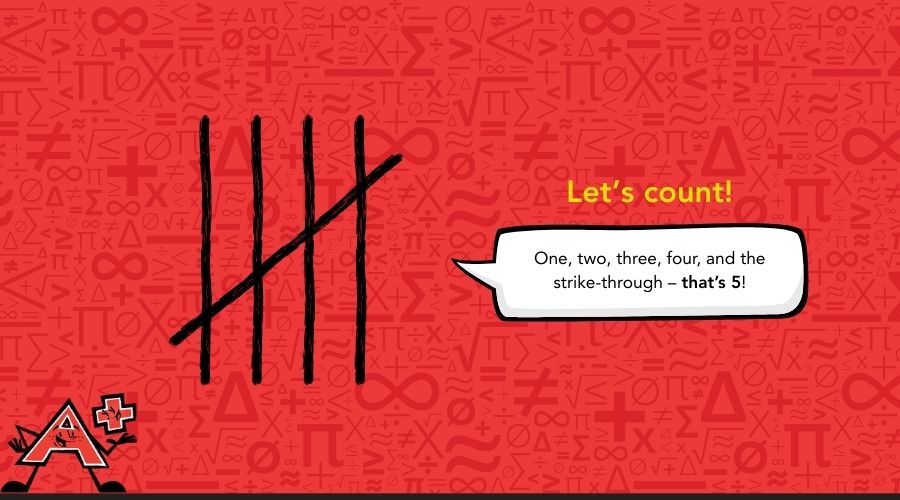
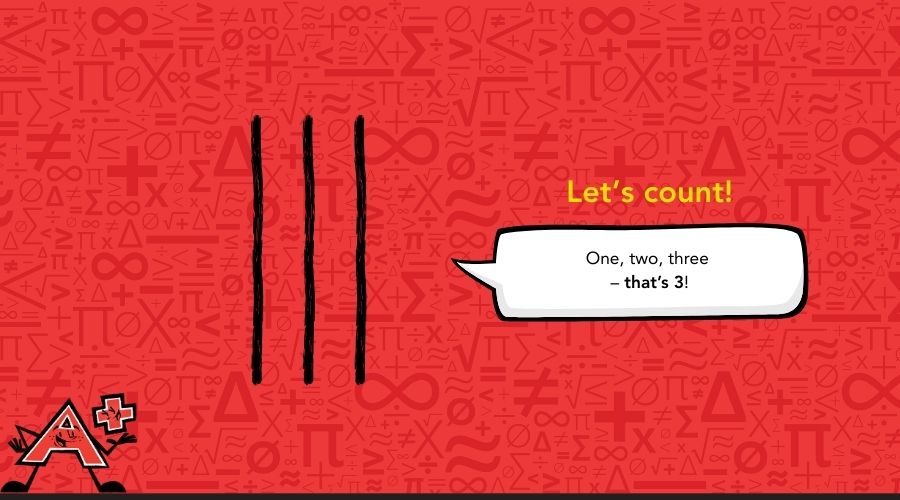
And what if we had only three things to count?
That would just be three straight lines, one for each item.
What about bigger numbers? This is where tally marks really help.
Instead of counting each line one by one, we group every five lines together. That way, we can count by fives first, then add any extras.
Let’s say we want to show the number 23. We would draw four full groups of five (which makes 20), and then three more single lines. That’s 5, 10, 15, 20… plus 3 more: 21, 22, 23.
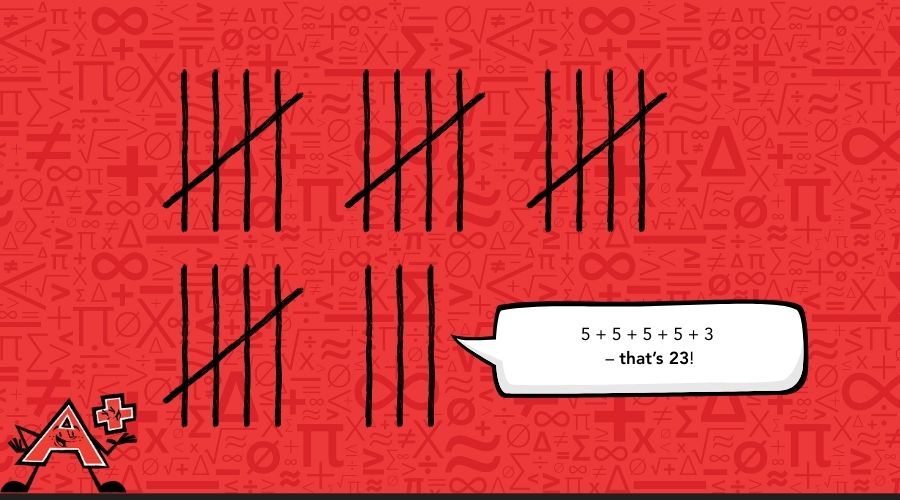
It’s faster, neater, and way less ‘wait, what number was I on?’
Why We Group Tally Marks by Fives
So, why do we group tally marks in fives instead of six or ten? The answer is more about habit than hard math.
Think about your hands: five fingers. A nickel is worth five cents. On a clock, five minutes make up each little section between numbers. Fives show up all around us, so they feel easy and familiar.
When we make tally marks in groups of five, our brains don’t have to count each line one at a time. We see the group, know it’s five, and add it up faster. It saves time and makes counting a lot easier, especially when we're keeping score or tracking something quickly.
Real-Life Examples of Tally Marks
Tally marks show up in everyday situations more often than you might think, and not just in math class.
Here are a few places you might see them in action:
-
Classroom votes: Imagine your class is voting for a new class president. As each student chooses a candidate, the teacher adds a tally mark next to that name. At the end, you can quickly see who won by looking at the tally groups—no need to count every mark one by one.
-
Scorekeeping in games: Whether it’s basketball at recess or a round of four corners in the gym, tally marks are a fast and easy way to keep score and see who’s winning.
-
Tracking daily routines: Tally marks can help you keep track of everyday things like how many chores you’ve done or how many library books you’ve finished. It’s a great way to see your progress and build good habits.
Want to try it at home? Grab a notebook and sit by the window. For 10 minutes, tally how many cars drive by. You’ll get counting practice and maybe even notice a pattern, like which color shows up the most.
How to Organize Data with Tally Charts
Once you’ve collected a bunch of tally marks, the next step is to organize them in a clear table. That’s where a tally chart comes in.
A tally chart is a table with three columns:
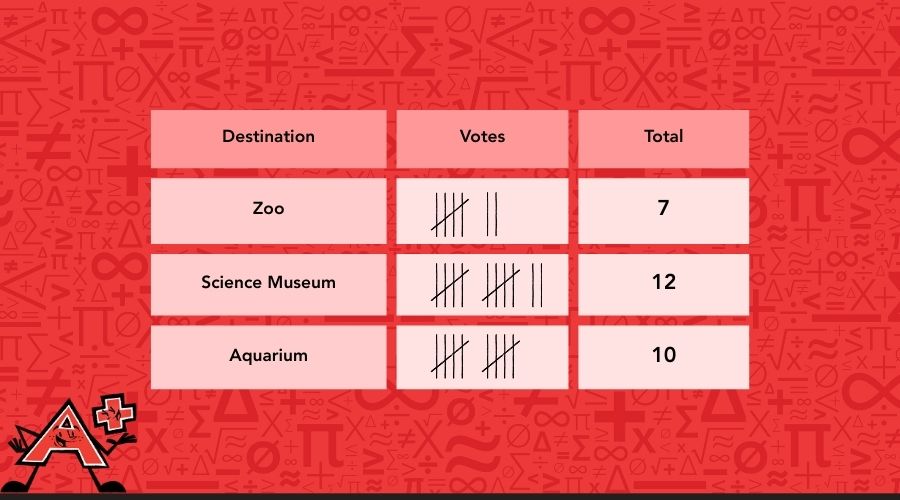
Let’s say your class is voting on where to go for your next field trip.
Each student picks a destination, like the zoo, the science museum, or the aquarium, and you add a tally mark next to their choice.
Once everyone has voted, you count the tallies and write the total in the last column. It might look something like this:
Try It Yourself: Tally Mark Challenges
Ready to put your tally skills to the test? Try these Mathnasium-approved challenges below.
When you're done, check your answers at the bottom of this guide to see how you did.
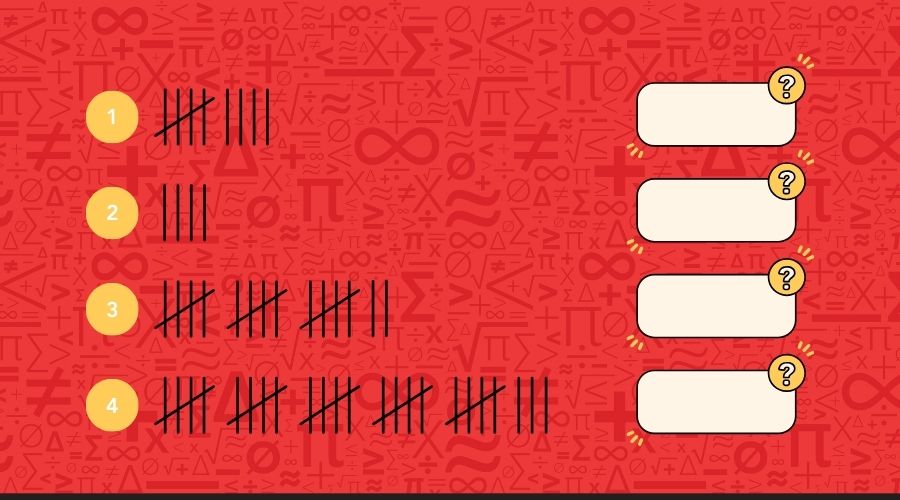
Challenge #1
Count the number of tallies.
Challenge #2
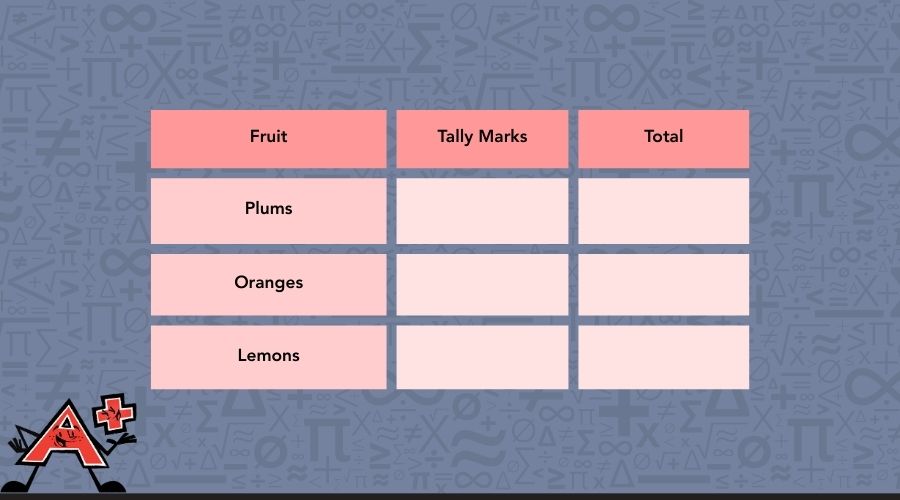
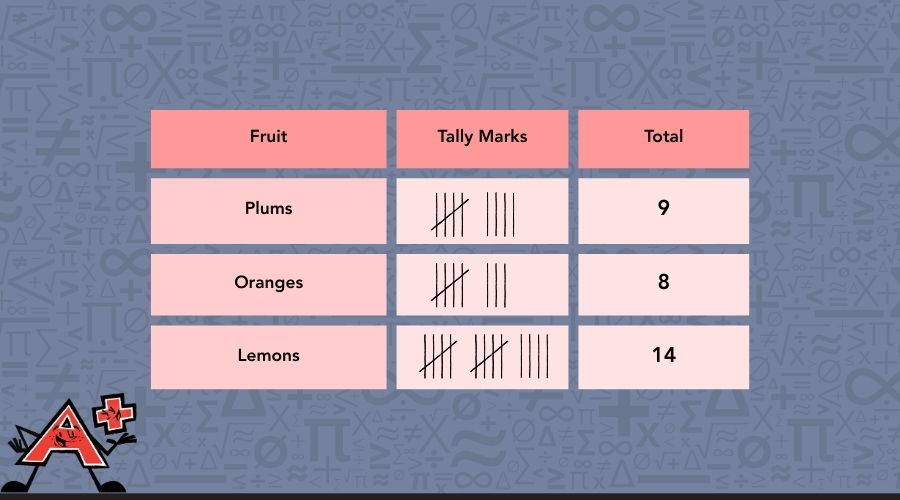
The store just received a shipment of fruit and it needs your help to count it all!

Look at the picture of the fruit display and use tally charts to count how many plums, oranges, and lemons there are.
Frequently Asked Questions About Tally Marks
Tally marks are one of the simplest and most efficient ways to count, but that doesn’t mean students don’t have questions about them!
At Mathnasium, we often hear great observations from curious learners. Here are a few of the most common questions we get, along with clear answers to help make tally marks even easier to understand.
1. When do students learn about tally marks in school?
Students are often introduced to tally marks in 1st or 2nd grade, once they’re comfortable with counting and basic number sense.
2. Do I always have to use tally marks in groups of five?
Yes! That’s what makes them easy to track. Without grouping by fives, they’re just lines, and that can get confusing fast.
3. Why do we draw the fifth line diagonally and not horizontally?
A diagonal line stands out more than a horizontal one. It crosses through the four vertical lines and makes the group easier to spot and count quickly.
4. Do all countries use tally marks?
Yes, tally marks are a common counting tool. The five-line grouping is widely used around the world because it’s so easy to recognize.
Learn and Master Math with Top-Rated Mathnasium Tutors
Tally marks are one of the first tools students use to make sense of numbers and organize information. At Mathnasium, we use them as part of a larger journey in helping students spot patterns, understand data, and build confidence in their math thinking.
And that journey is powered by the Mathnasium Method™. The goal? Not just to catch up with class or ace an exam, but to unlock each student’s true math potential and transform how they think and feel about the subject.
How does the Mathnasium Method™ work?
It starts with a diagnostic assessment—a low-pressure, interactive evaluation. We use it to find out what students already know, what they’re ready to learn next, and how they learn math best.
From there, we create a personalized learning plan tailored to each student’s needs, whether that means building number sense, improving problem-solving skills, or getting ready for more advanced math.
With that plan in place, our tutors provide face-to-face instruction in a supportive and fun environment. We teach math from all angles, using a mix of verbal, visual, mental, tactile, and written techniques.
When a student gets stuck, we break down the concept into manageable steps. Then we show not just how it works, but why. That’s how students build critical thinking skills they can apply in math and beyond.
Many parents and students tell us that our sessions don’t even feel like lessons. With games-based learning, hands-on activities, and meaningful rewards, students stay engaged, motivated, and proud of what they accomplish.
And the results? They speak for themselves.
-
94% of parents report an improvement in their child’s math skills and understanding
-
93% of parents report improved attitude toward math after attending Mathnasium
-
90% of students saw an improvement in their school grades
Whether your child is falling behind, doing fine but could be doing better, or ready for a new challenge, we’re here to help.
Find your nearest Mathnasium Learning Center and get in touch. We’ll schedule a diagnostic assessment and create a personalized learning plan to put your student on the best path toward math mastery.

Pssst! Check Your Answers Here
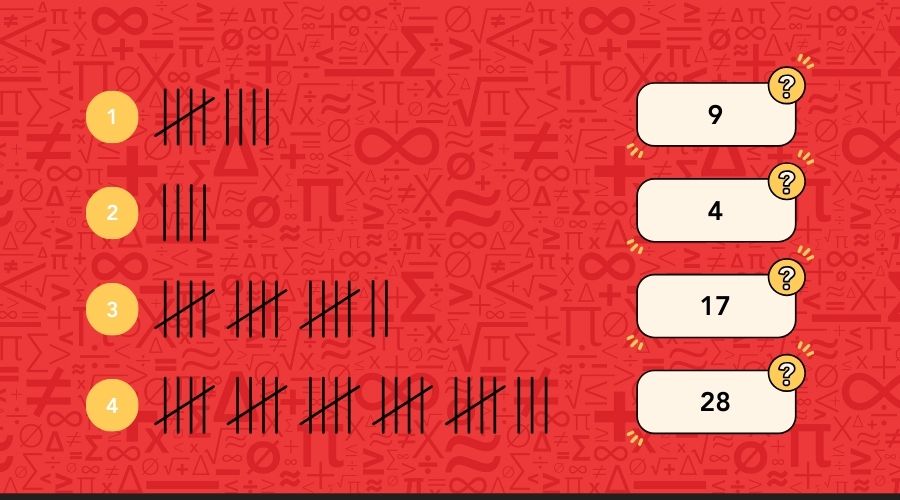
If you gave our tally mark challenges a go, it’s time to see how you did!
Challenge #1
Challenge #2


 (262) 287-0937