The struggle with reading and writing large numbers usually comes down to understanding place value. Specifically, the repeating pattern that makes our number system work, which never clicked.
Today, we’ll walk you through exactly how large numbers work, step by step, so you can read and write them without hesitation.

Why Large Numbers Trip Kids Up
Early in their math education, our children learn numbers by counting. They associate digits with objects they can see and touch. Three apples. Ten blocks. Even 100 stickers.
The numbers feel concrete for them because they connect to something real. But somewhere around third or fourth grade, numbers start growing faster than the kids’ ability to picture them.
A million is not something you can hold in your hand or count on your fingers.
There is also a structural reason this concept trips kids up.
Our number system is built on repeating patterns, groups of three digits called periods.
After young learners understand that pattern, large numbers become more manageable. Without that insight, a number like 4,283,719 is just a long string of digits.
Additionally, if instruction leans too heavily on memorization, it can work against a child's deeper understanding.
A place value chart is a useful reference tool. But knowing which column means what is not the same as understanding why. That distinction matters when the chart is no longer in front of them.
So, to summarize, what children need, before they can confidently read or write a number like 47,000,000 or 3,200,000,000, are two things:
-
A solid grasp of place value as a repeating pattern
-
A simple, reliable method for breaking large numbers into manageable pieces
📕 You May Also Like: Difference Between Odd & Even Numbers
The Building Block You Can't Skip: Place Value
Before your young learner can read or write large numbers confidently, one concept needs to be solid: place value. Everything else builds on it.
Most parents have heard the term. But what does it actually mean, and why does it matter so much?
In our number system, a digit's value is not fixed. It changes depending on where it sits in a number.
-
The digit 4 means four in one's place, as in the number 24, where 4 simply counts four units.
-
It means "forty" in the tens place, as in the number 47, where 4 represents four groups of ten.
-
It means four hundred in the hundreds place, as in the number 452, where 4 stands for four hundred.
Same digit, completely different value.
📕 You May Also Like: How to Teach Place Value Using Base-10 Blocks: A Parent’s Guide for Ages 7–8
Large Numbers System and Structure
Our system does not just keep adding new column names indefinitely. It repeats.
Every three places, we move into a new group.
-
The first group holds ones, tens, and hundreds, numbers like 382 or 947.
-
The next group holds thousands. Think of a small town with 45,000 residents.
-
The one after that holds millions. For example, a large city like New York has around 4,000,000 people.
-
Then billions, the kind of numbers you see when reading about the world's population of around 8,000,000,000 people.
This repeating structure means that if your child can read a three-digit number, they already have the skill they need to read a number ten times its size because the pattern is the same, and only the group name changes.
📕 You May Also Like: The Surprising Link Between Reading Skills and Math Success
How to Read Large Numbers Step by Step
Ready to put this into practice? Here is a simple method that works for numbers in the millions, billions, and beyond.
We'll walk through it using 4,283,719.
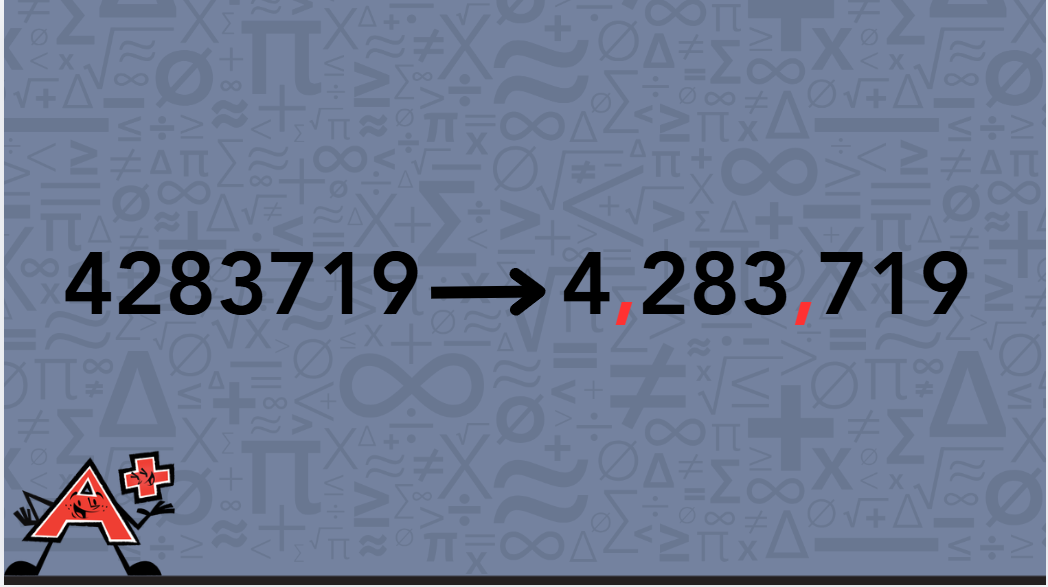
Step 1: Break the number into groups of three
Starting from the right, place a comma after every three digits:
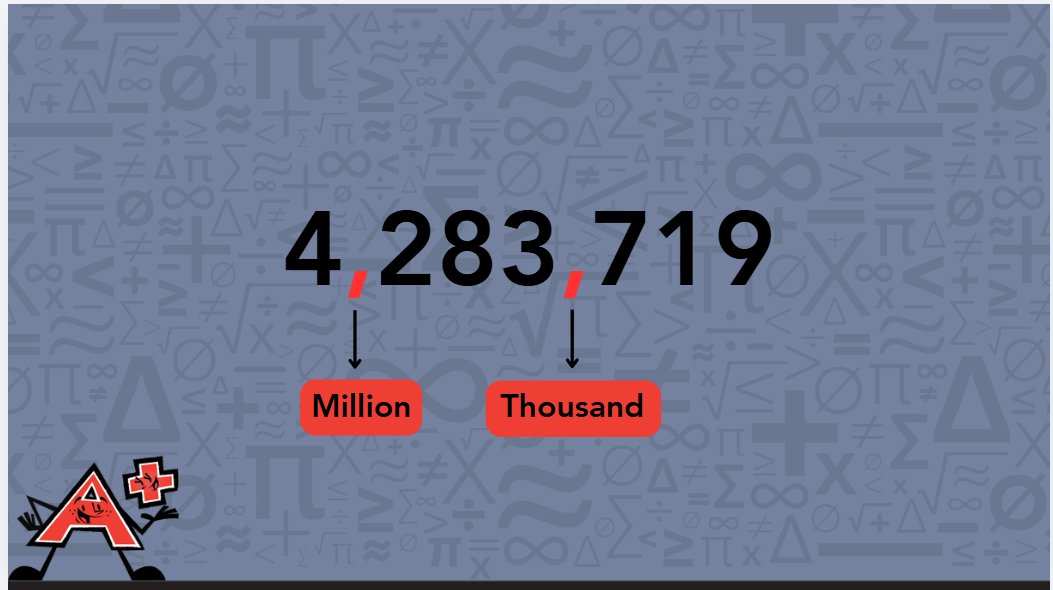
Step 2: Name the commas
Now look at the commas from right to left and name them:
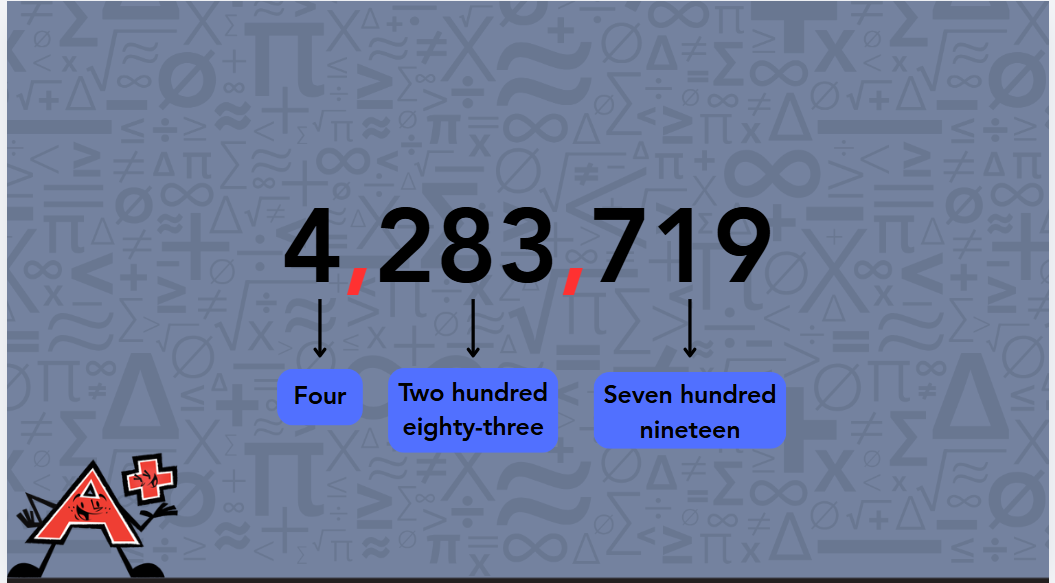
Step 3: Read each group between the commas
Read each group of digits on its own, as if it were a simple number:
Step 4: Put it all together
Read each group from left to right, naming the comma after each one:
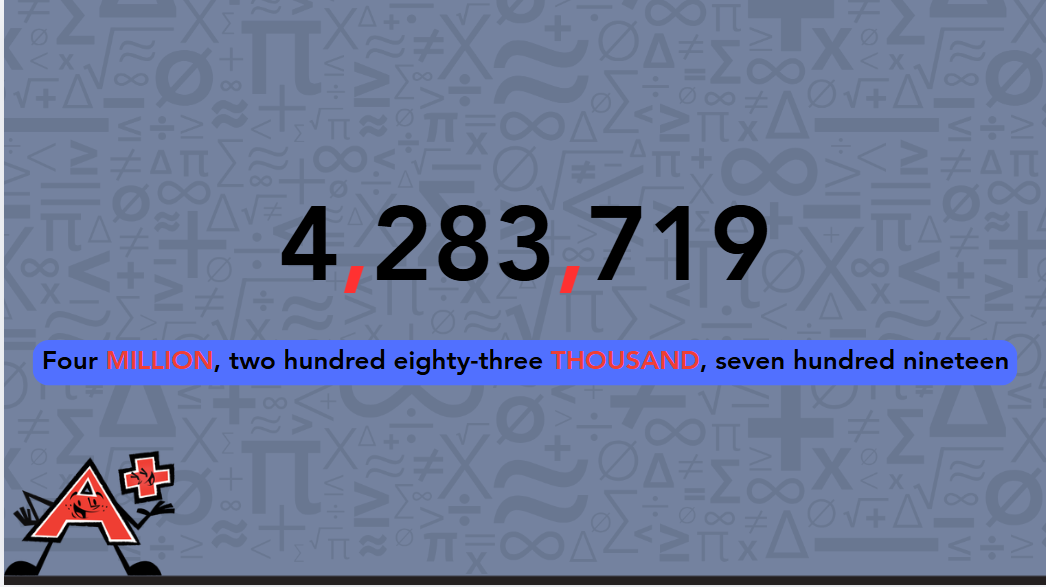
Now that the pattern makes sense, have your child read these out loud:
-
7,204,891
-
54,000,306
-
3,819,572,382
How to Write Large Numbers in Words
Reading a large number out loud and writing it in words are closely related skills. But writing adds a few things worth knowing. Miss them, and students lose marks on assessments.
The same method from the reading section applies here. The structure is identical; only the formatting rules are new.
This time, we'll work through 74,802,351 together.
Step 1: Break the number into groups of three
Starting from the right, place a comma after every three digits:
74802351 -> 74,802,351
The leftmost group may have one, two, or three digits — whatever is left over.
Step 2: Name the commas
From right to left, name each comma:
-
First comma -> thousand
-
Second comma -> million
Step 3: Write each group in words
Write each group as you would a simple number, moving left to right:
Step 4: Add the group name
After each group, add the comma name:
Step 5: Apply the formatting rules
This is where most mistakes happen. Two rules to follow:
-
Commas go between each group in the written form, just as they do in the numeral.
-
Hyphens connect compound numbers from twenty-one to ninety-nine.
Putting it all together: Seventy-four million, eight hundred two thousand, three hundred fifty-one.
And that’s it.
📕 You May Also Like: 10 Fun Math Games to Play at Home with Your Child
How to Help Your Child Practice at Home
Knowing the method is one thing. Making it stick is another. Luckily, practicing large numbers at home does not require worksheets or formal sessions.
Our tutors recommend these no-fuss activities:
-
Use numbers that already exist around you. Large numbers appear in everyday life. A country's population. The distance from Earth to the Moon. Set a simple rule: whenever a large number comes up, on the news, in a book, on a screen, pause and read it together.
-
Keep sessions short and regular. Ten minutes several times a week is enough to build fluency. The goal is not to cover a lot of ground but to keep the skill active.
-
Try a card game. Remove face cards from a standard deck. Draw five to seven cards and lay them in a row to form a number. Take turns reading it aloud. Add commas together before reading. It feels like a game. It is also real practice.
-
Let them catch your mistakes. Read a large number out loud and deliberately make a mistake. Ask your child to spot the error. Children engage differently when they are the ones correcting you.

At Mathnasium, students practice how to read and write large numbers through games and activities that make learning feel like play.
How Mathnasium Helps Students Master Any Math Concept
Mathnasium is a math-only learning center dedicated to helping K-12 students of all skill levels learn and master math.
Whether a student is looking to (re)build foundational skills like place value and number sense or is ready for a challenge above grade level, we offer a personalized path forward powered by our proprietary teaching approach, the Mathnasium Method™.
Here’s how that works.
Each student begins their Mathnasium journey with a diagnostic assessment that gives a clear picture of their strengths and knowledge gaps. Using these insights, we design a personalized learning plan tailored to their needs and goals.
Once the plan is in place, our tutors follow it closely, delivering face-to-face math instruction in a caring and fun environment.
During sessions, we always allow time for productive struggle, then rejoin students to check their work. This helps them rely more on their own thinking and build problem-solving skills for future assignments.
We help students not only reach the final answers but also see both the how and the why behind it. By seeing both the how and the why, students gain critical thinking tools to use in math and beyond.
Last but not least, our sessions often don’t feel like lectures. Activities are often game-based and hands-on, keeping students engaged and truly enjoying the process. We celebrate every step of progress and use meaningful rewards, so confidence grows right alongside skill.
The results speak for themselves:
-
94% of parents report an improvement in their child's math skills and understanding
-
93% of parents report their child's improved attitude toward math after attending Mathnasium
-
90% of students saw an improvement in their school grades
Mathnasium operates over 1,100 learning centers, bringing our proven approach close to your community.
If you're located near Lakewood, CO, you're in good hands. Mathnasium of Lakewood is a trusted local resource, recognized by Business Rate as the Best Tutoring Services in Lakewood.
Whether your child is looking to catch up, keep up, or get ahead in math, our team is more than happy to help!
Ready to get started?
📅 Schedule a Free Diagnostic Assessment at Mathnasium of Lakewood!
Not near Lakewood?
📍 Find a Mathnasium Learning Center Near You


 (303) 975-6159
 (303) 975-6159