When numbers alone aren't working, try reaching your child's brain through color, touch, and rhythm — because math is everywhere, and every child learns differently.
Math, more than almost any subject, can feel like a locked door when taught in only one style. At Mathnasium of Marina Hills, we see this every day. That's why the Mathnasium Method™ blends mental, verbal, visual, tactile, and written techniques to meet each student where they are. Here are three powerful approaches you can try at home, no teaching degree required.
Math Through Art for Visual-Spatial Learners
Art and math share more DNA than most parents realize. Symmetry, pattern, proportion, fractions, geometry — all of these live naturally inside drawing, painting, and craft. When a child measures a canvas, folds paper into thirds, or tiles a mosaic without gaps, they're doing real mathematics.
The visual nature of art activates the brain's spatial reasoning centers, helping kids who struggle to hold abstract numbers in their heads see and feel mathematical relationships instead. This is exactly the kind of visual engagement that our tutors build into sessions at Marina Hills.
Math Games to Try at Home
Draw geometric patterns together and ask: "how many triangles make this star?"
-
Use watercolors to mix fractions — half red, one-quarter blue — and compare the results
-
Try origami: every fold is a lesson in halves, angles, and symmetry
-
Create a "math quilt" by coloring graph paper in repeating patterns, then count area
-
Explore Mondrian-style art: divide a rectangle with lines and discuss fractions of color
Math Through Manipulatives for Kinesthetic Learners
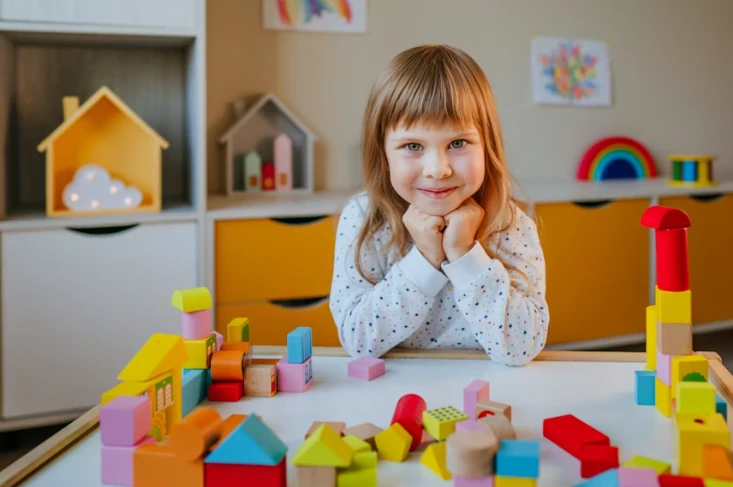
Manipulatives are any physical objects a child can hold, move, and arrange to explore a math idea — counting blocks, coins, beans, base-ten rods, or even LEGO bricks. When children touch and rearrange objects, they build a concrete foundation that makes abstract symbols meaningful.
The research-backed Concrete–Pictorial–Abstract progression — learn it physically first, then with pictures, then with symbols — is a cornerstone of effective math instruction and one you'll recognize if you've visited our center.
The Mathnasium Method™ in action: Our tutors guide students through this same progression — building with physical materials before moving to written equations — so concepts stick long-term rather than fade after the test.
Math Games to Try at Home
-
Use dried beans or pasta to model addition and subtraction before writing equations
-
Show multiplication as arrays: arrange 3 rows of 4 coins and ask "how many total?"
-
Explore fractions by cutting playdough or folding paper — then name each piece
-
Build place value towers with LEGO (1 stud = ones, 10-stud bar = tens)
-
Play store with real or play money — making change is subtraction in disguise
When kids experience math as part of life — not just homework — their confidence soars.
Math Through Music and Rhythm for Auditory and Rhythmic Learners
Music is mathematics made audible. Rhythm divides time into fractions. A 4/4 time signature is a ratio. Counting beats, clapping patterns, and recognizing musical structure all train the same cognitive pathways that underpin number sense and sequential thinking.
Neuroscience has found that musical training strengthens the brain regions involved in processing numbers and spatial relationships. You don't need instruments or lessons — simple body percussion and counting songs are enough to activate the rhythm-math connection.
Math Games to Try at Home
-
Clap multiplication tables: clap twice for each skip when counting by 2s, louder on the answer
-
Use a simple drum or kitchen pots to make a 4-beat pattern, then explore halving it
-
Sing skip-counting songs (by 3s, 5s, 7s) — melody makes sequences stick
-
Explore Chrome Music Lab to see sound waves as visual math patterns
-
Look up "Schoolhouse Rock" multiplication songs — still surprisingly effective
The Big Picture
No single approach works for every child — and most kids benefit from all three. The key is to follow your child's energy. If they light up when you bring out the paint, lean in. If they want to tap and clap, go there. Math is not just a subject; it's a way of noticing the world.
And if your child is frustrated right now, remember: frustration often means the current method isn't matching their brain — not that they can't do math. Sometimes all it takes is a different door. That's where we come in.
Mathnasium of Marina Hills
Ready to find your child's math breakthrough?
Our specially trained tutors use the Mathnasium Method™ — blending visual, tactile, verbal, and written techniques — to build a personalized learning plan for every student. Whether your child needs to catch up, keep up, or get ahead, we're here. Start with a free assessment — no commitment required.
Location: 30271 Golden Lantern, Ste A, Laguna Niguel, CA 92677
Phone: (949) 240-6284
Grades served: K–12 · In-center and online
First step: Free diagnostic assessment
Mathnasium of Marina Hills is located in the Laguna Heights Marketplace, proudly serving families in Laguna Niguel, Dana Point, Monarch Beach, and surrounding communities including Capistrano Unified and Laguna Beach Unified School Districts.


 (949) 240-6284
 (949) 240-6284