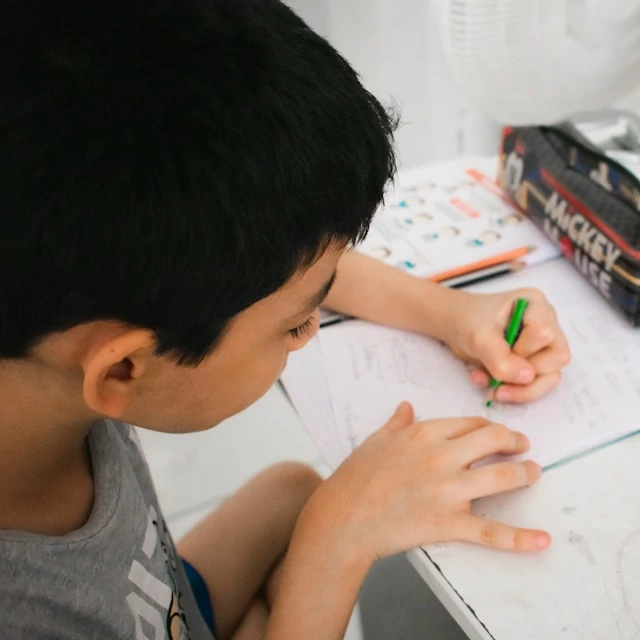
December in Marina Hills offers the perfect blend of holiday excitement and cooler weather—ideal conditions for engaging your children in playful math learning at home. These five creative activities transform ordinary seasonal moments into opportunities for mathematical discovery, all while your kids think they're just having fun.
1. Paper Snowflake Prediction Lab
Before you make a single cut in that folded paper, pause and predict. This December craft becomes a fascinating geometry experiment when kids must forecast their results. How many matching points will appear? How many lines of symmetry will emerge? The challenge is to sketch their prediction first, then test it by unfolding.
Start simple with two folds, then advance to three or four. Between attempts, discuss why the patterns multiply—what's the mathematical relationship between folds and final design? Older children can explore why authentic snowflakes always display hexagonal symmetry while paper versions can vary. Take photos of each attempt and create a prediction accuracy chart. This transforms a simple craft into an investigation of geometric principles, pattern recognition, and the scientific method rolled into one engaging activity.
2. Neighborhood Illumination Math Walk
Orange County neighborhoods glow magnificently during December, creating a living laboratory for mathematical thinking. Transform your evening strolls into estimation adventures by challenging kids to quantify the holiday displays around them. But skip simple counting—instead, focus on strategic approximation techniques that build genuine number sense.
Teach your children to look for patterns and units. Can they spot a repeating section and multiply? For elaborate displays, try breaking them into zones and adding estimates together. The real learning happens in discussing methods: "I saw five windows with about twenty lights each, so roughly one hundred total." Keep score across multiple walks to see which family member develops the sharpest estimation skills. This casual practice strengthens mental math and spatial reasoning without a worksheet in sight.
3. Date Number Challenge
Every morning in December presents a new puzzle. Today is the 11th? Find five different ways to create eleven using any operations. Tomorrow's the 12th? Now find six equations that equal twelve. This simple ritual takes three minutes but builds powerful computational flexibility.
Younger mathematicians can stick with addition and subtraction, while advanced students incorporate square roots, exponents, or negative numbers. Add weekly bonuses: "Use exactly three digits" or "Every equation must include the number seven." By December 31st, your child will have explored mathematical relationships for every number from one to thirty-one, developing the kind of number fluency that makes algebra and higher math far more accessible down the road.
4. Minimal Paper Wrapping Contest
Every gift represents a three-dimensional puzzle: what's the most efficient way to cover this shape? Challenge your kids to become wrapping efficiency experts by using the smallest amount of paper possible while still creating neat, complete coverage. This isn't just about frugality—it's about spatial reasoning, measurement, and geometric thinking.
Before wrapping, have them examine the package from all angles. Should they orient it differently? Where will the paper overlap? Can they calculate the surface area needed before cutting? Create a scoring system that rewards both neatness and paper conservation. For irregular shapes like tubes or balls, the problem becomes even more intriguing. This practical application connects abstract geometry to real-world problem-solving in ways that stick with kids long after the presents are opened.
5. Custom Cocoa Ratio Challenge
Those cool Marina Hills December evenings are perfect for a delicious math experiment. Set up a hot cocoa bar with multiple toppings, but here's the rule: everyone must describe their creation mathematically. "Mine is three-eighths marshmallows, one-quarter peppermint, and three-eighths chocolate chips."
The next layer adds complexity: can family members recreate each other's recipes exactly? Do the fractions sum to one? For younger kids, use visual fraction circles to make concepts concrete. Older students can convert between fractions, decimals, and percentages, or scale recipes up and down. What happens when you double someone's recipe? The multisensory experience—visual fractions, tactile measuring, and tasty results—creates powerful mathematical connections that abstract problems on paper simply cannot match.
Your Partner in Mathematical Growth
While these home activities build enthusiasm and foundational skills, sometimes children need more structured support to truly excel. That's where Mathnasium of Marina Hills comes in. We don't just help kids memorize procedures—we help them genuinely understand mathematical concepts through our proven, customized approach.
Every student receives an individualized learning plan based on a comprehensive assessment, ensuring they work on exactly what they need at exactly the right level. Our specially trained instructors know how to make mathematics click, building both competence and confidence. Whether your child struggles with math anxiety, needs to fill learning gaps, or wants to advance beyond grade level, we create the pathway to success.
Ready to see your child develop true mathematical confidence? Contact Mathnasium of Marina Hills today to schedule your child's assessment. Let's work together to make this the year math finally makes sense—and maybe even becomes their favorite subject.


 (949) 240-6284
 (949) 240-6284