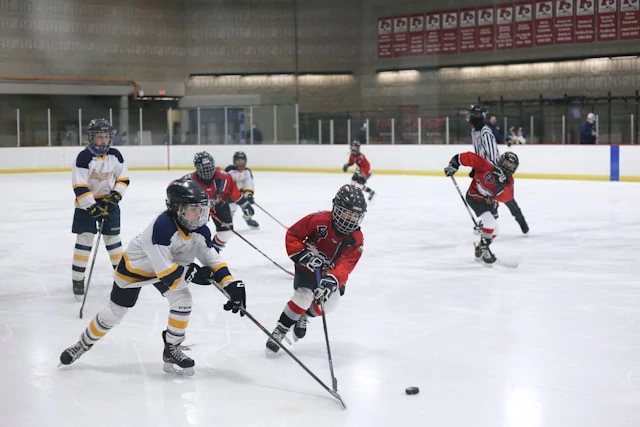
A fifth-grader sits at the kitchen table on a perfect 72-degree afternoon, glaring at his math worksheet like it just cross-checked him into the boards. "I hate word problems," he announces, tossing his pencil down with dramatic flair.
His mom glances at the Anaheim Ducks pennant on his wall. "Hey, if Trevor Zegras scored 23 goals and added 42 assists last season, how many total points did he have?"
The kid's eyes light up instantly. "65! Because you add goals and assists, so 23 plus 42 equals... wait." He pauses, processing. "That's literally addition. I just did a word problem about Zegras."
"Sure did. Now let's tackle the rest of that homework."
Welcome to the beautiful collision of hockey passion and mathematical thinking—where slap shots meet statistics, power plays involve probability, and every shift contains problem-solving gold. For kids in Marina Hills who live and breathe hockey (yes, even in Southern California), that enthusiasm becomes rocket fuel for learning. Here's how families and math tutors are transforming ice rink obsession into classroom confidence.
From Honda Center to Homework: Stats That Actually Matter
Hockey fans are walking stat databases, whether they realize it or not. Goals, assists, save percentages, plus-minus ratings—kids who "can't remember" their multiplication facts somehow retain Mason McTavish's complete rookie season breakdown, including ice time per game.
That's not random. That's passion meeting opportunity.
Basic scoring totals: "The Anaheim Ducks scored 2 goals in the first, 3 in the second, and 1 in the third. What's the final tally?" Addition becomes game analysis. Push it further: "They netted 52 goals over 16 games. Average per game?" Division suddenly has purpose because it reveals whether the offense is genuinely improving or just had a lucky streak.
The points equation: "Leo Carlsson finished with 10 goals and 19 assists in his rookie campaign. Total points?" The fundamental hockey formula (G + A = P) reinforces addition naturally. Level up: "Over 22 games played, what's his points-per-game average?" Now decimals matter because they track actual development.
Shot Accuracy: The Path to Percentage Mastery
Every young player wonders: "How good is my shot actually?" Enter percentage calculations, cleverly disguised as performance tracking.
The core formula: Shooting Percentage = (Goals ÷ Shots on Goal) × 100
"You took 45 shots at Great Park Ice this season and scored 7 goals. Calculate your shooting percentage."
Students dive into this calculation with focus because the answer is personally meaningful. (It's 15.6%, which beats the NHL average of approximately 10%. Not too shabby.)
Putting it in perspective: "Troy Terry posted around an 11% shooting percentage last season. You calculated 15.6% for yourself. Does that make you better than Terry?" This launches critical discussions about sample size, competition level, and why 45 shots in youth hockey differs vastly from 200+ shots against NHL goalies. The math works perfectly—context is what requires examination.
Goaltender statistics: "John Gibson faced 38 shots and stopped 35. What's his save percentage?" (35÷38 = 0.921, or 92.1%). NHL goalies maintaining .915+ earn Vezina Trophy consideration. Kids suddenly understand why their teammate won't stop talking about that .945 performance—it's statistically elite, and the numbers don't lie.
Plus-Minus: Integer Operations in Disguise
The plus-minus stat is essentially a masterclass in working with positive and negative numbers, and players track it obsessively.
How it operates: When your team scores at even strength while you're on ice, record +1. When opponents score, mark -1. After the game, add everything together.
"You were on ice for 5 goals for and 3 against. Calculate your plus-minus." (+5 and -3 = +2. Solid two-way performance.)
Students practice integer operations with genuine investment—they're measuring defensive reliability. (Answer: +15, which indicates strong overall play. Keep it up.)
Clock Management and Time Conversion
Professional players obsess over "time on ice" statistics. Youth players do the same, even when they pretend not to care.
Shift calculations: "You skated three shifts in period two: 48 seconds, 55 seconds, and 42 seconds. Total ice time?" Adding time requires understanding that 60 seconds converts to one minute—introducing base-60 number systems.
Total: 145 seconds = 2 minutes and 25 seconds. (Also, those are lengthy shifts for youth hockey. Someone's legs are probably burning.)
Percentage of game played: "The game ran 48 minutes total (three 16-minute periods at the FivePoint Valencia rink). You logged 22 minutes. What percentage of the game were you skating?"
22 ÷ 48 = 0.458 = 45.8%. That's heavy workload. For comparison, Anaheim's top players like Trevor Zegras average about 20 minutes in 60-minute NHL games (33%). You're shouldering significant responsibility.
Geometry Meets the Rink Surface
NHL rinks measure 200 feet long by 85 feet wide. California rinks at places like Anaheim Ice follow the same dimensions. Either way, geometry applies.
Perimeter problems: "The ice surface at Lakewood Ice measures 200 feet by 85 feet. If you skate the complete perimeter for conditioning, what distance do you cover?" (2×200 + 2×85 = 570 feet. Complete that ten times and you've skated over a mile. No wonder players are in incredible shape.)
Area calculations: "Calculate the total playing surface area." (200 × 85 = 17,000 square feet). Compare to practice space: "Your inline hockey court at Mile Square Park measures 50 feet by 100 feet. How much smaller is it?" (5,000 sq ft vs. 17,000 sq ft—about 29% of regulation size. Still plenty of room for skill work.)
Angles and shooting lanes: For advanced students exploring trigonometry: "You're positioned 18 feet from the goal at a 35-degree angle. Your teammate passes from the corner. What stick blade angle deflects the puck top corner?" Welcome to applied physics and geometry, hockey style. (No one expects you to calculate this during actual gameplay, but understanding angles helps explain why positioning matters.)
NHL Salary Cap: Advanced Economics
Older students fascinated by hockey's business side get unexpected lessons in budgeting and strategic resource management.
Cap space math: "The NHL salary cap ceiling is $83.5 million. The Anaheim Ducks have $77 million committed. How much cap space remains?"
$83.5M - $77M = $6.5M. Can they afford that free agent defenseman? Better check contract demands.
Contract percentage: "Trevor Zegras makes $5.75 million per season. What percentage of Anaheim's $83.5 million cap does that consume?"
5.75 ÷ 83.5 = 0.0688 = approximately 6.9%. That's a reasonable percentage for a rising star, leaving flexibility for other roster moves. Welcome to sports economics and budget management.
The Real Game-Changer: Confidence Drives Success
Here's what Marina Hills families already know: mathematics isn't some isolated subject disconnected from real life. It's the framework explaining everything kids already care about—including hockey, even in Southern California where year-round sunshine tempts everyone outdoors.
Most students don't bounce out of bed thinking, "Today I'm going to master fractions!" But calculating whether their shooting percentage improved since last month? Or figuring out what the Ducks need to clinch a playoff spot? Or determining if they're on pace to beat their personal points record? Those questions ignite real curiosity.
When parents and math tutors connect mathematics to authentic student passions—whether hockey, surfing, robotics, or music—they're not manipulating kids into learning. They're revealing that math already exists within what they love. The connection was always there, just waiting to be discovered.
Finding the Right Math Tutor Makes All the Difference
At Mathnasium of Marina Hills, math tutors witness these transformations regularly: the student insisting they're "terrible at math" becomes an engaged problem solver when fractions represent ice time, when decimals track shooting percentages, when negative integers measure plus-minus ratings.
The Mathnasium math tutors in Marina Hills don't just teach formulas—they invest time discovering what makes each student tick. Maybe it's hockey stats from the Anaheim Ducks. Maybe it's calculating batting averages for the Angels. Maybe it's figuring out the optimal strategy for their favorite video game. Whatever the hook, experienced math tutors use it to build understanding.
The Mathnasium Method™ rejects cookie-cutter approaches that treat every student identically. Instead, math tutors create customized learning plans designed around each child's unique needs, learning style, and interests. That might mean incorporating examples from last weekend's game at Irvine Inline. It might involve calculating travel distances between Southern California rinks. The mathematics remains consistent; the delivery adapts to maximize engagement.
Because here's the fundamental truth: confidence matters more than computation speed. A student who believes they can solve problems will push through challenges. A student convinced "math just isn't for me" gives up before trying—and that's the real loss.
Math tutors at Mathnasium of Marina Hills help students reframe mathematics from intimidating enemy to practical tool—whether they're headed toward engineering, sports analytics, business, or simply becoming the kid who understands why the Ducks' power play strategy actually makes statistical sense.
Bottom Line (With a Little Hockey Celebration)
Math doesn't have to feel like conditioning drills on a hot California afternoon. Not when there are shooting percentages to calculate, plus-minus ratings to track, and playoff probability scenarios to analyze.
Every boring word problem becomes infinitely more interesting when it involves one-timers and overtime winners. Every decimal suddenly has meaning when it's the difference between a .900 save percentage (rough outing) and a .950 save percentage (standing ovation at Honda Center).
So next time math homework triggers that glazed-over look, try asking: "What if we made this about hockey?" Those mental barriers might crumble faster than a defender getting deked on a breakaway.
After all, if kids can memorize every player on the Ducks' roster including jersey number, hometown, draft position, and contract status, they can definitely master percentages, ratios, and fractions. Both just require the right motivation—and maybe some highlight reels for inspiration.
Ready to help your child go from math-anxious to math-confident? The math tutors at Mathnasium of Marina Hills specialize in personalized instruction that connects with each student's unique interests. Schedule a free assessment to discover what makes your child's learning come alive.
Every student has something that ignites their curiosity. Sometimes it's hockey. Sometimes it's beach volleyball statistics. Sometimes it's calculating the perfect wave conditions. Whatever it is, our math tutors will find it—and use it to build the mathematical foundation your child needs for academic success and lifelong confidence.
Let's drop the puck on better math understanding. Our math tutors are ready when you are.


 (949) 240-6284
 (949) 240-6284