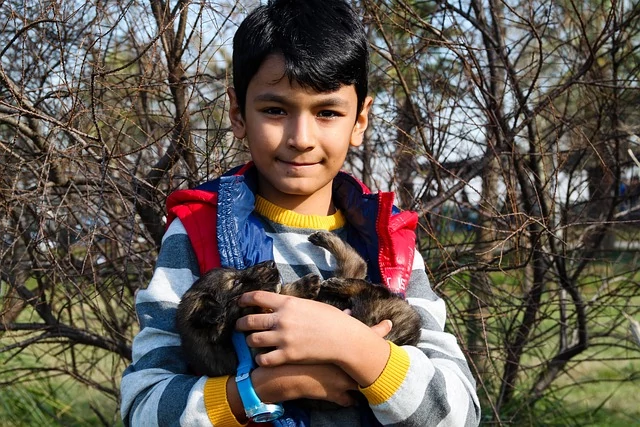
Just the other day, I spoke with a third grader who disliked math, and she was very excited about figuring out how many paws there were in a room full of Golden Retrievers. She was facing the same problem in the math workbook. The problem just had a fancier presentation.
When a child enjoys being around dogs and playing with them but hates doing math homework, then parents are sitting on an unclaimed treasure. Evgeny, one of the instructors at Mathnasium of Marina Hills, aims to inspire your child’s innate curiosity and encourage them to become more engaged in the real-world. Here’s how to utilize those two factors and create one enjoyable learning experience.
Begin with the Tangible
Children do not think in the abstract, they think in real terms. A dog has four paws. That’s not mnemonics, that’s just true. So when parents ask, “If there are eight dogs playing in the park, how many paws are running around”? They are teaching multiplication.
What many parents fail to see is the beauty in visualization. Instead of making the problem sound boring, make it enjoyable. Capture their imagination with those furry faces and all the paws in the grass. And then they will do it themselves without realizing they are doing math.
The reverse works too: "I can see 20 ears poking up over the fence—how many dogs are back there?" Now division feels like solving a mystery instead of another worksheet problem.
Treats Are Currency (and Also Fractions)
Every dog owner knows the power of a good treat. Every math teacher should, too. With a bag of dog biscuits—or just drawings on paper—parents can pose real dilemmas:
"We've got 30 treats and three dogs: Max the Beagle, Luna the Poodle, and Charlie the Terrier. How do we split them fairly?"
The child isn't just dividing 30 by 3. They're being fair. They're making sure no dog gets left out. That emotional hook makes the math stick in a way that "30÷3=" on a whiteboard never will.
For older kids, adding complexity works well: "If a 10-pound dog gets 2 treats a day based on weight, how many should a 50-pound dog get?" Now parents are building critical thinking—children need to spot the pattern (the ratio is 5:1) and apply it. The answer? Ten treats for the big guy.
Or this approach: "A bag of fancy dental chews costs $15 and has 12 chews inside. What's the price per chew?" Suddenly decimals have a purpose. "If the dog gets one every other day, what will you spend in January?" Now the exercise layers calendar math onto budgeting. It's real life, just smaller and furrier.
Scaling Up: The Hungry Labrador Problem
Middle schoolers wrestling with ratios and proportions? Enter the eternally hungry Labrador.
"A 20-pound Beagle needs 1.5 cups of kibble per day. Your neighbor's 60-pound Lab is staring at you with those big eyes. How much does he need?"
This isn't just cross-multiplication practice. It's empathy math. Children are taking care of an animal, scaling the portions correctly so the dog stays healthy. The emotional investment transforms the equation from abstract to essential.
Puppy edition: "Six puppies devour 12 cups of food daily. Two get adopted. How much do the remaining four need?"
First, find the unit rate: 12÷6 = 2 cups per puppy. Then apply it: 4 puppies × 2 cups = 8 cups total. The math is the same as any other proportion problem, but the story makes it memorable.
Turn the Dog Park Into a Data Lab
Next time families visit a dog park or scroll through a breed guide, pulling out some paper can transform the outing.
"Let's make a chart of all the breeds we see." Bar graphs suddenly have a purpose when tracking whether Labs or Beagles are more popular at the local park.
Pushing it further: Looking up the weights of five different breeds online and calculating the mean, median, and mode turns stats class into a way to understand favorite animals better.
Probability, made simple: "At the shelter, there are 5 Labs, 3 Boxers, and 2 Huskies. What are the chances the next dog getting a bath is a Boxer?" (3 out of 10, or 30%.) Boom—children just learned probability without even flinching.
The Real Lesson? Math as a Tool
Here's the thing educators sometimes forget: math isn't the destination. It's the vehicle that gets students somewhere they actually want to go.
Most children don't care about mastering long division for its own sake. But figuring out if a family can afford those premium dog treats? Or designing the perfect backyard space for a future puppy? Or calculating how fast a Greyhound runs compared to a human? Now the lesson resonates.
When parents and teachers connect math to something a child genuinely cares about—whether it's dogs, dinosaurs, soccer, or baking—they're not tricking students into learning. They're showing them that math is already part of the things they love. Children have been using it all along without realizing it.
Finding Each Child's "Hook"
At Mathnasium of Marina Hills, educators have seen it countless times: the kid who insists they're "bad at math" suddenly becomes a problem-solving wizard when the problem involves something they're passionate about. Dogs just happen to be a particularly good hook for many kids—they're visual, emotional, and everywhere.
Mathnasium tutors spend time figuring out what makes each student tick, then customize lessons around those interests. The Mathnasium Method™ isn't about forcing kids through a one-size-fits-all curriculum. It's about meeting them where they are and showing them that math can be as engaging as their favorite hobby.
Because at the end of the day, confidence matters more than computation. A child who believes they can solve a problem will find a way. A child who's been told math "just isn't their thing" won't even try.
Mathnasium of Marina Hills tutors help kids stop seeing math as the scary beast under the bed and start seeing it as the tool that helps them understand their world better—whether that world includes algebra, architecture, or just a really good dog.


 (949) 240-6284
 (949) 240-6284