Feedback shapes how children see themselves as learners, especially in math. A single comment or reaction can lift a child’s confidence or leave them feeling unsure. Because many students already view math as high-stakes or intimidating, even small moments of feedback can have a big impact.
The tone, words, and gestures adults use during math learning shape how students respond to challenges. Supportive feedback encourages persistence and curiosity. But rushed, critical, or overly fixed praise can quietly undermine confidence and create anxiety.
The right feedback builds skills, and it helps students believe they can grow, improve, and belong in math.
Why Feedback Matters in Math Learning
Though feedback often focuses on correction, it is important to remember that feedback is first and foremost about communication.
Every word, gesture, or facial expression sends a message about how a child is doing. Even a quick sigh, a raised eyebrow, or a quiet “good job” can affect how a student feels about math.
Over time, this feedback shapes a child’s math identity—what they believe about their abilities, whether they belong in math, and how they interpret mistakes. When feedback feels supportive, students are more likely to take risks and stay engaged. When it feels dismissive or pressured, they may start avoiding challenges or doubting themselves.
Education experts Hattie and Timperley found that feedback is one of the most powerful tools for improving student achievement, especially when it answers three key questions:
-
“Where am I going?”
-
“How am I doing?”
-
“What should I do next?”
Stanford math education professor Jo Boaler has shown that students thrive when they receive growth-focused feedback. When children are encouraged to try, reflect, and learn from mistakes, they become more curious and less anxious.
Carol Dweck’s research on mindset adds to this. Praise that focuses on intelligence (e.g. “You’re so smart”) can lead to fear of failure. Praise that focuses on effort and strategy (e.g. “You worked hard to figure that out”) helps students understand that progress comes from practice.
When children consistently hear messages that value effort, persistence, and strategic thinking, they begin to see themselves as capable math learners, and that belief drives lasting growth.

Encouragement during homework time builds confidence and calm.
What Kind of Feedback Builds Math Confidence?
Confidence in math doesn’t come from always getting the right answer—it comes from knowing how to keep going when the answer isn’t obvious. The right kind of feedback helps students stay calm, think critically, and bounce back from mistakes.
Here’s what effective math encouragement looks like:
1. Praise Effort and Strategy, Not Talent
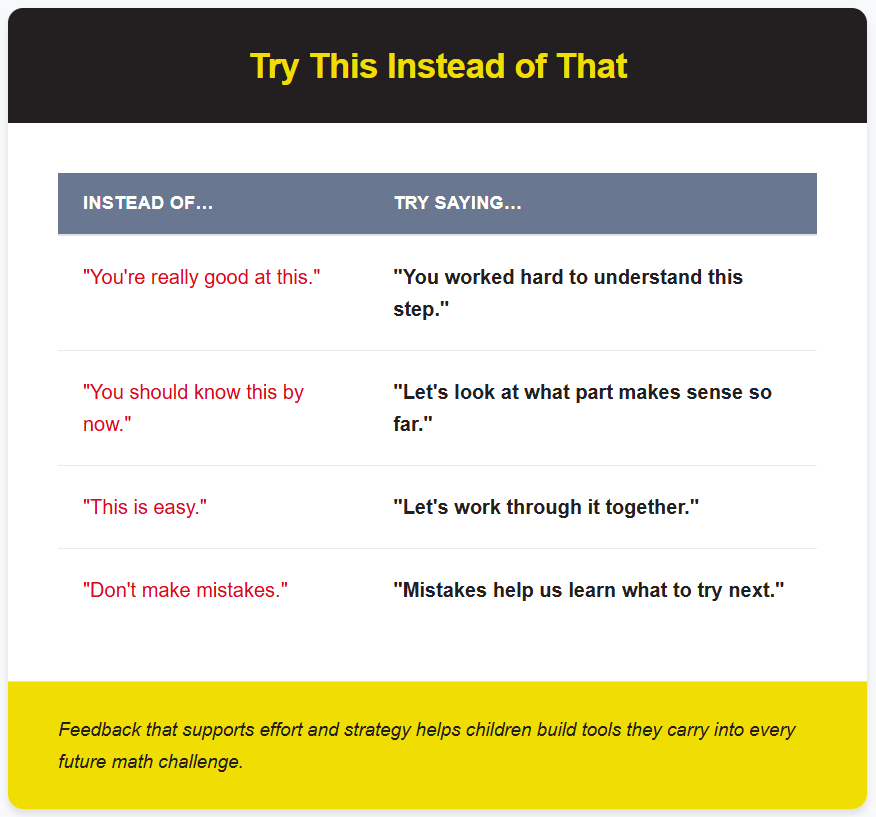
When a parent says, “You worked hard to understand that step,” they highlight something the child can control: their effort and approach. This reinforces that success comes from trying, not from being “naturally good at math.”
Comments like this also help with multi-step problems where persistence matters, whether it’s spotting a pattern, organizing a word problem, or solving an equation.
2. Focus on the Process
Instead of saying “You’re so smart,” shift to feedback like:
These kinds of comments help students value reasoning and creativity over speed or perfection. Over time, they learn that struggling through a problem is not a sign of weakness but a part of how learning works.
3. Treat Mistakes as Learning Moments
Neuroscience research from Jason Moser shows that the brain becomes more active when a mistake is made, even before it’s corrected. In other words, mistakes help the brain grow.
When adults respond calmly to mistakes and frame them as opportunities, children feel safer to experiment and ask questions. A simple comment like, “This mistake helps us see what to try next,” can transform frustration into curiosity and resilience.
📕 You May Also Like: Why Parents Should Teach Kids to Embrace Math Mistakes
4. Acknowledge Emotions Without Judgment
Math can bring up strong emotions: frustration, confusion, worry, or even embarrassment. Children often assume that their emotions mean they are “bad” at math.
When an adult says, “It makes sense that this feels tricky,” it normalizes the feeling and helps the child stay regulated enough to continue working. Validating emotions does not fix the problem for the child, it gives them the calm needed to work through it.
5. Be Consistent Across Settings
The most powerful confidence-building messages come when parents, teachers, and tutors reinforce the same principles. When children hear consistent feedback “keep trying,” “let’s look at the part that makes sense,” they begin internalizing these lessons.
This is when confidence becomes part of a child’s identity. Unified messaging across home, school, and tutoring helps children understand that persistence, practice, and strategy, not perfection, are the foundations of strong math learning.
📕 You May Also Like: 5 Simple Ways to Improve Your Child’s Math Confidence
How Feedback Can Erode Confidence
Some comments, even well-intentioned ones, can quietly undermine a child’s belief in their abilities. Children are highly sensitive to adult reactions, especially when they already feel unsure or frustrated.
When feedback creates pressure or shame, students begin to associate math with anxiety rather than curiosity. Over time, these patterns can shape how they see themselves as learners.
1. Overpraising Without Substance
Comments like “You’re a genius!” or “You’re naturally gifted!” are meant to encourage, but they tie success to innate talent rather than effort.
When children later encounter something difficult (and they inevitably will), they may worry that struggling means they’re “not smart anymore.” This can lead to avoidance, perfectionism, or shutting down at the first sign of challenge.
2. Focusing on Right or Wrong Answers Only
When feedback centers exclusively on correctness (“Yes, that’s right” or “No, that’s wrong”), students may rush for answers instead of understanding.
They learn that math is about speed, not thoughtfulness. This discourages exploration, reduces deeper comprehension, and makes children afraid to tackle questions where they aren’t immediately confident.
3. Expressing Math Anxiety
Many adults, without realizing it, pass their own math anxiety to children by saying things like “I was never good at math either” or “This stuff is confusing.”
Kids interpret these comments as proof that math ability is fixed and that struggling is something to be embarrassed about.
4. Labeling
Labels such as “You’re not a math person” or “This isn’t your strength” can feel harmless, but they create ceilings.
They limit the child’s belief about what they can achieve and send the message that some people simply “can’t do math,” which research shows is untrue.
5. Sarcasm or dismissive remarks
Comments like “That was easy” or “Why did that take so long?” make children afraid to ask for help.
A study on negative feedback found that controlling or discouraging feedback increases anxiety and makes students less willing to attempt challenging tasks.
Children thrive when adults communicate encouragement, patience, and belief in their ability to grow.
📕 You May Also Like: Understanding Math Anxiety and How to Overcome It

Supportive responses to mistakes help students take healthy risks.
What Math Encouragement Sounds Like
As we’ve seen, one of the most powerful ways to support a child is by using phrases that highlight effort, thinking, and persistence. These comments gently guide children back into problem-solving mode.
Here are some confidence-building phrases you can use:
-
“I can see you really worked hard on this.”
-
“Show me the part that makes sense to you.”
-
“You kept going even when it got confusing.”
-
“Let’s break this down together, we’ll figure it out.”
Let’s explore them in action:
Homework Help
Your child slams their pencil down and says, “I can’t do this.” Instead of jumping in with a fix, you say, “Show me the part you do understand.”
They point out the numerator in a fraction problem but don’t understand the denominator. You talk through it together, and they realize they were closer than they thought.
Pre-Quiz Nerves
Before a math quiz, your child says, “I’m going to mess this up.” You take a breath and say, “You’ve practiced your strategies. Let’s just start with the first question.”
That small nudge helps them calm down and get focused.
Tutoring Check-In
During a session, a student makes a mistake midway through a multi-step problem and looks discouraged. Their instructor says, “This mistake helps us figure out what to try next.”
The student stays engaged, adjusts their thinking, and tries again, with a little more confidence than before.
📕 You May Also Like: How Positive Math Talk Encourages a Growth Mindset at Home

Confidence-building feedback helps students tackle challenges with ease and clarity.
How Mathnasium Builds Math Confidence
At Mathnasium, we help students transform how they see themselves as math learners. Using the Mathnasium Method™, our instructors build deep understanding, strong skills, and lasting confidence through personalized, supportive instruction.
Diagnostic-Based, Personalized Learning
Every student begins with a diagnostic assessment that reveals their learning gaps, style, and goals. From there, we create a personalized learning plan that:
-
Meets them exactly where they are
-
Provides early, achievable wins
-
Supports long-term skill development
Because students start seeing progress right away, their confidence grows quickly.
Encouragement That Builds Resilience
Our instructors are trained to offer real-time feedback that celebrates effort, recognizes good thinking, and guides students through challenges.
Students learn that persistence—not perfection—is what leads to success.
Visual, Hands-On Learning
Using number lines, manipulatives, models, and real-world examples, we help students understand why math works.
Talking through problems and exploring concepts visually reduces anxiety and leads to lasting comprehension.
Building a Healthy Math Identity
Over time, students begin to trust their strategies, embrace challenges, and take ownership of their learning. They walk away from each session feeling capable, motivated, and ready to take on homework, quizzes, and new material with confidence.
Based in Mason, OH?
Mathnasium of Mason serves local families. We help children build a math identity grounded in effort, understanding, and self-belief.
We’re proud to be recognized for that work:
Book your free assessment today and see how Mathnasium can help your child grow into a confident, independent math thinker.
📍 Not in Mason? Mathnasium has over 1,000 learning centers nationwide, so families everywhere can access expert math instruction and support. Find a center near you.


 (513) 683-9800
 (513) 683-9800