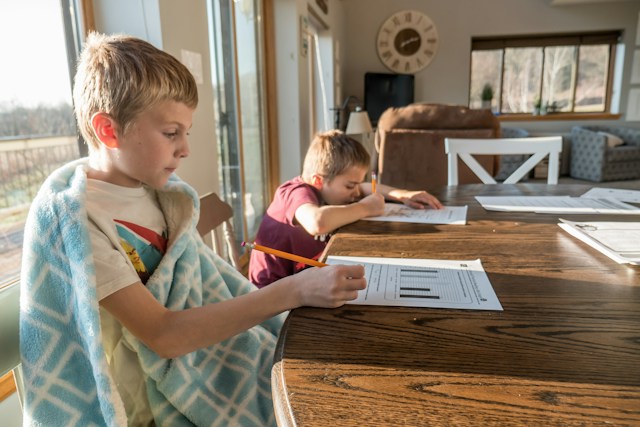
Nobody likes a report card surprise. You open the portal, see a math grade that doesn’t fit the kid you know, and wonder how it got there without you noticing.
Here’s the thing: it didn’t happen overnight. Math trouble tends to build quietly, and the early hints show up at home long before they show up on a transcript. If you’re a Naperville North parent with a gut feeling that something isn’t clicking, these eight signs can help you sort out whether it’s a bump in the road or a reason to get support.
1. Math homework swallows the whole evening
Other subjects get finished in a flash. Math drags on until bedtime. Along the way your child discovers urgent business elsewhere: a snack, a bathroom trip, a sudden need to reorganize their backpack.
That isn’t a motivation problem. People steer away from things that make them feel stuck. If dinner conversation keeps getting derailed by a math worksheet, there’s likely something your child never quite understood the first time it was taught.
2. Test mornings come with a sudden stomachache
Quiz day arrives and so does a headache, a sore tummy, or a plea to stay home. Sometimes kids are truly unwell. When the symptoms keep landing on math tests specifically, nerves are a likely culprit.
Math anxiety is far more common than most parents assume. A child who fears being wrong starts fearing the subject, and that worry can wipe out knowledge they really have. You may notice they can solve problems easily at the kitchen table and then blank out in the classroom.
Confidence usually comes from solid footing. A student who understands the material sees a test as a challenge. A student who’s guessing sees it as a threat.
3. The grades are drifting downward in small steps
Zoom out and look at the pattern rather than the most recent score. A single B-plus after a streak of A’s means nothing. A slow slope across quizzes, tests, and progress updates means something.
This kind of decline is easy to excuse. The test was tricky. She had a rough week. He was tired. Once you’ve heard three or four explanations like that, the real explanation may be a skill gap that keeps widening.
4. Simple math facts still take real effort
Little kids count on their fingers, and that’s perfectly healthy. It’s a different picture when a fifth grader grabs a calculator for basic multiplication, or a seventh grader has to build 7 times 8 from scratch every time.
Think about how reading works. A child who has to sound out each word can’t enjoy the story. In the same way, a child who struggles with basic facts has no mental room left for fractions, ratios, and algebra.
5. Word problems cause a full stop
Plenty of kids can calculate just fine until the problem turns into a short story. Then they stall, underline random numbers, and take a wild swing at which operation to use.
Word problems reveal whether a student understands what’s going on, not just whether they can follow steps. Kids who memorize procedures can coast for a while. Eventually the questions get more layered, and the shortcuts stop working.
6. Your child has gone silent in class
Teachers often say it at conferences: “She’s a quiet one.” If your child used to chime in during math and now keeps their eyes on the desk, they may be lost and hoping no one notices.
A classroom has a pacing guide and a lot of students. Teachers can’t always pause to re-teach one idea for one child, and kids know it. Many decide that smiling and nodding is safer than admitting they’re confused.
7. You can’t help anymore, and neither can YouTube
“That’s not how I learned it” might be the most common sentence in modern homework history. Schools now teach several strategies for the same problem, which can leave parents and kids equally puzzled.
The real warning sign is when the two of you sit side by side, neither can explain the method, and everyone ends up more frustrated than before. At that point your child needs a fresh voice who can present the idea in a way that finally lands.
8. A big academic jump is right around the corner
Certain moments in school are tougher than others. Moving up to junior high, stepping from pre-algebra into algebra, or heading into high school at Naperville North can expose small gaps that were easy to hide earlier. Kids who cruised through the lower grades sometimes hit a wall when the work starts asking for real reasoning.
If a transition is coming up in District 203 or District 204, you don’t have to wait for trouble. Getting help ahead of time often means your child walks in feeling prepared instead of scrambling to catch up.
Okay, so what now?
Take a breath first. Seeing one or two of these signs doesn’t mean something is wrong with your child. It means they could use a boost at the right moment, and the fact that you noticed is the hardest part.
Next, talk with your child in a low-key way. Ask which part of math feels toughest right now. A lot of kids are visibly relieved to be asked.
Then find out exactly where the gaps are. Guessing costs time and money. A thorough assessment shows which skills are shaky so the help goes where it counts instead of reviewing what your child already knows.
That’s the first step at Mathnasium of Naperville North. Our math tutors start by getting a clear picture of how your child thinks about math, then build a personalized learning plan around it. Families can choose in-center sessions at the Naperville Plaza Shopping Center or online tutoring from home, whichever fits the week. The goal goes beyond a better grade. We want your child to leave math class feeling capable instead of discouraged.
Don’t let the report card tell you first
A report card describes what already happened. The signs above tell you what’s coming, and that gives you time to change the story before it’s written.
If your child matched even a few of these, now is a great time to reach out. Early support is nearly always quicker and less stressful than digging out of a hole mid-semester.
Ready to see where your child stands? Visit us at Mathnasium of Naperville North to schedule an assessment and meet the math tutors who can help your child feel confident again.


 (630) 281-2384
 (630) 281-2384