There's a seventh-grader in Naperville hunched over her algebra homework, pencil frozen mid-air, face twisted in confusion. "I seriously don't understand ratios," she groans.
Her older brother glances up from his phone. "What's Auston Taylour Matthews' goals-to-games ratio this season?"
She doesn't even hesitate. "Like 0.68. He's got 34 goals in 50 games, so you just divide 34 by 50..." Her voice trails off as realization hits. "Oh. Oh, that's literally a ratio, isn't it?"
"Yep. Now about that homework."
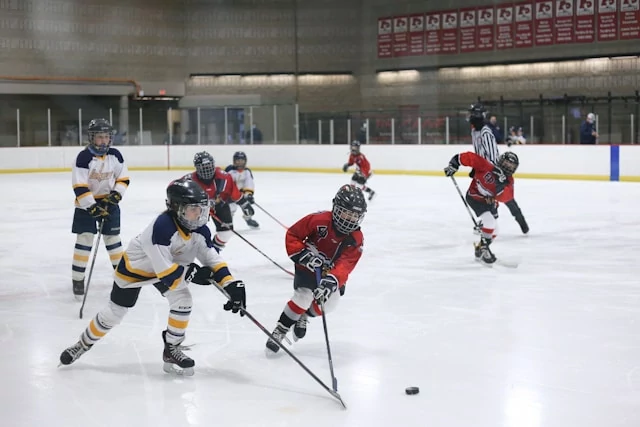
This is the magic that happens when hockey passion collides with math concepts—where breakaway goals illuminate division, power plays demonstrate probability, and penalty minutes reveal the truth about negative numbers. For Naperville North students who obsess over hockey, that enthusiasm transforms into an unexpected advantage in the classroom. Here's how parents and educators are channeling rink-side energy into genuine mathematical understanding.
Stats Obsession: Your Child's Secret Math Superpower
Hockey players are statistics junkies, whether they realize it or not. Points, goals, assists, time on ice, blocked shots—kids who claim they "can't remember anything" somehow retain Jonathan Toews' entire career stat line, complete with playoff performance breakdowns.
That's not luck. That's passion, generating curiosity and thirst for knowledge.
Game totals become additional practice: "The Naperville North team netted 3 goals in period one, 1 in period two, and 4 in period three. Final score?" Basic addition transforms into post-game analysis.
Next you can increase difficulty: "Over 12 games, they scored 38 total goals. What's the per-game average?" Division gains meaning when it determines whether offensive production is trending upward or just statistical noise.
Points calculation: "Sarah finished with 15 goals and 21 assists for the season. Total points?" The hockey equation (G + A = P) reinforces addition naturally. Next level: "Across 20 games, what's her points-per-game?" Suddenly decimals matter because they measure personal improvement over time.
Mastering Percentages Through Shot Accuracy
Every young player secretly wonders: "How good is my shot?" Enter percentage calculations, brilliantly disguised as performance analysis.
The essential formula: Shooting % = (Goals divided by shots on goal) × 100
"You launched 60 shots at Centennial Ice Arena this season and buried 9. Calculate your shooting percentage."
Students attack this problem with focus because the answer has personal significance. (It's 15%, which actually exceeds the NHL average of roughly 10%. Not bad at all.)
Reality-check mathematics: "Sidney Crosby maintains about a 13% career shooting percentage. You calculated 16% for yourself. Are you outperforming Crosby?" This opens discussions about sample size, competition quality, and why 60 shots in recreational hockey differs from 5,000+ shots against elite goaltenders. The mathematical comparison works perfectly—it's the context that needs examination.
Goaltending calculations: "Your goalie faced 42 shots, making 39 saves. What's the save percentage?" (39÷42 = 0.929, or 92.9%). NHL goalies posting .920+ earn serious contract money. Kids suddenly grasp why their teammate celebrates that .940 performance—it's statistically exceptional, and the numbers prove it.
Understanding Integers Through On-Ice Performance
The plus-minus statistic essentially teaches integer operations without students noticing they're practicing pre-algebra.
How it functions: Your team scores while you're playing at even strength? Add +1. Opposition scores? Subtract 1. Game ends, total them up.
"During last night's game, you were on ice for 4 goals scored and 2 goals allowed. Calculate your plus-minus." (+4 and -2 = +2. Solid defensive game.)
Students practice adding and subtracting integers with genuine investment—they're measuring defensive responsibility. (Total: +10, indicating strong two-way play. Well done.)
Converting Seconds to Minutes: Time Management Math
Professional players track "time on ice" obsessively. Youth players do too, even when pretending they don't care.
Shift duration math: "First period shifts: 52 seconds, 41 seconds, and 47 seconds. Total ice time?" Adding time requires understanding that 60 seconds equals one minute—introducing base-60 systems and unit conversion.
Answer: 140 seconds = 2 minutes, 20 seconds. (Also, those are extended shifts. Someone's definitely winded.)
Game time percentage: "Regulation lasted 45 minutes (three 15-minute periods). You logged 20 minutes total. What percentage of the game did you play?"
20 ÷ 45 = 0.444 = 44.4%. That's heavy usage. For reference, NHL stars like Nathan MacKinnon average about 21 minutes in 60-minute games (35%). You're carrying significant responsibility.
Applying Geometry to Ice Surface Calculations
A standard ice rink measures 200 feet by 85 feet. Local rinks around Naperville might vary slightly, but geometry applies universally.
Perimeter calculations: "The ice at Fox Valley Ice Arena spans 200 feet long and 85 feet wide. Skating the entire perimeter once covers what distance?" (2×200 + 2×85 = 570 feet. Ten laps equals over a mile—explaining why conditioning drills feel endless.)
Surface area problems: "Calculate total playing area." (200 × 85 = 17,000 square feet). Compare this to backyard projects: "Your family's outdoor rink measures 30 feet by 50 feet. How much smaller than regulation?" (1,500 sq ft versus 17,000 sq ft—about 8.8% of NHL size).
Building Confidence Beyond Formulas
Math isn't some disconnected academic requirement existing in isolation. It's the framework describing everything students already care about—including hockey.
Most kids don't enthusiastically wake up thinking, "Today's the day I conquer percentages!" But calculating whether their shooting improved since November? Or determining playoff qualification scenarios? Or checking if they are tracking toward a personal scoring record? Those questions spark authentic engagement.
Personalized Learning: Meeting Students Where They Are
At Mathnasium of Naperville North, instructors witness these breakthroughs regularly: the student insisting they're "hopeless at math" transforms into an enthusiastic problem-solver when percentages become shooting stats, when fractions represent ice time distribution, when negative numbers track plus-minus ratings.
What makes the difference? Personalized attention that discovers each student's unique interests and motivations. The Mathnasium Method™ rejects generic, one-size-fits-all curriculum that treats every student identically. Instead, tutors invest time understanding what drives each individual learner—sometimes literally incorporating examples from their weekend tournament at Seven Bridges Ice Arena.
Every child receives customized instruction designed around their specific needs, learning style, and interests. For the hockey enthusiast, that might mean reframing geometry through rink dimensions. For another student, it could involve musical timing or video game probability. The mathematics remains consistent; the delivery adapts to maximize engagement and understanding.
Mathematics doesn't need to feel like punishment laps after a bad practice. Not when shooting percentages need calculating, playoff scenarios require analysis, and salary cap puzzles await solving.
Ready to transform your child from math-anxious to math-capable? Mathnasium of Naperville North specializes in personalized instruction tailored to each student's unique interests and learning style. Schedule a free assessment to discover what makes your child's learning click.
Every student has something that ignites their curiosity. Sometimes it's hockey. Sometimes it's astronomy. Sometimes it's elaborate Minecraft calculations. Whatever it is, our tutors will discover it—and leverage it to build the mathematical foundation your child needs for academic success and lifelong confidence.
Let's drop the puck on better math understanding. We're ready when you are.


 (630) 281-2384
 (630) 281-2384