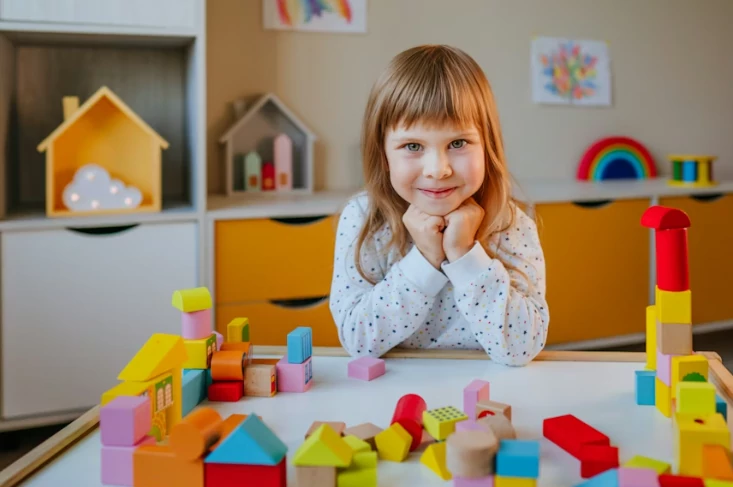
Art, hands-on materials, and rhythm aren't just fun diversions — they're legitimate pathways to mathematical understanding that textbooks often miss.
From the team at Mathnasium of Naperville North · Serving K–12 families in Naperville, Indian Prairie, Lisle & Woodridge
Here's something we hear from parents all the time: "My kid is smart, but math just doesn't click for them." What they're often describing isn't a math problem — it's a mismatch between how their child's brain works and how the material is being presented. At Mathnasium of Naperville North, we've built our entire approach around closing that gap. And the good news? You can start at home, today, with things you probably already have.
Draw It, Paint It, Build It — Then Do the Math for the Visual Thinker
Math lives inside art whether we name it or not. The angles in a pencil sketch, the symmetry in a paper snowflake, the proportions in a painting — these are all geometry and fractions in disguise. For children who think visually, engaging through creative media can be the shortcut that months of worksheets never provided.
When a child folds paper into eighths to make an origami crane, they're experiencing fractions with their hands before they ever write one down. That embodied understanding is exactly what makes abstract symbols finally stick.
Ideas to Try at Home
-
Sketch geometric patterns on grid paper and count the shapes inside each shape
-
Mix paint colors using fraction ratios — then predict what three-quarters blue will look like
-
Fold origami together and name each new fraction as the paper divides
-
Design a "color quilt" on graph paper: how many squares are red? What fraction is that?
-
Use ruler and compass to recreate Mondrian-style art and talk about area and proportion
Even young children (ages 4–6) can sort shapes, trace edges, and count corners while drawing. Older kids (ages 7–10) can explore tessellations and mirror symmetry, while middle and high schoolers can dig into scale, ratio, and the mathematics behind perspective.
Put Something in Their Hands Before You Write Anything Down | For the Hands-On Learner
There's a reason young children learn to count by touching objects. Physically handling and rearranging things gives the brain a concrete model to attach abstract ideas to. Skip that step, and many kids are left trying to memorize operations that may be perceived as arbitrary.
Educators call this the Concrete–Pictorial–Abstract sequence: you build it first, draw it second, and write the equation third. It's a research-backed progression that prevents the kind of surface-level learning that collapses the moment a problem looks slightly different.
How we apply this at Naperville North: Our tutors never rush students to pencil and paper. We let them work with physical materials until the idea makes sense in their hands — then we bridge to written math. That's why our students retain what they learn.
Ideas to Try at Home
-
Count out beans or buttons to act out addition and subtraction stories before writing them
-
Demonstrate multiplication by building equal groups with coins or blocks — then count the total
-
Cut an orange or a piece of playdough into equal pieces to make fractions tangible
-
Stack LEGO bricks to show place value — singles, strips of ten, flat hundreds
-
Set up a pretend store and practice making change — it's subtraction with real stakes
Younger children (ages 4–6) thrive with simple sorting and counting objects. Elementary students (ages 7–10) benefit from fraction bars and area models. Older students can use algebra tiles to visualize expressions before they ever simplify them symbolically.
Some students struggle so much with math — our tutors want to give them a reason to enjoy coming, until we've built up their confidence.
If They Can Clap It, They Can Count It | For the Rhythm and Sound Learner
Music and math are so deeply intertwined that some researchers describe music as the brain's natural rehearsal space for number sense. Every beat is a unit. Every measure is a fraction of the whole. Every pattern that repeats is a sequence waiting to be generalized.
Children who seem distracted in math class but light up around music, drumming, or singing are often telling you something important about how their brain organizes information — through sound and time, not symbols on a page. You don't need an instrument to tap into this. Rhythm is free.
Ideas to Try at Home
-
Chant multiplication tables to a beat — stress the multiples, whisper the in-between counts
-
Tap out a four-beat pattern on a table, then cut it in half — that's halving, right there
-
Make up skip-counting songs together; the sillier the melody, the better it sticks
-
Use Chrome Music Lab's "Shared Piano" to explore how pitch relates to frequency numbers
-
Watch Schoolhouse Rock multiplication videos — decades old and still remarkably effective
For little ones (ages 4–6), simple clapping games and counting songs build number sequencing naturally. Elementary kids (ages 7–10) can connect skip-counting to rhythm and explore time signatures as fractions. Older students can investigate the actual math of sound waves, musical ratios, and why certain notes sound harmonious together.
One Last Thing
If your child is struggling with math right now, the worst conclusion to draw is that they're just not a "math person." That label sticks, and it isn't true. What's more likely is that they haven't yet encountered the approach that matches the way their brain naturally works.
Try one of these approaches this week and watch what happens. You might be surprised — and so might they. When you're ready for the next step, our team in Naperville is here to take it with you.
Mathnasium of Naperville North
Let's figure out how your child's brain does math. Every student who walks through our door starts with a free diagnostic assessment — not a test, but a conversation and a chance for us to understand exactly how your child thinks. From there, we build a learning plan around them, not around a curriculum calendar. No long-term contracts. No one-size-fits-all worksheets. Just math that finally makes sense.
Location: 8 West Gartner Road, Suite 132, Naperville, IL 60540
Phone: (630) 281-2384
Grades served: K–12 · In-center and online
First step: Free diagnostic assessment — no commitment required
Schedule a Free Assessment
Mathnasium of Naperville North is located in the Naperville Plaza Shopping Center at 8 West Gartner Road, proudly serving families in Naperville, Indian Prairie, Lisle, Woodridge, and surrounding communities across CUSD 203, CUSD 204, SD 68, and CUSD 202.


 (630) 281-2384
 (630) 281-2384