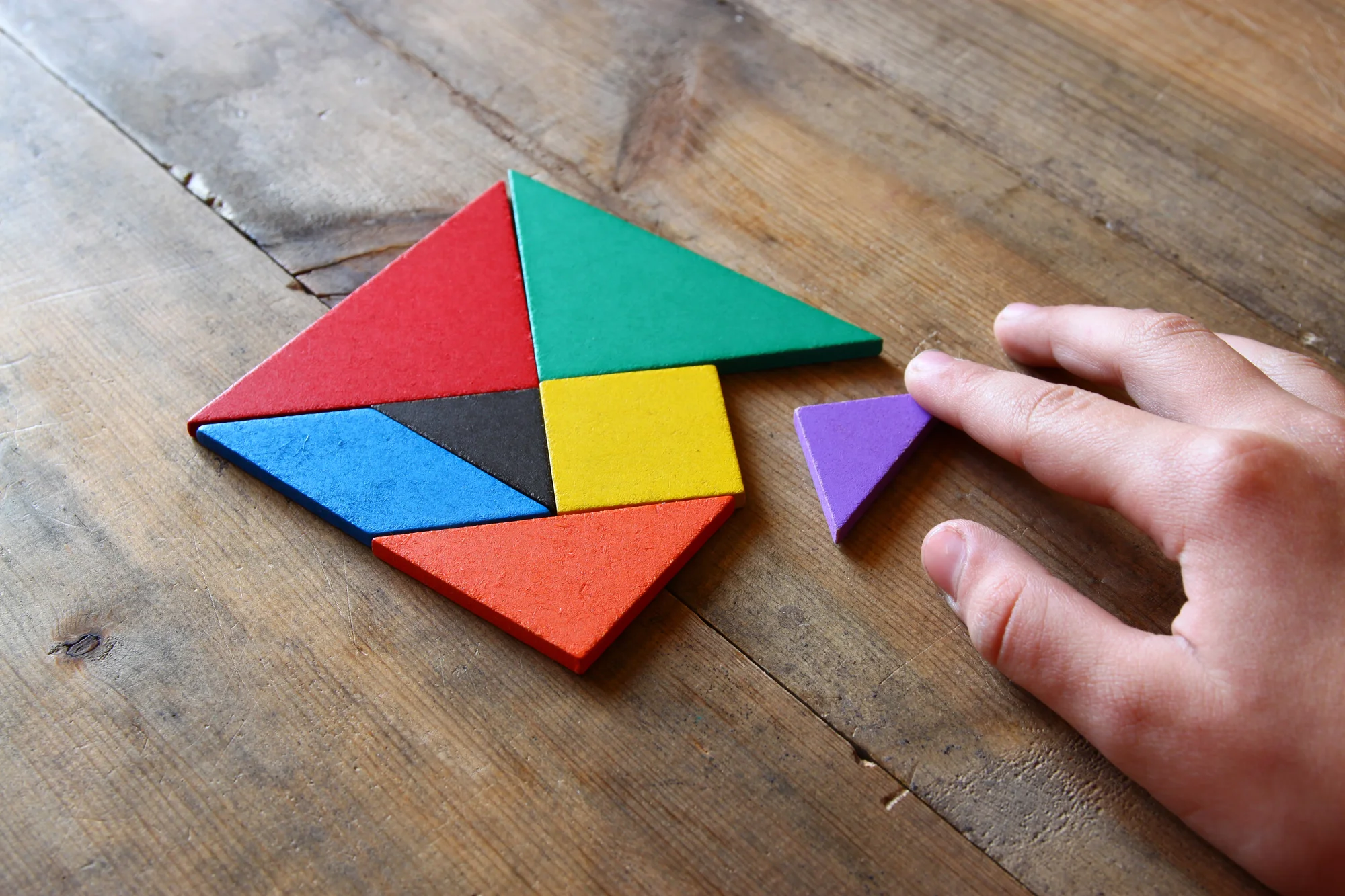
A composite figure is a shape made by combining two or more simpler shapes. It might look like a rectangle attached to a triangle, a square with a section cut out, or a floor plan that mixes several shapes at once.
Composite figures show up in middle school geometry curricula and state assessments. But, perhaps more interestingly, we see them frequently beyond the classroom in garden layouts, athletic fields, and building facades.
Today, we’ll be looking at how to calculate the area of a composite figure. To be able to do so, we first need to recognize the simpler shapes inside it and calculate their total area step by step. Let’s start with a quick review of the shapes we will use most.

A Quick Review of 4 Simple Shapes and Their Area Formulas
The name “composite” tells us that the figures we are talking about today are a composition of other figures. So, before we can find the area of a composite figure, we first need to refresh our knowledge of how to find the area of the shapes that build it.
Here are the area formulas we will use today:
a. Area of Rectangles and Squares
Think about a rectangular rug. To find how much floor space it covers, we can picture the rug as rows of square units.
If the rug is 4 feet long and 3 feet wide, we can imagine 3 rows with 4 square feet in each row. That gives us 12 square feet total.
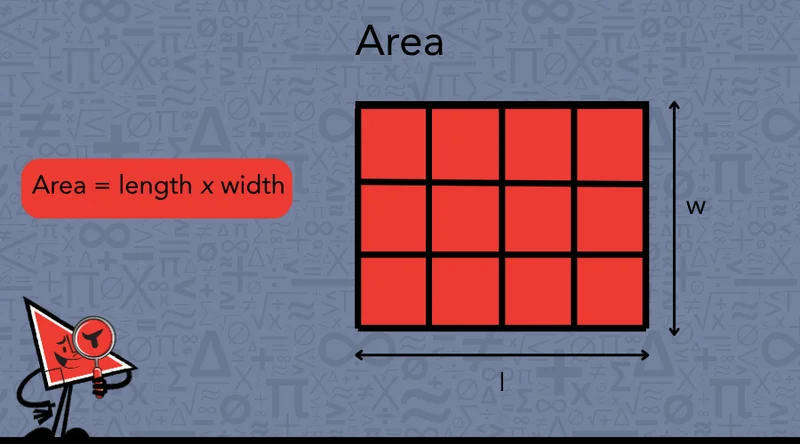
That is exactly what the area formula captures: length times width. We can write the rectangle area formula like this:
A = l × w
A square is a special rectangle with four equal sides, so we can use the same area idea and multiply one side length by the other side length to find its area.
b. Area of Parallelograms
A parallelogram looks a little like a rectangle that has been pushed to one side. It still has two pairs of parallel sides, but its corners are not right angles like in a rectangle or a square.
That slant can make the area seem harder to find. But we can picture cutting off the small triangular part on one side and sliding it to the other side. Once we do that, the parallelogram becomes a rectangle.
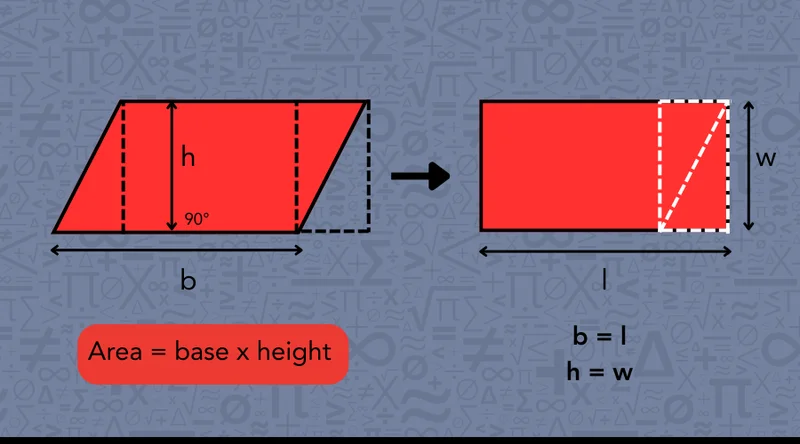
The amount of space did not change. We only rearranged the shape. The base of the parallelogram becomes the length of the rectangle, and the height becomes the rectangle’s width. That is why we find the area of a parallelogram by multiplying base times height:
Area = base × height
Make sure that you use the perpendicular line as the height, the straight distance from the base to the opposite side, measured at a right angle. Be careful not to use the slanted side instead. Even though it may be longer, it does not show the parallelogram’s true height.
📕 You May Also Like: Types of Angles: Acute, Right, Obtuse & Straight Explained
c. Area of Triangles
Imagine a triangular napkin. To find how much area it covers, we can compare it to a parallelogram with the same base and height.
If we make a second copy of the triangle and fit the two triangles together, they form a parallelogram. Say the triangle has a base of 6 inches and a height of 4 inches, then the parallelogram has an area of:
6 × 4 = 24 square inches
Since the parallelogram is made from two identical triangles, each triangle covers half of that area:
24 ÷ 2 = 12 square inches
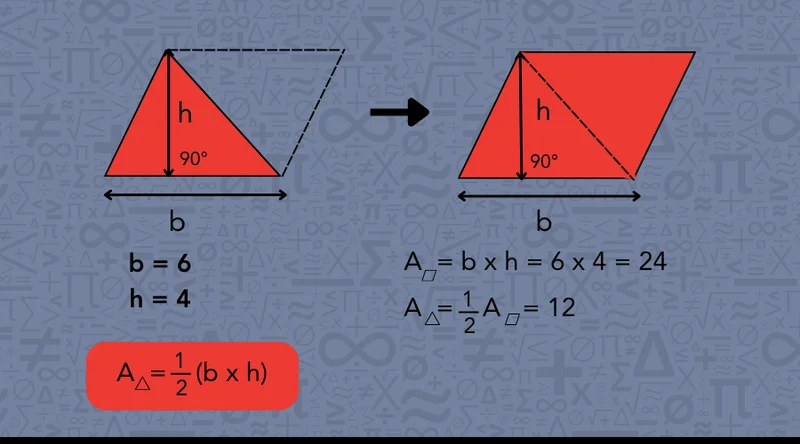
That is why we find a triangle’s area by multiplying the base by the height, then taking half of the result.
A = (b × h) ÷ 2 or A = \(\frac{1}{2} (b × h)\)
📕 You May Also Like: How to Calculate the Area of Triangles - A Beginner's Guide
d. Area of Trapezoids
A trapezoid is a two-dimensional shape with four sides, exactly two of which are parallel sides, called bases. Usually, one base is longer, and the other is shorter.
To understand the area formula, we can connect it to a shape we already know, a parallelogram.
Imagine making a second copy of the trapezoid, flipping it, and placing it next to the first one. Together, the two trapezoids form a parallelogram. The height stays the same. The base of the new parallelogram is the two trapezoid bases added together: b₁ + b₂. So the area of the parallelogram is: (b₁ + b₂) × h
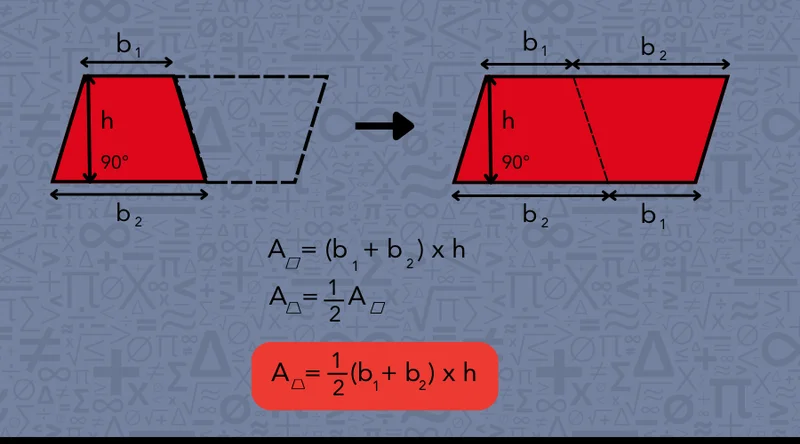
But that parallelogram is made from two identical trapezoids. That means one trapezoid has half of that area. So the area of a trapezoid is:
A = \(\frac{1}{2}\) (b₁ + b₂) × h
📕 You May Also Like: Perimeter vs. Area: How to Teach the Difference at Home
How to Find the Area of a Composite Figure Using the Decomposition Method
To find the area of a composite figure, we break it into familiar shapes that are easier to measure. This process is called decomposition. After that, we need to decide how those parts relate to the whole figure.
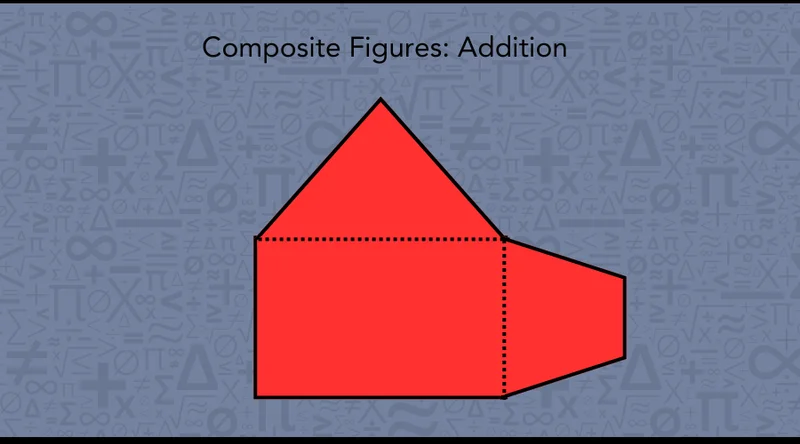
a. When smaller shapes are joined together, making one larger figure, we find the area of each part and add them together. The total area is the sum of all the components.
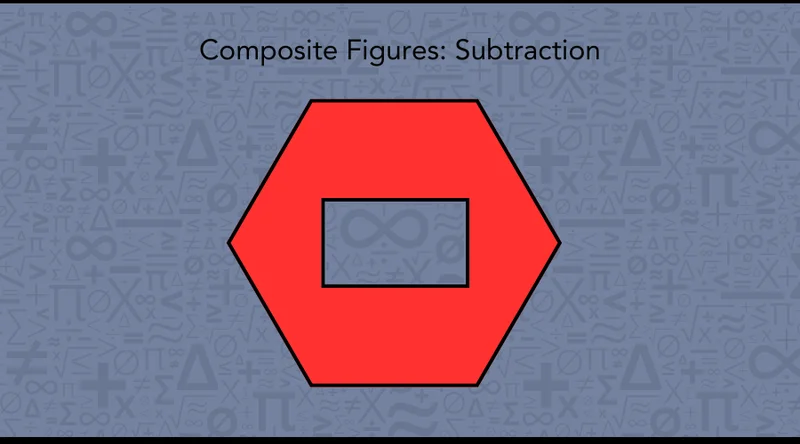
b. If one shape has been removed from another, we start with the larger shape and subtract the area of the part that’s been removed.
Here is a simple way to approach a composite figure:
-
Identify the familiar shapes in a composite figure. Are there rectangles, triangles, trapezoids, or other shapes we know?
-
Find the dividing lines: Some lines may already be drawn. Other times, we may need to imagine where a line could split the figure into simpler parts.
-
Decide whether to add or subtract: Are the smaller shapes joined together to make one larger figure? Or has one shape been cut out of another?
-
Find each area separately: Use the correct formula for each smaller shape. Use the measurements given in the figure, and look carefully for any missing measurements you can figure out from the shape.
-
Combine the areas: Use your decision from Step 3 to add or subtract the areas and find the total area of the composite figure.
The add-or-subtract decision is often the most important part. We may know the formulas, but still make mistakes if we do not first decide how the smaller shapes fit together. That is why we break multi-step geometry problems into clear parts before calculating.
📕 You May Also Like: What Is Area in Math? A Complete & Kid-Friendly Guide
When to Add Areas in Composite Figures (Solved Example)
Let’s start with this problem.
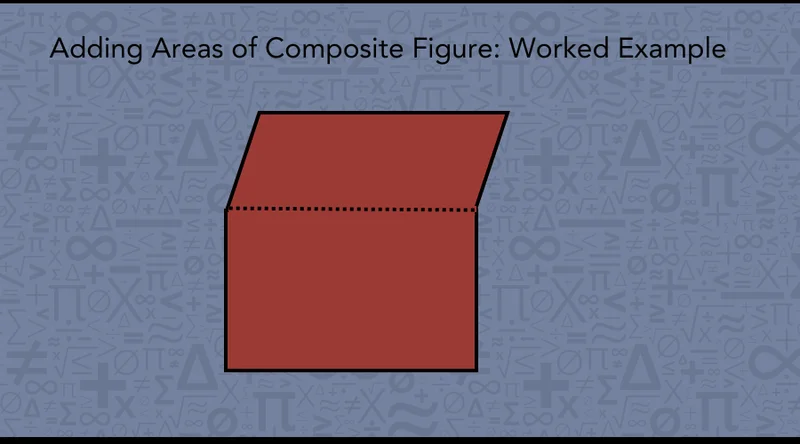
Imagine we’re helping a landscaper calculate the area of a garden bed. The shape is made of a rectangle and a parallelogram joined along one edge. The rectangle is 8 m long and 5 m wide. The parallelogram attached to it has a base of 8 m and a height of 2 m.
We can show it like this:
Step 1: Identify familiar shapes in a composite figure.
This garden bed is made from one rectangle and one parallelogram.
Step 2: Decide whether to add or subtract.
The smaller rectangle is attached to the larger rectangle. Nothing is cut out or missing, so we add the two areas.
Step 3: Find the area of each recognized shape.
The larger rectangle is 8 meters by 5 meters: 8 × 5 = 40 m²
Area of the parallelogram is 8 × 2 = 16 m²
Step 4: Add the areas together.
Now we combine both parts of the garden: 40 + 16 = 56 m²
The total area of the garden is 56 m².
When to Subtract Areas in Composite Figures (Solved Example)
Now, we’ll look at a composite figure where one part has been removed.
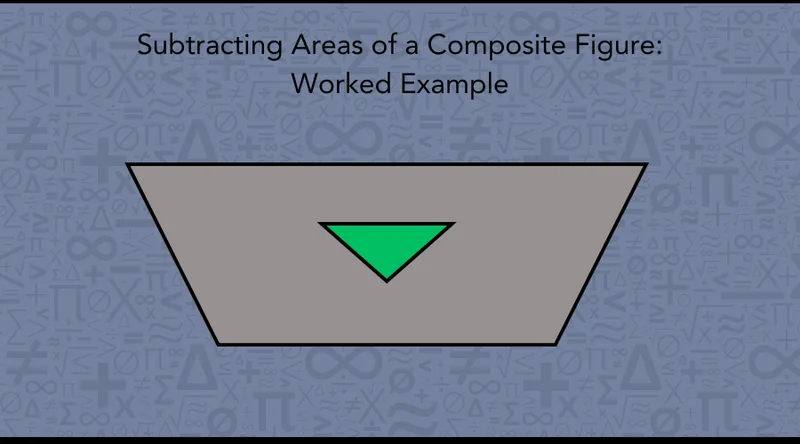
A school is redesigning a trapezoidal courtyard. A triangular flower bed will be planted in its center, and the rest of the space will be paved. The courtyard has parallel sides of 12 m and 8 m and a height of 6 m. The triangular flower bed has a base of 4 m and a height of 3 m. What is the area of the courtyard that will be paved?
The visual can help us understand the problem more clearly:
Step 1: Identify the familiar shapes in the composite figure.
The paved part of the courtyard is a trapezoid with a triangular notch cut into its center. We can recognize a trapezoid and a triangle.
Step 2: Decide whether to add or subtract.
To calculate the area of the courtyard that will be paved, we need to subtract the area of a triangle from the area of a trapezoid.
Step 3: Find each area separately.
First, find the area of trapezoid: \(\frac{1}{2}\) × (12 + 8) × 6 = \(\frac{1}{2}\) × 20 × 6 = 60 m²
Then find the area triangle: \(\frac{1}{2}\) × 4 × 3 = 6 m²
Step 4: Subtract the missing area.
Now subtract the triangle from the trapezoid: 60 − 6 = 54 m²
The area of the courtyard that will be paved is 54 m².
On state assessments like the Georgia Milestones, the subtraction setup often appears as a shaded-region problem. The shaded area is what remains after the unshaded part is removed from the larger shape.
After we recognize that setup, we use the same method. Find the area of the whole shape, find the area of the part removed, and subtract.
📕 You May Also Like: Math Test Prep: How to Help Your Child Succeed on Exams
Your Turn! Solve Area Problems With Composite Figures Yourself
For the area problems below, identify component shapes and decide whether we need to add or subtract to find the area of the composite figure. Check your answers at the bottom of the page.
Problem 1
A school is designing a new courtyard. The layout combines a rectangle 10 m long and 6 m wide with a trapezoid attached to one of the shorter ends. The trapezoid has parallel sides of 6 m and 4 m, and a height of 3 m. What is the total area of the courtyard?
Problem 2
A rectangular welcome sign is 5 m wide and 3 m tall. A triangular section with a base of 2 m and a height of 1.5 m has been cut from one corner for a design feature. What is the remaining area of the sign?

Mathnasium tutors use personalized learning plans and interactive teaching techniques to help students master math skills, including finding the area of composite figures.
How Mathnasium Helps Students Master Composite Figures and Geometry Concepts
Mathnasium is a math-only learning center dedicated to helping K–12 students of all skill levels excel in math. We work with students to build a solid understanding of math and geometry concepts, like composite figures, instead of just memorizing formulas.
Our specially trained tutors use a proprietary teaching approach, the Mathnasium Method™, to meet students where they are and guide them towards math mastery, step by step.
Every student begins with a diagnostic assessment that identifies their current skills, knowledge gaps, and how they think about math, including the geometry, measurement, and number sense skills behind area problems.
From there, we create a personalized learning plan that targets exactly what each student needs. Our tutors deliver face-to-face instruction using a mix of verbal, visual, written, tactile, and mental techniques, so each concept lands clearly.
Sessions are also designed to be fun, with game-based activities, earned rewards, and consistent celebration of progress, so confidence grows alongside understanding.
The impact is clear in the results:
-
94% of parents report improvement in their child’s math skills and understanding
-
93% of parents report an improved attitude toward math after attending Mathnasium
-
90% of students saw improvement in their school grades
With over 1,100 learning centers across North America, there is likely a Mathnasium close to you.
Families across Johns Creek, Duluth, and Suwanee trust Mathnasium of North Johns Creek to help students build the geometry foundations and problem-solving skills they need for school, Georgia Milestones, and the math courses ahead.
If your child is working through composite figures, area, or any geometry concept and needs more targeted support, our team is ready to help.
📅 Schedule a Free Assessment at Mathnasium of North Johns Creek
Not near Johns Creek, Duluth, or Suwanee?
📍 Find a Mathnasium Learning Center Near You
Psst! Check Your Answers Here
Here are the answers to the practice problems above.
Problem 1 Solution — Adding Areas
Shapes identified: one rectangle and one trapezoid joined together.
Area of rectangle: 10 × 6 = 60 m²
Area of a trapezoid: \(\frac{1}{2}\) × (6 + 4) × 3 = 15 m²
Total area: 60 + 15 = 75 m²
Problem 2 Solution — Subtracting Areas
Shapes identified: one rectangle with one triangle removed.
Area of rectangle: 5 × 3 = 15 m²
Area of triangle: \(\frac{1}{2}\) × 2 × 1.5 = 1.5 m²
Remaining area: 15 − 1.5 = 13.5 m²
How did you do?


 (770) 273-9697