
 (973) 577-8005











Why Personalized Learning Plans Are the Key to Academic Success
Jul 20, 2026 | Kendall Park

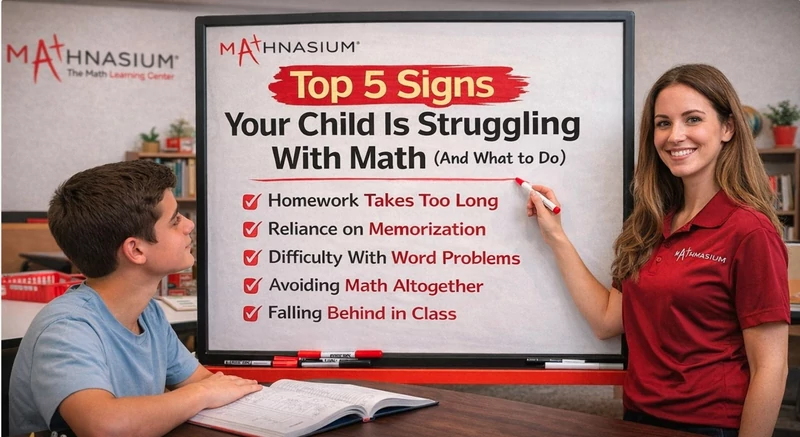
Many parents don’t realize their child is struggling with math until grades start to drop. But math challenges often begin much earlier — and recognizing the signs early can make a big difference. Families across Kendall Park, South Brunswick, Monmouth Junction, Dayton, Franklin Park, Somerset, North Brunswick, Kingston, and Princeton frequently notice subtle signs before report cards reflect a problem.
Here are the top 5 signs your child may be struggling with math — and what you can do about it.
1. Homework Takes Too Long (or Ends in Frustration)
If your child spends excessive time on math homework, gets easily frustrated, or avoids it altogether, it’s often a sign they don’t fully understand the concepts.
You may notice Re-reading the same problem multiple times, Asking for help frequently, Giving up quickly
What to Do: Instead of pushing through frustration, focus on understanding where the confusion begins. Seeking homework help at Mathnasium of Kendall Park NJ can provide structured support and reduce stress at home. You can start by booking an assessment Here
2. Reliance on Memorization Instead of Understanding
Some children can perform calculations but don’t understand why they’re doing them.
For example Memorizing multiplication without understanding groups, Solving problems by guessing patterns, Struggling when questions are asked differently
What to Do: Encourage conceptual learning. A strong math tutor at Mathnasium of Kendall Park NJ can help rebuild number sense and ensure your child understands the “why” behind each step. But you may need to evaluate the situation first. You can start by booking an assessment Here
3. Difficulty With Word Problems
Word problems require both reading comprehension and math reasoning — making them one of the first areas where struggles appear.
Signs include: Not knowing where to start, Ignoring key information, Guessing answers.
What to Do: Practice breaking problems into smaller steps. The learning plan and problem-solving support at Mathnasium of Kendall Park can help students build confidence in tackling these questions. You can start by booking an assessment Here
4. Avoiding Math Altogether
If your child, Says “I hate math” or Avoids math homework or Becomes anxious during tests…it may be more than just a dislike — it could be math anxiety.
What to Do: Create a positive learning environment. Explore Mathnasium of Kendall Park for a tour, share your thoughts with the staff. You can start by booking an assessment Here
5. Falling Behind in Class
Sometimes the signs show up in, Lower test scores, Missed concepts, Difficulty keeping up with lessons only because math builds on itself, missing one concept can make future lessons harder.
What to Do: Try to address gaps early. Working with Mathnasium of Kendall Park to identify what concepts your child needs to work on. You can start by booking an assessment Here
Many parents hear this during high school:
“I studied a lot… but I still failed the math test.”
Students who once did well suddenly struggle in Algebra I, Geometry, Algebra II, Pre-Calculus, and Calculus. At the same time, pressure rises because of SAT prep, ACT prep, PSAT preparation, high school placement tests, and college entrance exams. The issue usually isn’t effort — it’s that math changes in high school.
Before high school, math is repetition and steps.
In high school, it becomes reasoning and problem-solving.
Students must now:
Explain answers
Solve multi-step equations
Apply concepts to unfamiliar questions
Understand why formulas work
This is why SAT math and ACT math sections feel difficult — they measure thinking, not memorization.
Algebra is the turning point for both school and standardized testing.
It affects:
Future math classes
Chemistry and physics
PSAT scores and scholarships
SAT math scores
ACT math scores
College placement exams
High school math tests — especially SAT/ACT practice tests — require:
Critical thinking
Pattern recognition
Time management
Combining multiple concepts
Students must solve problems quickly and confidently under time pressure. Without confidence, scores drop even after studying.
Many teens prepare by:
Re-reading notes
Watching videos
Repeating homework problems
But real improvement comes from guided math tutoring and structured test prep with feedback.
Otherwise students unknowingly practice mistakes, which leads to frustration and lower scores.
Math struggles often become test anxiety, especially before the PSAT, SAT, and ACT.
Students begin to think:
“I’m just not a math person.”
This leads to:
Freezing during exams
Avoiding advanced math
Lower SAT/ACT scores
Avoiding STEM pathways
The issue is rarely ability — it’s missing foundations.
Students improve when they receive:
Foundational skills rebuilt (especially Algebra)
Personalized learning pace
Confidence before speed
Consistent SAT/ACT math practice and strategy coaching
When understanding improves, grades — and test scores — follow.
Consider support if your teen has:
Falling math grades after middle school
Stress or frustration during homework
Low PSAT, SAT, or ACT math scores
Strong reading but weak math performance
Difficulty in Algebra, Geometry, or Pre-Calculus
Starting early (freshman or sophomore year) makes college entrance exam prep much easier.
Families around Rockaway, Wharton, Dover, Mine Hill, and Morris County often notice students don’t need more homework — they need math taught in a way that makes sense.
At Mathnasium of Rockaway, students receive personalized math learning plans, homework help, and structured SAT, ACT, and PSAT test prep. The goal is to rebuild math foundations, improve confidence, and reduce test anxiety so students can perform better both in school and on college entrance exams.
High school math stress isn’t laziness and it isn’t intelligence.
It’s almost always a foundation and preparation issue.
With strong math foundations and consistent test prep support, students regain confidence, improve school performance, and approach SAT and ACT exams with far less stress — and often much higher scores.
Students don’t just improve their grades — they begin to feel confident in math again.
If you are still not sure Book a Free Assessment or a Trial Sessions if you are located near Kendall Park, South Brunswick, Monmouth Junction, Dayton, Franklin Park, Somerset, North Brunswick, Kingston, and Princeton.
These sessions help Identify learning gaps, Understand your child’s needs and Experience our teaching approach firsthand
The Bottom Line
Math struggles don’t appear overnight — they build over time so, The earlier you recognize the signs, the easier it is to help your child regain confidence and succeed.

