South Westminster
10443 Town Center Drive
, Suite D-103
Westminster, CO 80021
Westminster, CO 80021
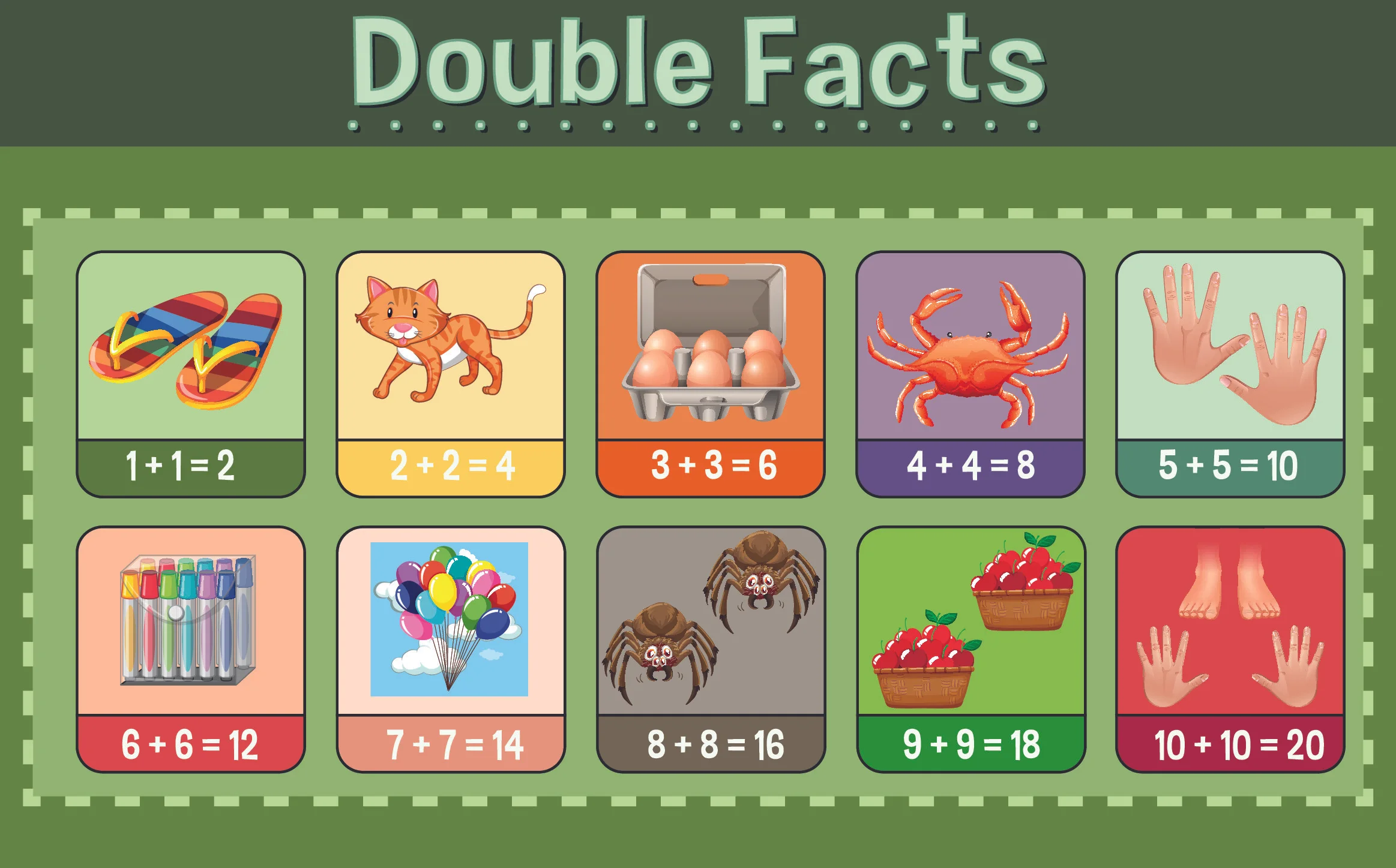
At Mathnasium, we like to say that double facts are like building blocks for numerical fluency. Once a student understands and remembers these, they gain speed, confidence, and a strong base for solving a wide range of math problems.
That’s why today we’re shedding light on this essential concept.
Read on to find out what double facts are, how they show up in math and help us solve problems, get practice exercises using double facts, and explore answers to questions students often ask about them.

A double fact is a math fact where the same number is added to itself. In other words, it’s when you double a number by adding it twice.
In practice, this would be:
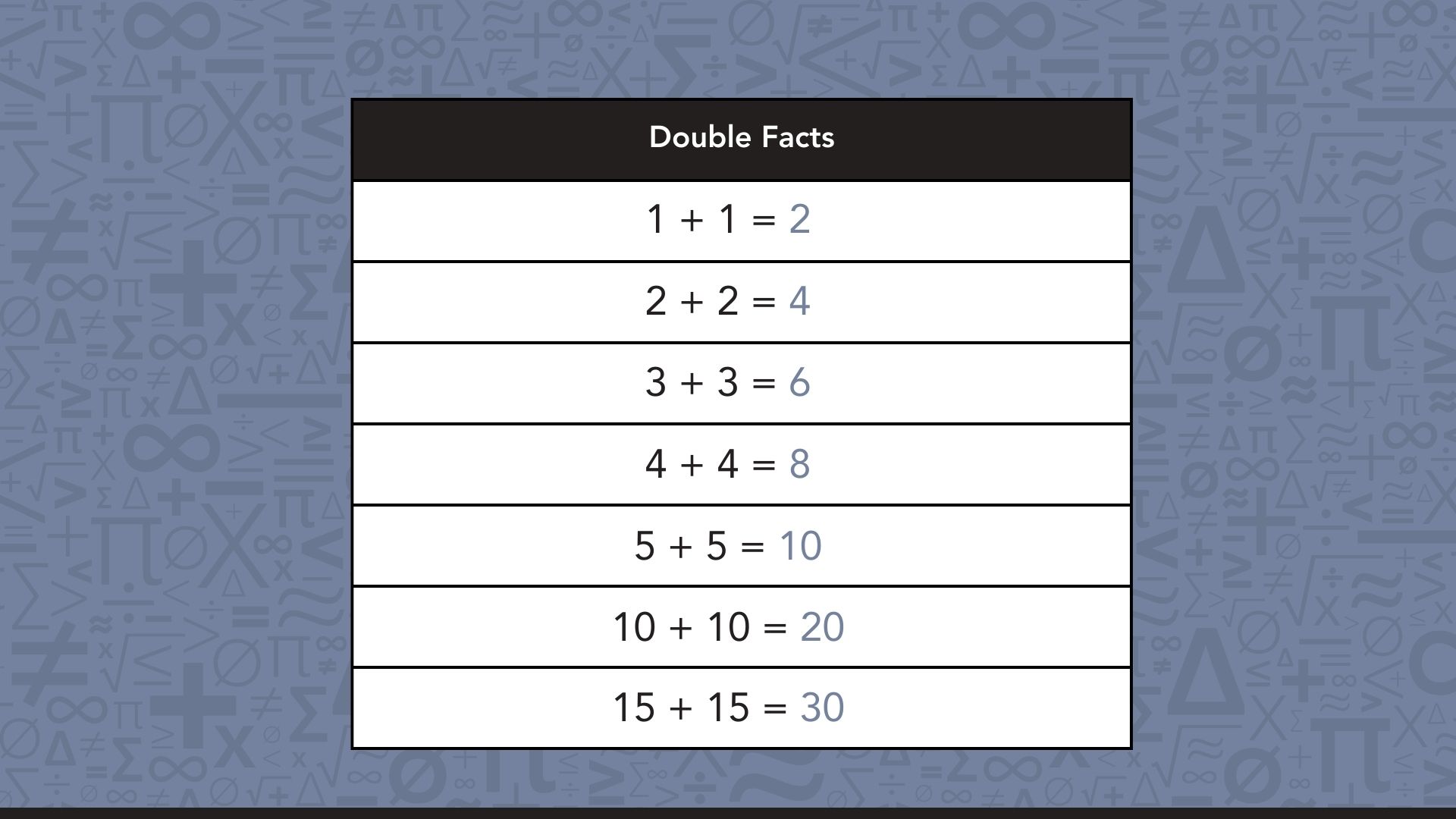
Let’s ask ourselves: What do we notice about all the answers here?
The sum is always an even number when we double a whole number. Every double fact leads to an even result, no matter what whole number you start with.
When we work with early learners and elementary students, we place special focus on double facts because:
They build fluency. Students who know double facts solve addition problems faster and with less effort.
They support subtraction. If a student knows that 8 + 8 = 16, they can quickly solve 16 − 8.
They lay the groundwork for multiplication. Doubles are a natural lead-in to 2× facts.
They reinforce number patterns. Every double fact results in an even number, helping students build number sense.
They boost confidence. Recognizing and using double facts gives students a sense of control over math problems.
📕You May Also Like: Building Confidence in Math: How Tutoring Can Help
Double facts do more than help with simple addition. Once students become familiar with them, they begin to see how doubling connects to other parts of math. These connections help students solve more complex problems with confidence, often by using what they already know.
Let’s look at a few ways double facts show up in math and help us think through bigger ideas.
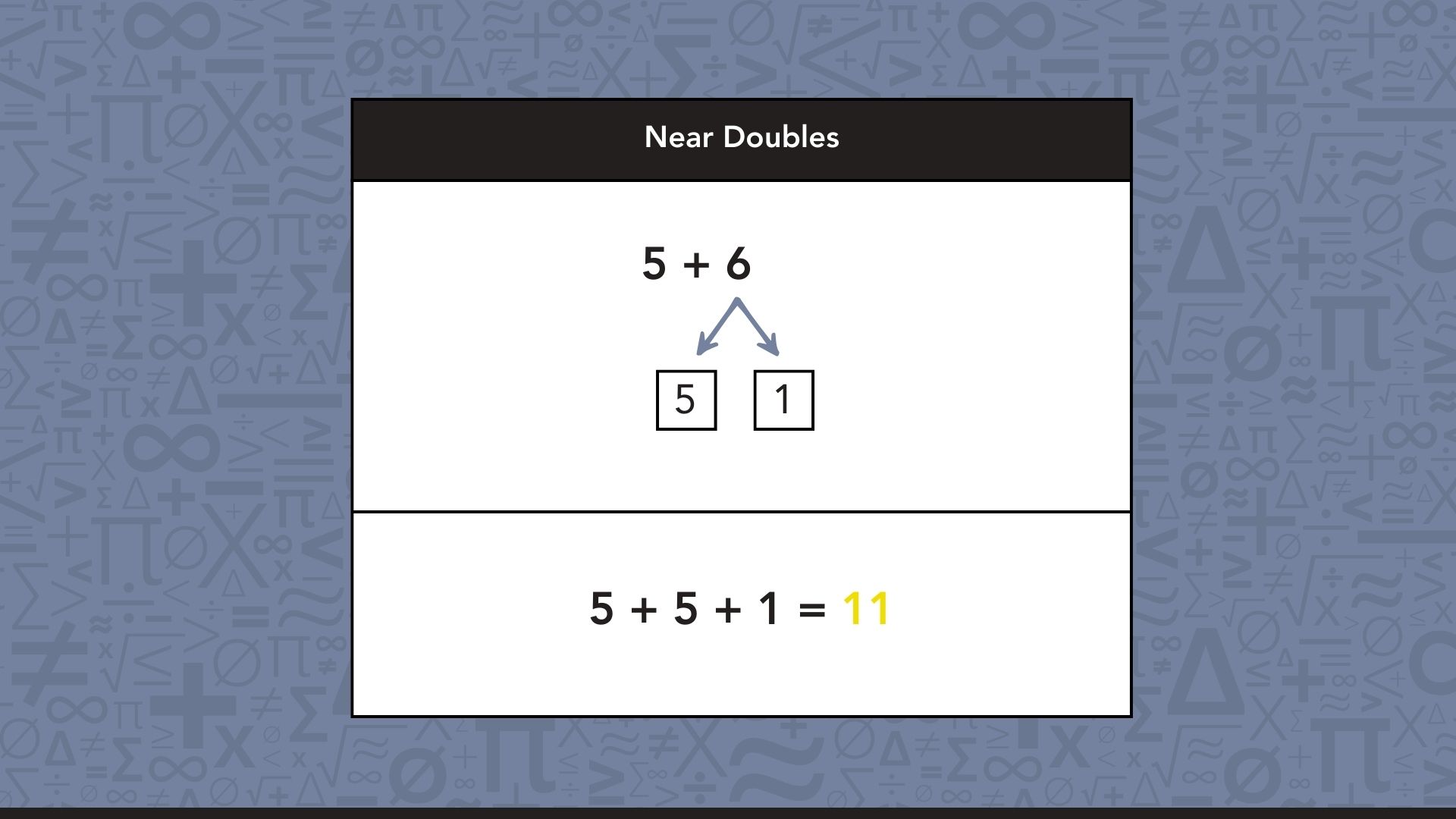
A near double is a math fact that’s just one more or one less than a double fact.
Instead of solving 6 + 7 from scratch, a student might think:
I know 6 + 6 is 12, and 7 is one more than 6… so 6 + 7 must be 13.
In other words (or in numbers):
6 + 7 = (6 + 6) + 1 = 13
This strategy works both ways:
4 + 5 = (4 + 4) + 1 = 9
8 + 7 = (8 + 8) − 1 = 15
As students get the hang of near doubles, they stop relying on counting and start thinking about how numbers relate to each other, and that’s a big step toward better number sense.
Double facts are a great starting point for understanding multiplication.
When a student knows that 7 + 7 = 14, they’ve already seen what 2 × 7 means in action: adding 7 two times.
That’s what multiplication is: repeated addition.
So instead of learning multiplication from scratch, students who are confident with double facts can build on what they already know.
They start to recognize patterns like:
4 + 4 = 8 2 × 4 = 8
9 + 9 = 18 2 × 9 = 18
20 + 20 = 40 2 x 20 = 40
and so on…
The greatest common factor, or GCF, is the biggest number that can divide two numbers evenly. It’s the largest number they both share as a factor.
Here’s where double facts come in:
When one number is a double of the other, the smaller number will always be the greatest common factor.
For example:
GCF of 6 and 12 = 6
GCF of 5 and 10 = 5
GCF of 9 and 18 = 9
Why does this work?
Because if you double a number, the original number is built into it—it’s one of its factors. So when students understand double facts, they’re already set up to make sense of how factors work.
📕You May Also Like: What Is the Greatest Common Factor? A Step-by-Step Guide
The least common multiple, or LCM, is the smallest number that two numbers can both divide into evenly.
When one number is a double of the other, the LCM is always the larger number (the double).
For example:
LCM of 6 and 12 = 12
LCM of 4 and 8 = 8
LCM of 10 and 20 = 20
That’s because the double already contains the smaller number as a factor. So it’s the first number they both share in the multiplication table.
📕You May Also Like: What Is the Least Common Multiple? A Kid-Friendly Guide
The more we practice double facts, the more comfortable we become with recognizing patterns and solving math quickly.
Try these double fact challenges to see how fast and clearly you can think through them.
When you’re finished, check your answers at the bottom of the guide.
Use a nearby double to solve each:
13 + 14 =
26 + 25 =
31 + 30 =
Emma jumped rope 15 times. Her friend jumped double that. How many times did her friend jump?
What is the greatest common factor of the following number pairs?
24 and 48
16 and 32
50 and 100
Find the least common multiple of:
18 and 36
12 and 24
14 and 28
When we teach double facts at Mathnasium, students often ask great questions that show they’re thinking deeply about math. We've gathered some of the most common ones below, along with clear, simple answers to help clear up any confusion.
Yes! Double facts aren’t just for addition; they help with subtraction too.
If you know that 8 + 8 = 16, then you also know that 16 − 8 = 8.
That’s because subtraction is the opposite of addition. So when one number is a double of another, you can work backward just as easily.
When you double 0, you still get 0.
That’s because 0 + 0 = 0, and 2 × 0 = 0.
Doubling zero is a great reminder that adding or multiplying nothing still gives you nothing!
Double facts are usually taught in early grades, but they're useful far beyond that.
Students continue to use them when learning multiplication, mental math, and even topics like factors, multiples, and algebra later on.
So while they start simple, double facts stay helpful as math gets more complex.
If you're working with whole numbers, then yes: doubling any whole number always gives an even number. That’s because you’re adding the same number to itself, and pairs always total to an even result.
Examples:
3 + 3 = 6
7 + 7 = 14
10 + 10 = 20
But if you double a decimal, the result is not always even. For example:
1.5 + 1.5 = 3
2.5 + 2.5 = 5
So while doubling whole numbers always gives an even result, the same rule doesn’t apply when you’re working with fractions or decimals.
Yes, negative numbers can be doubled too! Doubling a negative number means adding it to itself, just like with positives.
For example:
−4 + (−4) = −8
So we say that the double of −4 is −8
This works the same way with multiplication:
2 × (−4) = −8
At Mathnasium, we help students transform how they think and feel about math.
Whether a child comes in needing support with basic number facts or advanced algebra, our goal is the same: to build deep understanding, lasting confidence, and real problem-solving ability. Students stop relying on memorized steps and start seeing why math works.
This shift is possible because of our proprietary teaching approach, the Mathnasium Method™. It begins with a diagnostic assessment designed to identify your child’s skill level, knowledge gaps, and how they learn best, whether they respond more to hands-on learning, visuals, or discussion.
Using those insights, we create a learning plan built just for them.
During sessions, our specially trained tutors deliver face-to-face instruction in a caring and fun group environment. They follow the learning plan but adapt in real time to meet each student’s needs.
When a student struggles with a concept, we break it down into manageable steps and guide them to the “aha” moment, not just the right answer.
We use a mix of teaching techniques—verbal, visual, mental, tactile, and written—so students can explore math from different angles and discover what truly makes sense to them.
Our sessions often feel more like collaborative challenges than traditional lessons. Our caring, specially trained tutors mix in hands-on activities, strategic games, and motivating rewards to keep learning fun and focused. Every breakthrough, whether big or small, gets celebrated.
And the results speak for themselves:
94% of parents report improvement in their child’s math skills and understanding
93% of parents report a more positive attitude toward math
90% of students see improvement in their school grades
Find a center near you and schedule a free assessment to get started!
If you’ve given our double facts challenges a go, check your answers below.
a) 13 + 14 can be solved two ways:
Using 13 as the base: (13 + 13) + 1 = 26 + 1 = 27
Using 14 as the base: (14 + 14) − 1 = 28 − 1 = 27
b) 26 + 25 can be solved two ways:
Using 25 as the base: (25 + 25) + 1 = 50 + 1 = 51
Using 26 as the base: (26 + 26) − 1 = 52 − 1 = 51
c) 31 + 30 can be solved two ways:
Using 30 as the base: (30 + 30) + 1 = 60 + 1 = 61
Using 31 as the base: (31 + 31) − 1 = 62 − 1 = 61
The answer is 30 times.
a) 24 and 48 -> 48 is double 24 -> GCF = 24
b) 16 and 32 -> 32 is double 16 -> GCF = 16
c) 50 and 100 -> 100 is double 50 -> GCF = 50
Find the least common multiple of:
a) 18 and 36 -> 36 is a multiple of 18 -> LCM = 36
b) 12 and 24 -> 24 is a multiple of 12 -> LCM = 24
c) 14 and 28 -> 28 is a multiple of 14 -> LCM = 28
Mathnasium of South Westminster is a math-only learning center for K-12 students in Westminster, CO. Trusted by over a million parents, Mathnasium uses personalized learning plans and the proprietary Mathnasium Method™ to help students catch up, keep up, and get ahead on their math journey.
Our specially trained tutors deliver face-to-face instruction in a supportive and fun small-group environment, working with students both in center and online to develop a deep understanding of math, build confidence, and improve academic performance.
Schedule Free Assessment
 (720) 524-4533
 (720) 524-4533