Domain and range usually come up for the first time in Algebra 1 or 2, right around when functions are introduced. Most students get through the initial explanation, follow along in class, and then find themselves stuck the moment they have to apply the concepts on their own.
That's completely normal. Domain and range describe something specific about how functions work, and the idea needs a little time to settle before it starts to feel intuitive.
Our Mathnasium tutors put together this guide to explain what domain and range actually mean, how to find them from a graph and equation, and mistakes to watch out for along the way.

What Are Domain and Range?
The domain of a function is the complete set of input values it can accept, every x-value that is allowed to go in. The range of a function is the complete set of output values it can produce, every y-value that can come out.
Think of a function as a vending machine. The domain is every valid button you can press. If a button is out of order, it gets excluded from the domain. The range is the complete set of snacks that can actually drop into the dispenser when you push those valid buttons. Some items might not be loaded.
Knowing which inputs are allowed and which outputs are possible is exactly what the domain and range are asking you to figure out.
How to Find Domain and Range From a Graph
Reading domain and range from a graph is the most visual approach, and for most students, it's the easiest place to start. We’ll show you how to do it, step by step.
Step 1: Look left to right
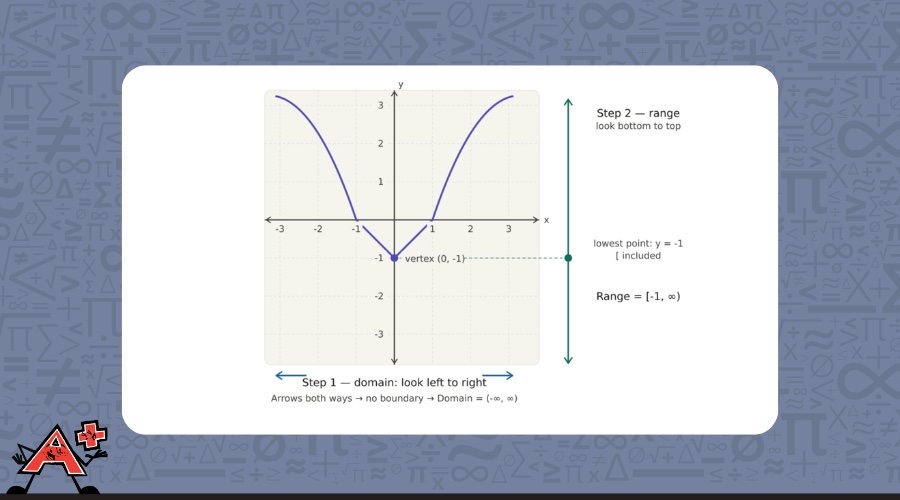
Run your eyes across the graph horizontally, from the leftmost point to the rightmost point.
Every x-value the graph covers is part of the domain.
Ask yourself: where does the graph start and where does it end horizontally?
If it stretches in both directions with arrows, it has no left or right boundary, and the domain goes to infinity in both directions.
Step 2: Look from bottom to top
Now run your eyes vertically, from the lowest point the graph reaches to the highest. Every y-value the graph covers is part of the range.
Ask yourself:
If the graph goes up or down without end, the range is unbounded in that direction.
Step 3: Write your answer in interval notation
Once you know what the domain and range cover, write them using interval notation.
Two rules to remember:
-
Square brackets [ ] mean the endpoint is included
-
Parentheses ( ) mean the endpoint is not included
-
Infinity always gets a parenthesis; you can never actually reach it, so it's never included
So if the domain covers all x-values from -3 onwards, including -3, you write [-3, ∞).
If the range goes up to but doesn't include 7, you write (-∞, 7).
Step 4: Watch the arrows
If the graph has arrows at either end, the function continues beyond what's visible on the page.
Follow where the arrows point; if they go left, the domain extends to negative infinity. If they go right, it extends to positive infinity. The same logic applies vertically for range.
Keep in mind that if an arrow points diagonally (like down and to the left), it is moving toward negative infinity for both the domain and the range.
Step 5: Check for anything missing
Before you write your answer, scan the graph for three things:
-
Holes: a single point shown as an open circle. The x-value at that point is excluded from the domain, and its corresponding y-value is excluded from the range.
-
Gaps: a section where the graph simply doesn't exist. Any x-values or y-values in that gap are excluded.
-
Asymptotes: Invisible (or dashed) boundary lines that the graph approaches but never touches. If a graph flattens out along a horizontal line or shoots vertically along a vertical line, those boundary values must be excluded using parentheses ( ).
A quick example to put it all together
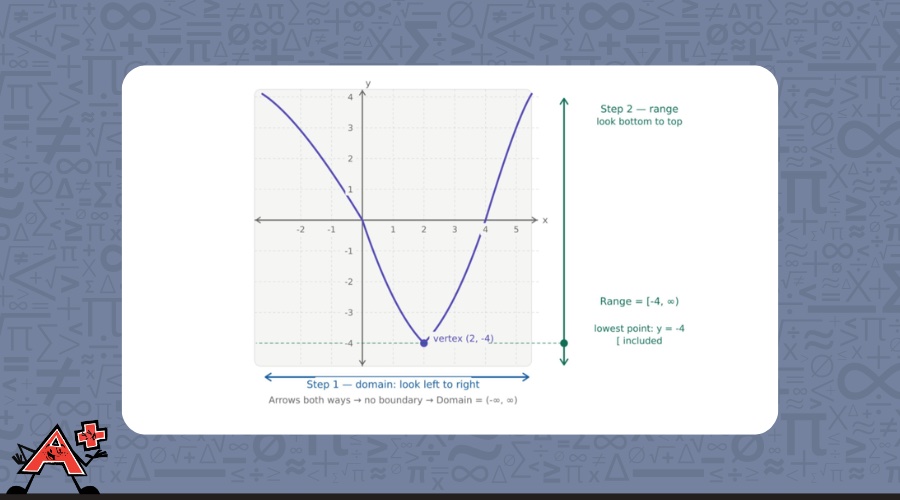
Picture a parabola opening upward with its vertex sitting at the point (2, -4).
Running your eyes left to right, the graph stretches in both directions with no boundary; the domain is (-∞, ∞).
Running your eyes bottom to top, the lowest point is -4 at the vertex, and the graph goes upward from there without end; range is [-4, ∞).
Notice the square bracket at -4: the vertex is an actual point on the graph, so that value is included.

When there's no graph in front of you, the equation itself tells you everything you need to know.
How to Find Domain and Range From an Equation
When there's no graph in front of you, you find the domain and range algebraically, by analyzing the equation itself.
Let's walk through it together.
Step 1: Look for a fraction
If the equation has a denominator, set it equal to zero and solve.
Whatever value of x makes the denominator zero is undefined; division by zero doesn't exist, so that value gets excluded from the domain.
For example, take f(x) = \(\Large\frac{1}{(x-3)}\)
Set the denominator equal to zero: x - 3 = 0, so x = 3. That means x = 3 is excluded.
The domain is every real number except 3, written as (-∞, 3) ∪ (3, ∞). The ∪ symbol just means "and also”; you're combining two separate intervals into one domain.
Step 2: Look for a square root
If the equation has a square root, the expression inside it cannot be negative; you can't take the square root of a negative number and get a real answer.
Set the expression inside the square root greater than or equal to zero and solve.
The values of x that satisfy that condition make up your domain.
For example, take f(x) = \(\sqrt{(x-5)}\).
Set up the inequality: x - 5 ≥ 0, so x ≥ 5.
That means only x-values of 5 and above are allowed. The domain is [5, ∞).
Square bracket at 5 because x = 5 is included, which makes the expression equal to zero, which is fine.
Step 3: If you don't see either, the domain is all real numbers
If the equation consists only of basic polynomials (like x2 or 2x + 1), there's nothing that can break it, there's nothing that can break it. Every x-value works as a valid input. The domain is (-∞, ∞)
Step 4: Find the range
The range is harder to read from an equation than the domain, because instead of asking what goes in, you're asking what can come out. The approach depends on the type of function you're working with.
Here are the ones you'll encounter most often in Algebra 2 and Pre-Calculus:
-
Linear functions like f(x) = 2x + 1 produce every possible y-value as x changes.
Range is (-∞, ∞).
-
Quadratic functions like f(x) = x² have a vertex that represents either a minimum or a maximum output. An upward parabola has a minimum; the range starts at the y-value of the vertex and goes up. A downward parabola has a maximum; the range goes down from the vertex. For f(x) = x², the vertex is at (0,0), so the range is [0, ∞).
-
Rational functions like f(x) = \(\Large\frac{1}{x}\) can produce any y-value except zero; the graph gets infinitely close to zero but never actually reaches it. Range is (-∞, 0) ∪ (0, ∞).
-
Square root functions like f(x) = \(\sqrt{x}\) can only produce outputs of zero or above, since square roots never give negative results. Range is [0, ∞).
Step 5: Put it all together
Let’s use f(x) = \(\sqrt{\Large\frac{(x+2)}{(x-1)}}\) as an example, a function that combines both a square root and a fraction.
Work through it in order:
First, the square root: x + 2 ≥ 0, so x ≥ -2.
Then, the fraction: x - 1 ≠ 0, so x ≠ 1.
Put both restrictions together: x must be greater than or equal to -2, but x cannot equal 1. The domain is [-2, 1) ∪ (1, ∞).
That's the complete process.
For most algebraic functions, it comes down to two primary restrictions:
-
Is there a fraction?
-
Is there a square root?
Answer those, and you’ll find the domain.
📕 You May Also Like: 5 Gaps that Derail High School Math Success (+How to Fix Them)
What to Watch Out For When Finding Domain and Range
Before you finalize any domain or range answer, run through these checks.
Each one corresponds to a mistake that's easy to make and just as easy to avoid once you know to look for it.
A. Is there a fraction anywhere in this function?
Look carefully. Sometimes the fraction is nested inside a larger expression and is easy to miss.
If there is one, you haven't finished until you've set the denominator equal to zero and excluded that value.
B. Is there a square root?
A function can have both a fraction and a square root at the same time, like the example we used above.
Check for each one separately, then combine the restrictions. Students often catch one and miss the other.
C. Check your interval notation before you move on.
Two things to verify: the smaller number always comes first, and infinity always gets a parenthesis.
A bracket next to an infinity symbol is one of the most common notation errors we see in Algebra 2, and it's an easy point to lose on a test for something that has nothing to do with whether you actually understood the math.
📕 You May Also Like: 21 Best Math Jokes to Make Learning FUN (by Grade)

Mathnasium tutors work with high school students to build math confidence that carries them through Algebra 2, Pre-Calculus, and beyond.
How Mathnasium Can Help Your High Schooler Thrive in Math
Mathnasium is a math-only learning center helping students of all skill levels catch up, keep up, and get ahead in math.
For high school students working through concepts like domain and range, that means targeted support that goes beyond getting through the next test.
Behind everything we do is the Mathnasium Method™, our proprietary teaching approach. Unlike a one-size-fits-all curriculum, it adapts to each student and the pace at which they are ready to move forward.
Each student begins with a diagnostic assessment that pinpoints exactly where their understanding is solid and where gaps exist. From those insights, we build a personalized learning plan tailored to their needs.
Our specially trained tutors then deliver face-to-face instruction guided by that plan, using verbal, visual, mental, tactile, and written techniques so that every concept makes sense, not just for the next quiz, but for everything that builds on it.
We also give students space to work through problems independently before reconnecting with their tutor to check their reasoning. That back-and-forth develops the critical thinking and problem-solving habits that carry students through high school, college, and beyond.
And the results speak for themselves:
-
94% of parents report an improvement in their child's math skills and understanding
-
93% of parents report their child's improved attitude toward math after attending Mathnasium
-
90% of students saw an improvement in their school grades
We operate over 1,100 learning centers across North America, bringing our proven approach close to your community.
Families in and near Steiner Ranch are in good hands with our local team at Mathnasium of Steiner Ranch, with experience helping students build lasting confidence in math.
If you'd like to see your child grow into a confident math thinker, we'd love to be part of that journey.
📅 Schedule a Free Assessment at Mathnasium of Steiner Ranch
Not located near Austin?
📍 Find a Mathnasium Learning Center Near You


 (512) 246-6284