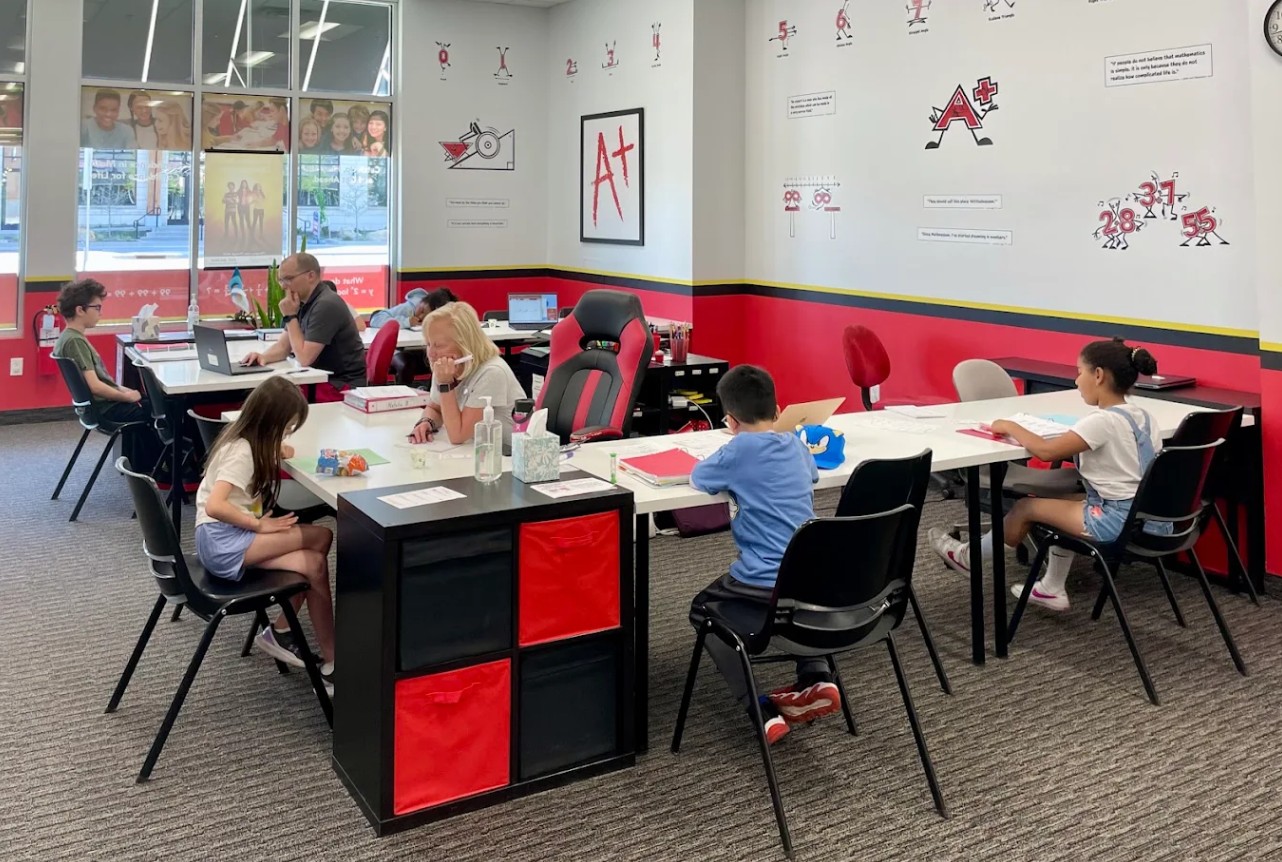
If you have ever sat beside a child doing homework and heard "How much longer?" for the fifth time on a single page, you are in good company. I hear it at the center too, and I have a small habit that changes how those moments go.
The trick: hand the question back as a math problem
When a student asks how much time is left in their session, I don't just announce the answer. I tell them when the session ends and let them work out the rest. It sounds like this: "Your session is over at 4:30pm. What time is it now?"
Then they look at the clock, do the subtraction, and tell me. That's it. No lecture, no fuss.
I do this because I want to avoid learned helplessness. If a child can always get the answer by asking an adult, they have little reason to look for it themselves. Kids who ask multiple times per page are often not worried about the time at all. It's a way to check in, take a breather, or find out whether the work will ever end. When I turn it into a quick calculation, the question stops being a pause from math and becomes a bit of math.
Why it works
- It's real math. Elapsed time is a skill kids use constantly, and it's rarely practiced in a way that feels useful.
- It builds independence. The child finds the answer on their own, and that feels good.
- It slows the interruptions. Once a student knows they will have to figure it out, they often keep working a little longer before asking again.
Ideas you can use at home in St. Louis Park and beyond
You don't need any special materials. Try these during homework time, whether your child is at St. Louis Park Middle School, Susan Lindgren Elementary, or a school in Hopkins or Edina:
- Give the end time, not the minutes left. "We're finishing at 5:15. What time is it now? How long do we have?"
- Use an analog clock when you can. Counting forward from the minute hand to the finish time builds number sense in a different way than reading a digital display.
- Ask for a plan. "You have 20 minutes and four problems. About how long can you spend on each?" This brings in division and estimation.
- Let them check, then confirm. If your child's answer is off, ask them to count up from now to the end time together with you. The goal is understanding, not a quick correction.
- Apply it to everyday life. Practice with the drive to Hopkins, the time until dinner, or how long until practice starts. Short, low-pressure questions add up.
Keep it light. If your child is truly frustrated, it's fine to just answer. The aim is to turn a habit into a chance to practice, not to make homework harder.
A small moment, a bigger habit
This is the kind of thing that happens behind the scenes at our center. Much of what we do is small moments like this one, where a student learns that they can figure things out on their own.
If you'd like to see how this looks in person, we'd love to meet you and your child. Stop by Mathnasium of St. Louis Park at 5610 W 36th St, or book a free consultation, and we'll talk about where your child is and where they want to go. Follow along with us on Instagram at @slp_edina, too.


 (612) 568-4590