Mental math can make everyday number problems easier to handle. For example, you might use it while splitting a bill with friends, keeping score in a game, or calculating a total price of several items in a shop. In moments like these, quick strategies help us find answers faster without reaching for a calculator.
Today, we’ll learn how to multiply by 5, 9, 11, and 25 using quick mental math tricks. Each of them builds on shortcuts for multiplying by 10 and 100, numbers we already know how to handle fast.

How to Multiply by 5 in Seconds
To multiply a number by 5, we multiply it by 10 first by shifting each digit one place to the left, and filling the ones place with zero. Then cut the result in half.
Let's see how it works. 5 is half of 10. So we can multiply a number by 10 and then cut the answer in half and land on the same result as multiplying by 5 directly. We're just taking the easier route to get there.
Take 8 × 5. We know 8 × 10 = 80. Cut that in half, and we get 40, so 8 × 5 = 40.
Now, we'll try this strategy with a two-digit number: 14 × 5.
-
Step 1: Multiply the number by 10. We can do this with a shortcut for multiplying by 10: 14 × 10 = 140.
-
Step 2: Cut the result in half. Half of 140 is 70, so 14 × 5 = 70.
We can check our answer by breaking 14 apart:
-
14 = 10 + 4
-
10 × 5 = 50
-
4 × 5 = 20
-
50 + 20 = 70
Two steps, any number. Hard to beat that.
📕 You May Also Like: 7 Multiplication Games to Help Kids Master Times Tables
How To Multiply by 9 Quickly
To multiply a number by 9 in a second, we multiply it by 10 first, then subtract the original number once.
Here's the idea behind it. Think of 6 × 9 as 9 groups of 6. 10 groups of 6 would be 60, so we can find 9 groups of 6 by taking away one group of 6: 60 − 6 = 54. That means: 6 × 9 = 54.
Let's work through this with a slightly bigger number: 12 × 9.
-
Step 1: Multiply the number by 10. 12 × 10 = 120.
-
Step 2: Subtract the original number. 120 − 12 = 108, so 12 × 9 = 108.
Now, we’ll check our work by breaking 12 apart:
-
12 = 10 + 2
-
10 × 9 = 90
-
2 × 9 = 18
-
90 + 18 = 108
Pretty neat, right?
📕 You May Also Like: 7 Strategies to Move Beyond Memorization in Multiplication
How to Multiply by 11 Easily
To multiply a number by 11 easily, we multiply it by 10 first, then add the original number back one more time.
We’ll see how it works through this example: 7 × 11. We know 7 × 10 = 70. Add one more 7, and we get 77, so 7 × 11 = 77. This method becomes especially helpful when we work with three-digit numbers or larger.
Let's size up to a three-digit number: 135 × 11.
-
Step 1: Multiply the number by 10. 135 × 10 = 1350.
-
Step 2: Add the original number. 1350 + 135 = 1485, so 135 × 11 = 1485.
We need to see if we calculated correctly by breaking 135 apart:
-
135 = 100 + 30 + 5
-
100 × 11 = 1100
-
30 × 11 = 330
-
5 × 11 = 55
-
1100 + 330 + 55 = 1485
Kind of satisfying, isn't it?
A Faster Trick for Two-Digit Numbers Times 11
If the number we're multiplying by 11 has two digits, there's an even quicker way. We split the digits apart, add them together, and drop the sum in the middle.
We are still using the same idea: multiply by 10, then add the original number. Only this time, we break the number into place-value parts first, so the addition is easier to handle.
Take any two-digit number, say 43. When we multiply it by 11, we multiply by 10 and add the number once more:
43 × 11 = 430 + 43
Now we’ll line those up by place value:
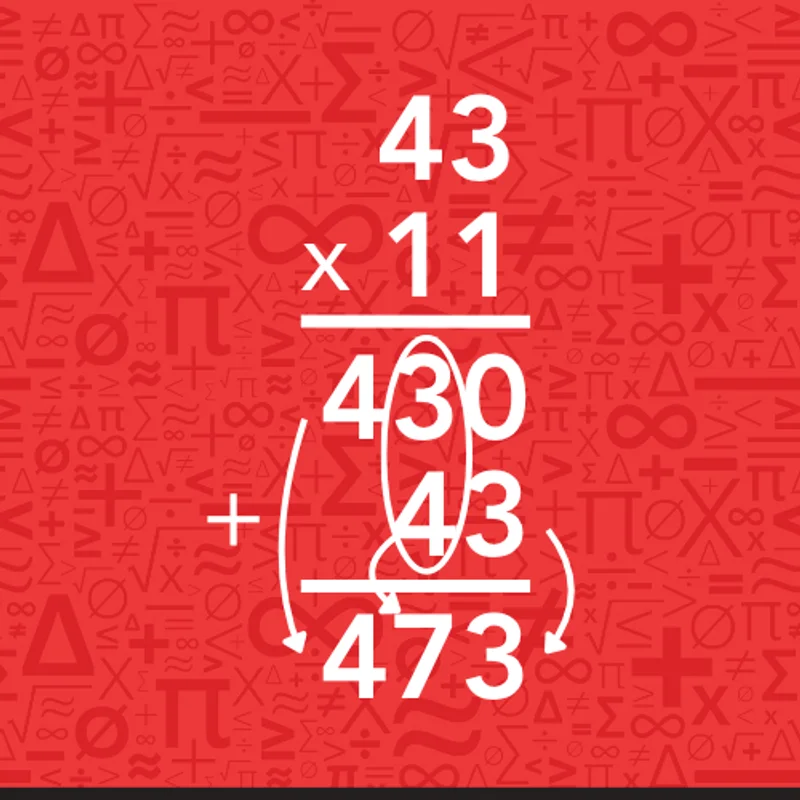
Look at what's happening column by column:
-
The ones digit (3) stays put.
-
The hundreds digit (4) stays put.
-
The only column that changes is the tens place, where 3 (from 430) and 4 (from 43) add together to make 7. That middle digit is always the sum of the original two digits because that's the one spot where the numbers overlap.
Let's see it in action with 52 × 11.
-
Step 1: Split the number you multiply by 11 into its two digits. 52 becomes 5_2.
-
Step 2: Add the digits of the number multiplied by 11. 5 + 2 = 7.
-
Step 3: Place the sum between the original digits. 5_7_2, so 52 × 11 = 572.
But what happens when the two digits add up to 10 or more, like in 78 × 11? We write the ones digit of the sum in the middle and carry the 1 to the hundreds place, just like in regular addition. See how it goes:
-
Step 1: Split the digits: 7 _ 8.
-
Step 2: Add the two digits together: 7 + 8 = 15.
-
Step 3: Put the ones digit of the sum in the middle. Since the ones digit of 15 is 5, we place 5 between 7 and 8,
-
Step 4: Carry the 1 to the hundreds place. We add the carried 1 to the first digit: 7 + 1 = 8. So the final answer is 78 x 11 = 858.
📕 You May Also Like: How to Multiply 1 and 2-Digit Numbers — Carrying Method
How to Multiply by 25 in an Instant
To multiply a number by 25, we divide it by 4 and then multiply the result by 100. We multiply by 100 by shifting the digits two places left and filling the tens and ones places with 0.
What lies underneath this strategy? 25 fits into 100 exactly 4 times, which means dividing a number by 4 and then multiplying it by 100 gives us the same result as multiplying by 25 straight away.
We’ll try multiplying 12 by 25, using this strategy:
-
Step 1. Divide the number by 4: 12 ÷ 4 = 3,
-
Step 2: Multiply the result by 100. We multiply 3 by 100 and land on 300, so 12 × 25 = 300.
Let's stretch this to a bigger number: 16 × 25.
We can double-check by breaking 16 apart:
-
16 = 10 + 6
-
10 × 25 = 250
-
6 × 25 = 150
-
250 + 150 = 400
A Quick Way to Multiply Tricky Numbers by 25
When a number does not divide evenly by 4, we can still multiply by 25 without long multiplication. We just need to think of the remainder as quarters, or “25-cent” pieces. A remainder of 1 is worth 25 cents. So a number with a remainder of 1 ends in 25, with a remainder of 2 in 50, with a remainder of 3 in 75.
We’ll try multiplying 15 by 25 using this strategy:
-
Step 1: Find the closest multiple of 4 below your number. The closest multiple of 4 below 15 is 12.
-
Step 2: Divide that number by 4. We divide 12 by 4, which gives us 3. It is the first part of the answer: 3.
-
Step 3: Find the remainder. Now find out how far 15 is from 12? 15 − 12 = 3. So the remainder is 3.
-
Step 4: Think of your remainder as quarters. Each quarter is worth 25, so we multiply the remainder by 25: 3 × 25 = 75. Our number ends in 75.
-
Step 5: Put the parts together. The first part is 3, and the ending is 75. So: 15 × 25 = 375.
📕 You May Also Like: Why Kids Struggle With Multi-Digit Multiplication + Tips
Try Out the Mental Math Tricks Yourself!
Now it's your turn to put these tricks to the test. Grab a timer if you want to make it a challenge, and see how quickly you can work through each one. You can check the answers at the bottom of the page.
-
9 × 5
-
17 × 5
-
8 × 9
-
15 × 9
-
28 × 25
-
36 × 25
-
9 × 11
-
15 × 11

At Mathnasium, tutors help students build the number sense and number relationships behind mental math strategies, so calculation fluency grows from understanding.
📕 You May Also Like: What Is Grid Method Multiplication? A Step-by-Step Guide
How Mathnasium Students Build Calculation Fluency and Master Other Math Skills
As a math-only learning center, Mathnasium helps K–12 students of all skill levels excel in math.
In our work with students, we focus on helping them understand the thinking behind each math concept and skill, including mental math shortcuts. These strategies work best when children understand the number relationships underneath them.
Behind every program we offer is our proprietary teaching approach, the Mathnasium Method™. We don't just rely on rote drills but rather aim to help students truly understand what they're learning.
Each student begins their Mathnasium journey with a diagnostic assessment that helps us understand what they know, how they think, and where they are ready to grow next. From there, we create a personalized learning plan tailored to their needs.
Using these insights, we create a personalized learning plan focused on the skills the student needs most, whether that means focusing on multiplication facts, building mental math confidence, improving number sense, or preparing for more advanced topics.
Our specially trained tutors explain math in clear, everyday language, using visual, verbal, tactile, and written techniques to help students make sense of math in a clear and engaging way. Students don’t just practice procedures; they learn to look for patterns and connect math to the world around them.
We give students space to work through challenges on their own, then rejoin them to check their reasoning. Instead of just giving them the answer, we help them understand the how and why. This helps them develop problem-solving skills and critical thinking tools they can use in math and life.
Many of our activities are hands-on or game-based. We use reward systems and consistent encouragement to keep students interested in the subject. And we celebrate progress because confidence grows with every win.
The result? True, measurable progress:
-
94% of parents report improvement in their child’s math skills and understanding
-
93% of parents report a more positive attitude toward math after attending Mathnasium
-
90% of students saw improvement in their school grades
Mathnasium operates over 1,100 learning centers across the U.S., bringing our proven approach close to your community.
For families in Winter Springs, FL, and the surrounding communities, Mathnasium of Tuskawilla is a trusted local center with years of experience transforming how students think and feel about math.
If multiplication facts, mental math, or any part of your child’s math foundation feels shaky, a free diagnostic assessment is the right place to start.
📅 Schedule a Free Assessment at Mathnasium of Tuskawilla
Not near Tuskawilla?
📍 Find a Mathnasium Learning Center Near You
Check Your Answers Here!
Ready to see how you did? Here are the worked solutions to the problems above.
-
9 × 5 → 9 × 10 = 90, half of 90 = 45.
-
17 × 5 → 17 × 10 = 170, half of 170 = 85.
-
8 × 9 → 8 × 10 = 80, 80 − 8 = 72.
-
15 × 9 → 15 × 10 = 150, 150 − 15 = 135.
-
28 × 25 → 28 ÷ 4 = 7, 7 × 100 = 700.
-
36 × 25 → 36 ÷ 4 = 9, 9 × 100 = 900.
-
9 × 11 → 9 × 10 = 90, 90 + 9 = 99.
-
15 × 11 → 1 + 5 = 6, place it in the middle: 165.


 (407) 243-6284