Surface area and volume appear together in middle school geometry, and the two are easy to mix up.
They apply to the same shapes, use the same dimensions, and show up in the same unit. The difference comes down to what each one is actually measuring.
Today, Mathnasium tutors break down what each measurement means, how the two compare, and the situations where students most often reach for the wrong one.

What Is Surface Area?
Surface area is the total area of all the faces on a 3D shape. It measures the total outside surface of an object.
Think of wrapping a birthday present. How much wrapping paper do we need to cover every face of the box, with no gaps or overlaps? That amount is the surface area.
Each face of a 3D shape is a flat surface, and flat surfaces are measured in square units.
Think of counting how many unit squares tile each face. Surface area adds all those faces together, so the answer is always in square units:
-
square inches (in²)
-
square feet (ft²)
-
square centimeters (cm²)
So how do we calculate the total surface area of a shape? For a rectangular prism, we start by counting its faces. A rectangular prism has six faces.
They come in three pairs: top and bottom, front and back, left and right.
Each pair shares the same dimensions, so we find the area of one face in each pair and double it:
-
Top and bottom: l × w, twice → 2lw
-
Front and back: l × h, twice → 2lh
-
Left and right: w × h, twice → 2wh
Add all three pairs together, and we get the total surface area:
SA = 2lw + 2lh + 2wh
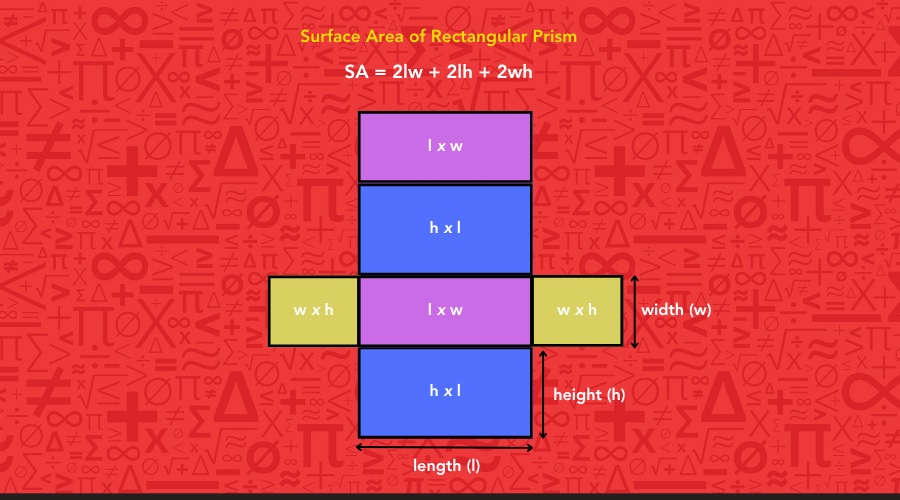
Let's put that formula to work. A rectangular prism measures 5 inches long, 3 inches wide, and 4 inches tall. How much surface area does it have?
SA = 2(5 × 3) + 2(5 × 4) + 2(3 × 4)
SA = 2(15) + 2(20) + 2(12)
SA = 30 + 40 + 24
SA = 94 in²
The total area covering the outside of that prism is 94 square inches.
📕 You May Also Like: Surface Area of a Rectangular Prism – A Kid-Friendly Guide
What Is Volume?
Volume measures how much three-dimensional space a shape occupies, in other words, how much fits inside it.
Think of a solid brick made of building blocks. The volume is the total amount of physical space that the brick occupies in the room.
Volume is always expressed in cubic units, and here is why.
Cubic units work the same way square units do, but in three dimensions. Instead of counting flat squares tiling a surface, we count small cubes making up a space. Each unit cube is 1 unit long, 1 unit wide, and 1 unit tall.
Volume tells us how many of those cubes make up the object, which is why the answer is expressed in cubic units, like:
-
cubic inches (in³)
-
cubic feet (ft³)
-
cubic centimeters (cm³)
So, how do we calculate volume for a rectangular prism?
A rectangular prism has three dimensions: length, width, and height.
To measure its volume, we look at how those three dimensions build the object together. Imagine building the prism out of equal-sized cubes.
First, we cover the bottom, which takes l × h cubes. Then we stack layer after layer upward, one for each unit of height h. So the total space the object occupies is:
V = l × w × h
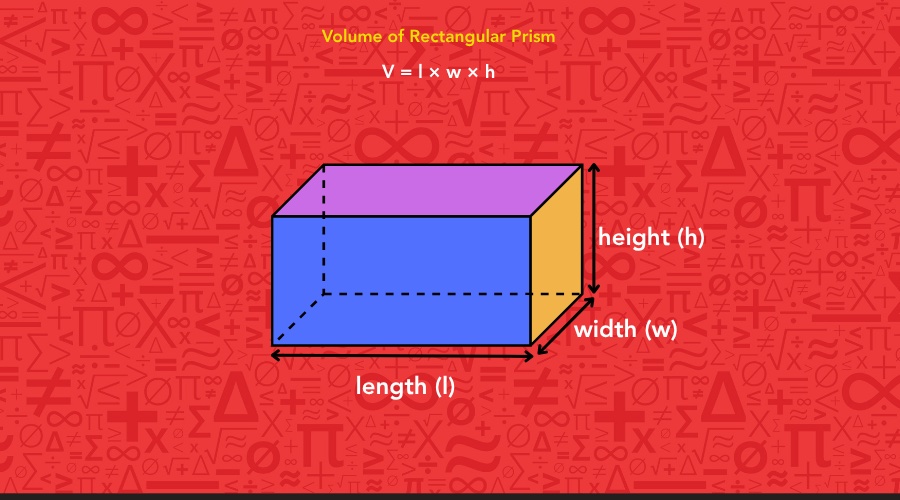
Let's use the same prism from the surface area example. It measures 5 inches long, 3 inches wide, and 4 inches tall. How much space does it hold inside?
V = 5 × 3 × 4V = 60 in³
The total space inside that prism is 60 cubic inches.
📕 You May Also Like: What Is Volume in Math? A Kid-Friendly Guide
Surface Area vs. Volume: What Is the Difference?
Surface area measures the outside of a shape. Volume measures the inside. They use the same dimensions but answer completely different questions.
We saw that with our rectangular prism. The same three dimensions gave us 94 in² for surface area and 60 in³ for volume.
Same prism, two different answers, because the two measurements are asking different things of the same shape.
The table below breaks down exactly how the two compare.
|
Feature
|
Surface Area
|
Volume |
|
What it measures
|
The outside of a shape
|
The inside of a shape
|
|
What it counts
|
The faces
|
The space the faces enclose |
|
Units
|
Always square units (cm², in², ft²)
|
Always cubic units (cm³, in³, ft³)
|
Where Surface Area and Volume Show Up in Everyday Life
Real situations make the two concepts much easier to tell apart, particularly in word problems that skip the terms entirely.
Surface area comes up whenever we are dealing with the outside of an object.
-
A gift wrapper needs enough paper to cover every face of the box.
-
A painter needs enough paint to cover every wall, the ceiling, and the floor.
-
A manufacturer needs enough metal sheet to form the curved side and both circular ends of a tin can.
Volume comes up whenever we are dealing with what fits inside an object.
-
Filling a fish tank requires knowing how much water the tank holds.
-
A construction crew pouring concrete needs to know how much space the foundation requires.
-
A person packing for a move needs to know how much fits inside each box.
The simplest question to ask is, "Are we dealing with the outside surface or the inside space?"
That answer points directly to which measurement we need.
📕 You May Also Like: What Are Vertices, Edges, and Faces? A Complete Overview
3 Reasons Surface Area and Volume Get Mixed Up
Our tutors have noticed four places where surface area and volume most commonly get mixed up.
1. The formulas use the same dimensions
Both surface area and volume for a rectangular prism use length (l), width (w), and height (h).
Under pressure, it is easy to start with the right dimensions and reach for the wrong formula. We need to identify which measurement the problem is asking for, then select the formula.
2. Square units and cubic units look similar under pressure
The difference between in² and in³ is a single digit. A mismatch between the units and what the problem asks for points to the wrong formula.
3. Word problems don't always use "surface area" or "volume"
Word problems rarely use the terms "surface area" or "volume" directly, but the situation always points us to the right measurement:
Reading for the situation rather than scanning for keywords is what gets us to the right one.
📕 You May Also Like: 10 Geometry Concepts Students Should Master Before 10th Grade
Time for Practice: Surface Area or Volume?
Our tutors put together these challenges to check your understanding of what we have covered today. Work through each one and decide whether surface area or volume is needed.
Problem 1: A rectangular box needs to be made from cardboard. Which measurement determines how much cardboard is needed?
Problem 2: A rectangular fish tank needs to be filled with water. Which measurement determines how much water it holds?
Problem 3: All the walls of a rectangular room need to be painted. Which measurement determines how much paint is needed?
Problem 4: A rectangular storage unit needs to be packed with boxes. Which measurement determines how much fits inside?
When you’re done with our challenges, check your answers at the bottom of the guide.

Mathnasium tutors use multi-faceted teaching techniques and real-world examples to help students tell surface area and volume apart with confidence.
How Mathnasium Helps Students Master Geometry (And Any Other Math Concept)
Mathnasium is a math-only learning center dedicated to helping K–12 students of all skill levels learn and master math.
Whether students need help telling surface area and volume apart, want to build a solid understanding of 3D shapes and measurement, or are ready for a challenge beyond their current curriculum, Mathnasium offers a personalized path forward.
That personalized path is enabled by the Mathnasium Method™, our proprietary teaching approach, designed around each student's individual learning needs and style.
We start with a diagnostic assessment, a relaxed interaction that uncovers each student's strengths and knowledge gaps. From those insights, we build a personalized learning plan tailored to their needs.
Our specially trained tutors follow that plan closely, teaching math face-to-face in a supportive and fun setting.
We use plain, everyday language to explain concepts and draw on a mix of verbal, visual, mental, tactile, and written techniques so the math makes sense.
If a concept feels challenging, we break it down into manageable parts and teach both the how and the why behind it. In time, students build their own problem-solving skills and critical thinking tools they can use in math and in life.
Fun is a core part of the Mathnasium Method™. Our sessions are often game-based; students earn rewards along the way, and we celebrate every bit of progress, so learning stays enjoyable and confidence grows with every session.
Results are real and measurable:
-
94% of parents report an improvement in their child's math skills and understanding
-
93% of parents report their child's improved attitude toward math after attending Mathnasium
-
90% of students saw an improvement in their school grades
We operate over 1,100 centers, bringing our proven approach close to your community.
For families in and around Boca Raton, FL, Mathnasium of West Boca Raton is a trusted local center with years of experience helping students build confidence in geometry and every math concept that follows.
Whether your child needs to catch up, keep up, or get ahead, our team is happy to help.
📅 Schedule a Free Diagnostic Assessment at Mathnasium of West Boca Raton
Not near West Boca?
📍 Find a Mathnasium Learning Center Near You
Pssst! Check Your Answers Here
Here is how each problem breaks down.
Problem 1: Surface area. Covering the outside of the box determines how much cardboard is needed.
Problem 2: Volume. The space inside the tank determines how much water it holds.
Problem 3: Surface area. Covering the outside of the room determines how much paint is needed.
Problem 4: Volume. The space inside the unit determines how much it fits inside.


 (561) 470-6284