The distance around a circle, equal to 2πr, where r is the radius.
Circumference is the distance all the way around the outside edge of a circle. It's the circle's version of perimeter; if you could unroll a circle's edge into a straight line, that line's length would be the circumference.
Circumference is calculated using either the radius or the diameter:
-
C = 2πr (using the radius, the distance from the center to the edge)
-
C = πd (using the diameter, the distance straight across through the center)
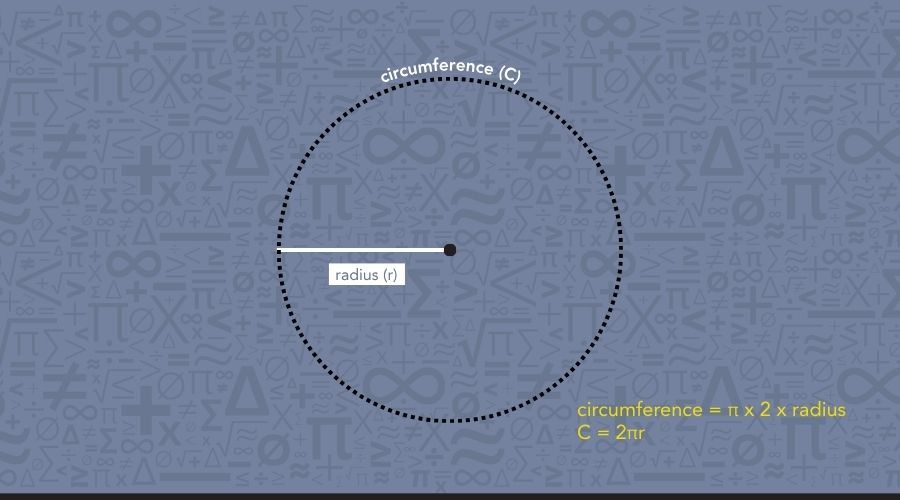
For example, a circle with a radius of 5 cm has a circumference of 2 × π × 5 = 10π ≈ 31.4 cm.
Circumference relies on pi (π), the constant ratio of a circle's circumference to its diameter, which is approximately 3.14159 for every circle, no matter its size. Because that ratio never changes, the formula works for circles of any size, from a coin to a wheel to a planet's orbit.
When Do Students Learn About Circumference?
Students build toward circumference through their earlier work with circles and their parts.
Grades 3–5 – Circles, Radius, and Diameter
Students identify the parts of a circle and measure radius and diameter directly, laying the groundwork for circumference.
Grades 5–6 – Calculating Circumference
Students learn the circumference formulas and use them to solve for the distance around circles of different sizes.
Grades 6+ – Circumference in Area, Volume, and Applications
Students apply circumference alongside area and volume formulas in geometry, and use it in real-world problems involving wheels, tracks, and circular objects.