





In geometry, the process of changing one configuration into another, including slides, rotations, and reflections.
A Euclidean transformation is a way of moving or repositioning a shape in a plane without changing its size or proportions. The shape may end up in a different location or orientation, but every length, angle, and area stays exactly the same.
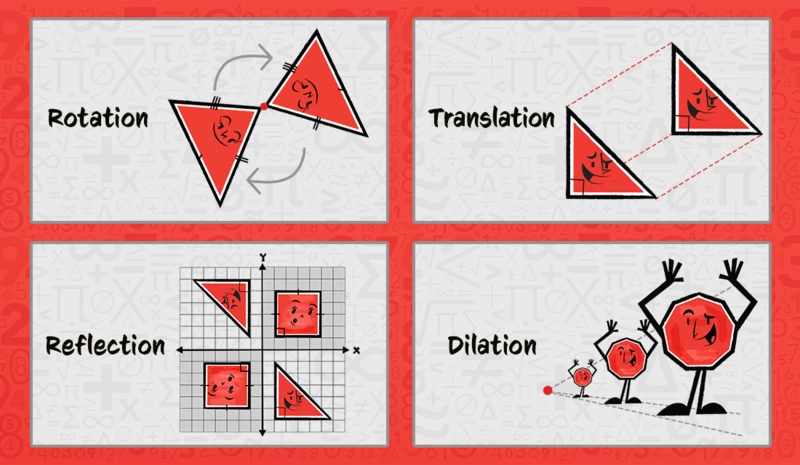
There are three main types of Euclidean transformations:
-
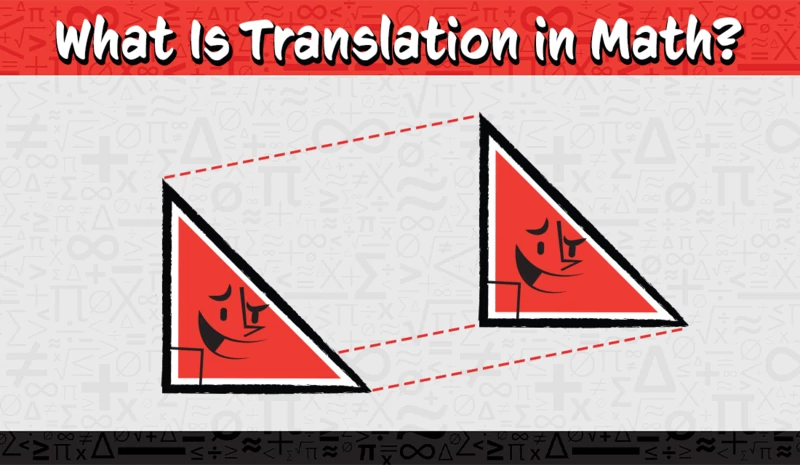
Translation (slide): the shape moves in a straight line from one position to another, without turning or flipping
-
Rotation: the shape turns around a fixed point by a given angle
-
Reflection: the shape flips across a line, producing a mirror image
A fourth transformation — dilation — changes the size of a shape and is therefore not a Euclidean transformation, since Euclidean transformations preserve all measurements.
Because size and shape are preserved, the original figure and its transformed image are always congruent. This is what makes Euclidean transformations useful in geometry: they let us move figures around the plane while keeping their properties intact.
Euclidean transformations are named after the ancient Greek mathematician Euclid, whose work on geometry established the rules of flat, two-dimensional space that students study today.
When Do Students Learn About Euclidean Transformations?
Students begin exploring transformations informally through movement and symmetry, well before the formal term is introduced.
Grades 3–5 – Slides, Flips, and Turns
Students identify and perform translations, reflections, and rotations using shapes on grids, building direct experience with the three types of Euclidean transformations.
Grades 6–8 – Transformations on the Coordinate Plane
Students apply transformations to figures on the coordinate plane, describing them using coordinates and connecting them to congruence and symmetry.
Grades 9+ – Euclidean Transformations in Formal Geometry
Students study transformations formally, using them in proofs, exploring their properties, and connecting them to broader topics in Euclidean geometry.