












What is an Improper Fraction?
A fraction whose value is greater than one whole. The numerator is necessarily greater than the denominator.
An improper fraction is a type of fraction that represents a quantity greater than one whole.
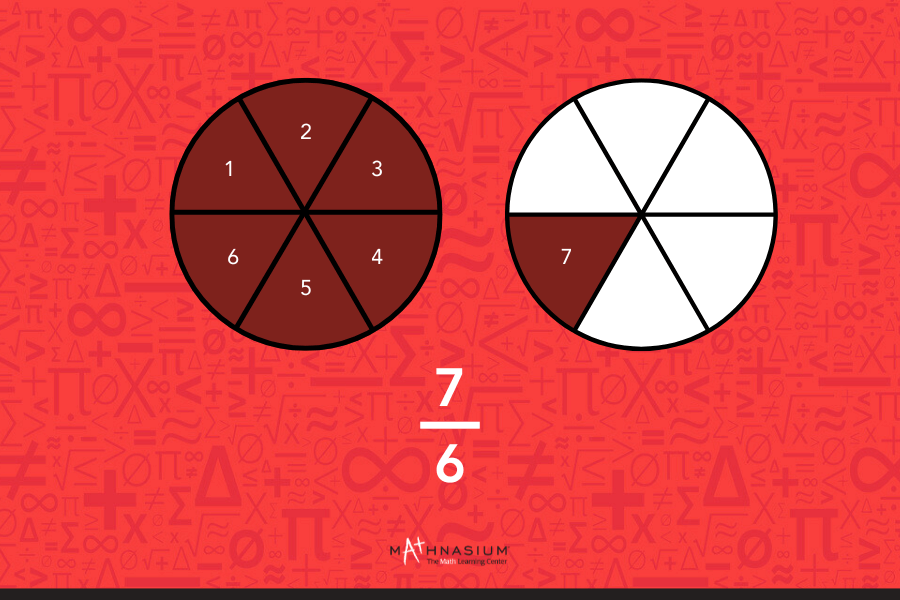
In an improper fraction, the numerator (top number) is equal to or larger than the denominator (bottom number). This tells us that we have more than one complete whole.
For example:
- \(\Large\frac{5}{4}\) means five parts out of four (more than one whole)
- \(\Large\frac{9}{8}\) means nine parts out of eight
- \(\Large\frac{7}{7}\) equals exactly one whole
Improper fractions are especially useful in math when we’re performing operations like multiplication or division with fractions. You can also convert an improper fraction into a mixed number (a whole number and a proper fraction), like \(\Large\frac{5}{4}\) = \(1\Large\frac{1}{4}\).
When Do Students Learn About Improper Fractions?
Students learn about improper fractions after they understand how proper fractions and whole numbers work together.
Grades 3–5 – Introduction to Improper Fractions
Students learn to recognize and convert between improper fractions and mixed numbers. They begin using them in real-world contexts and word problems.
Grades 6+ – Applying Improper Fractions in Math
Students use improper fractions in more complex operations such as solving equations, multiplying and dividing fractions, and algebraic expressions.

