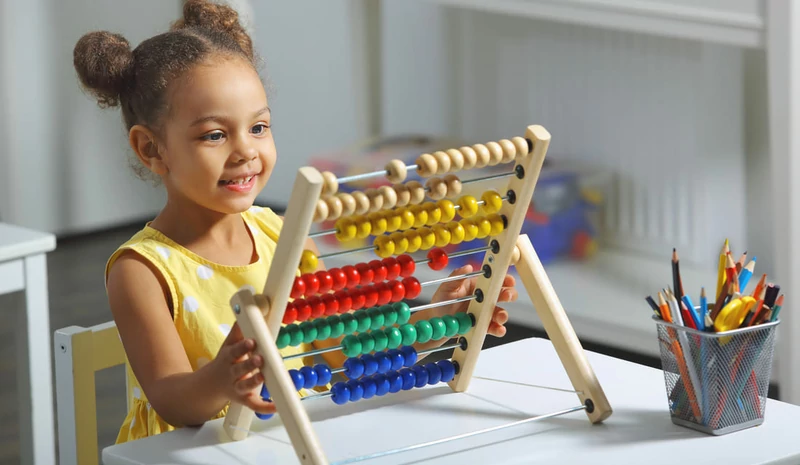












A physical object that is used to teach an abstract idea in mathematics.
In math, a manipulative is a hands-on tool that helps us understand abstract concepts. It’s a physical object we can touch, move, or build with to see how math works.
For example, students might use:
- Blocks or counters to show addition and subtraction
- Fraction tiles to understand parts of a whole
- Base-ten blocks to learn about place value
- Geometric solids to explore 3-D shapes
Manipulatives make math visual and tactile, which helps us truly understand the ideas behind the numbers.
We use manipulatives when:
- Introducing new math topics
- Exploring patterns and shapes
- Solving problems in a concrete way
When Do Students Use Manipulatives in School?
Students use manipulatives most often in elementary school, but they can also be helpful in middle and high school for exploring geometry, algebra, and other concepts.
Grades K–5 – Frequent Use of Manipulatives
Students use a wide range of manipulatives to build number sense, explore operations, and visualize fractions and geometry.
Grades 6+ – Using Manipulatives for Complex Concepts
Students may use algebra tiles, graphing tools, and geometric models to deepen their understanding of advanced math topics.