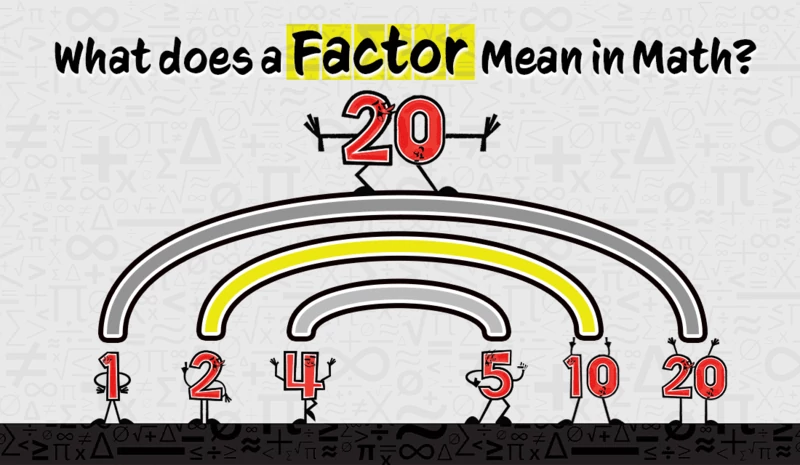






A factor of a given number that is itself prime.
A prime factor is a factor of a number that is also a prime number. To understand prime factors, it helps to recall two things:
-
A factor is any number that divides evenly into another number.
-
A prime number is a number greater than 1 that has no factors other than 1 and itself.
So a prime factor is a factor that meets both conditions: it divides the number evenly, and it is prime.
For example, the factors of 12 are 1, 2, 3, 4, 6, and 12. Of those, 2 and 3 are prime. So the prime factors of 12 are 2 and 3.
We can also express 12 as a product of its prime factors: 12 = 2 × 2 × 3. This is called the prime factorization of 12. Every whole number greater than 1 has exactly one prime factorization, which is a unique combination of prime factors that multiply together to produce it.
We use prime factors to simplify fractions, find the greatest common factor, calculate the least common multiple, and more.
When Do Students Learn About Prime Factors?
Students work toward prime factors through their study of multiplication, division, and prime numbers.
Grades 3–5 – Factors and Prime Numbers
Students learn to identify factors of whole numbers and distinguish prime numbers from composite ones, laying the groundwork for prime factorization.
Grades 6–8 – Prime Factorization and Its Applications
Students find prime factorizations using factor trees and apply them to simplify fractions, find the GCF, and calculate the LCM.
Grades 9+ – Prime Factors in Number Theory and Algebra
Students encounter prime factors in more advanced contexts, including algebraic factoring, number theory, and cryptography applications.