A relation is symmetric if, for any two elements a and b, the positions of a and b can be switched and the relation remains true.
The symmetric property tells us that the order of two elements in a relation can be flipped without changing whether the relation holds. In other words, if something is true one way, it's also true the other way.
The most familiar example is equality. If a = b, then b = a. If 5 + 3 = 8, then 8 = 5 + 3. Switching the sides doesn't change the fact that they are equal.
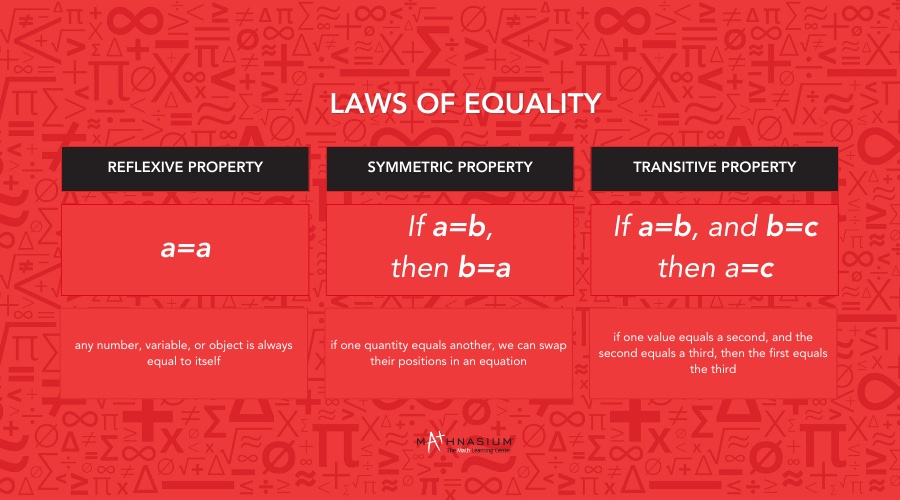
This property is one of three properties of equality, alongside the reflexive property (a = a) and the transitive property (if a = b and b = c, then a = c). Together, they describe how equality behaves consistently and predictably.
Not all relations are symmetric, though. For example, "greater than" is not symmetric: if a > b, it is not also true that b > a.
When Do Students Learn About the Symmetric Property?
Students are introduced to the symmetric property as they begin working with equations and the rules that govern equality.
Grades 3–5 – Equality Works Both Ways
Students learn that equations can be written in either direction, and that the two sides of an equal sign can be switched. This is their first encounter with symmetric thinking.
Grades 6–8 – Naming and Applying the Property
Students begin to name and apply the symmetric property formally as part of their work with equations, expressions, and algebraic reasoning.
Grades 9+ – Symmetric Property in Proofs and Advanced Algebra
Students apply the symmetric property in formal mathematical proofs and explore symmetry across more advanced topics in algebra and geometry.