












A trigonometric function of an angle which is defined as the ratio of the lengths of the leg opposite to the leg adjacent to an angle in a right triangle.
In trigonometry, the tangent (abbreviated as "tan") of an angle in a right triangle compares two sides: it’s the length of the opposite side divided by the length of the adjacent side. Tangent helps us find unknown angles or side lengths in triangles when we have enough information.
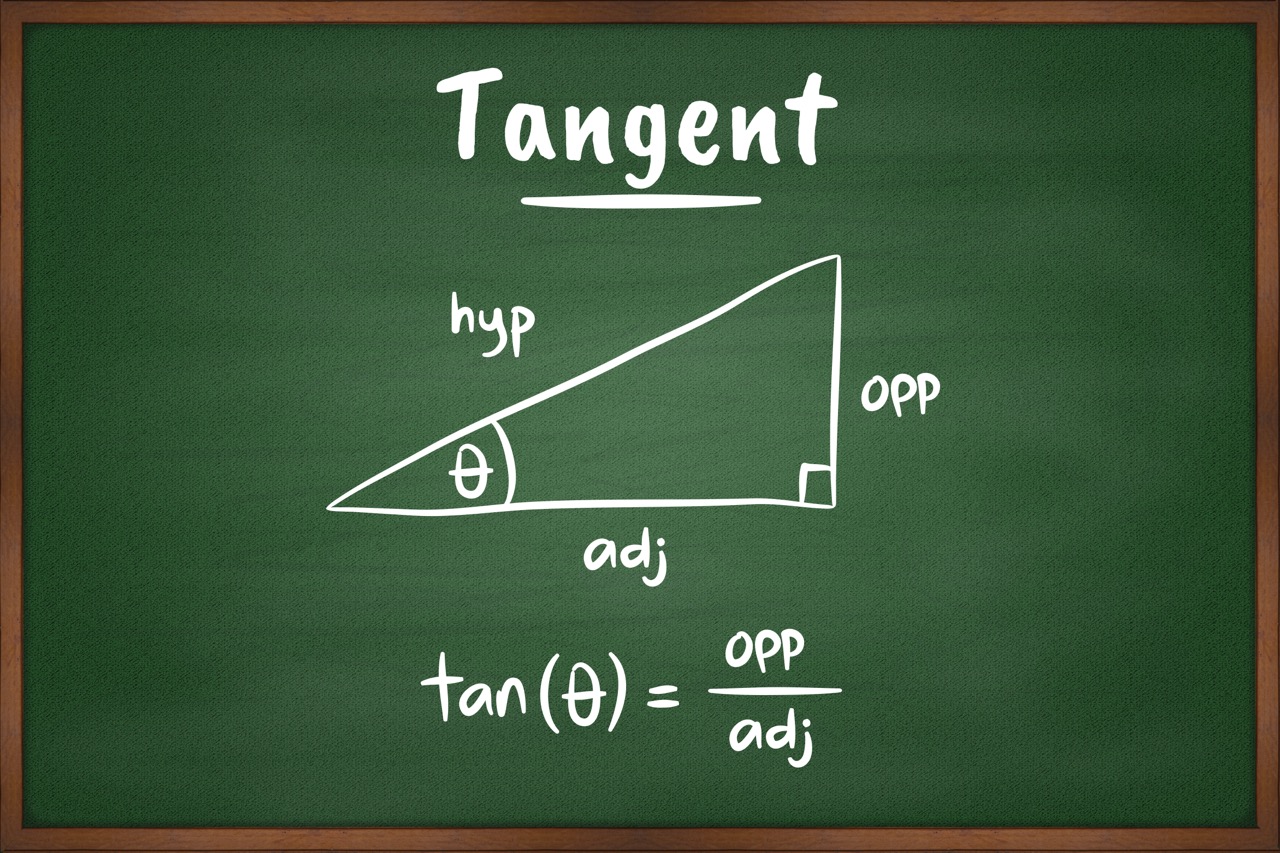
We write it like this:
\(tan(\theta) = \Large\frac{opposite}{adjacent}\)
For example, in a right triangle where the angle θ has an opposite side of 3 units and an adjacent side of 4 units, the tangent of θ is:
\(tan(\theta) = \Large\frac{3}{4} = 0.75\)
In geometry, "tangent" can also mean a line that touches a curve at exactly one point without crossing it, like a line just brushing the outside of a circle.
Tangents are useful in:
- Solving right triangle problems
- Calculating slopes, heights, and distances in real-world scenarios
- Understanding how curves behave in geometry and calculus
When Do Students Learn About Tangents?
Students encounter the concept of tangent as they explore right triangle trigonometry in middle and high school.
Grades 8–9 – Introduction to Trigonometry
Students learn the definitions of sine, cosine, and tangent and how to apply them to right triangles.