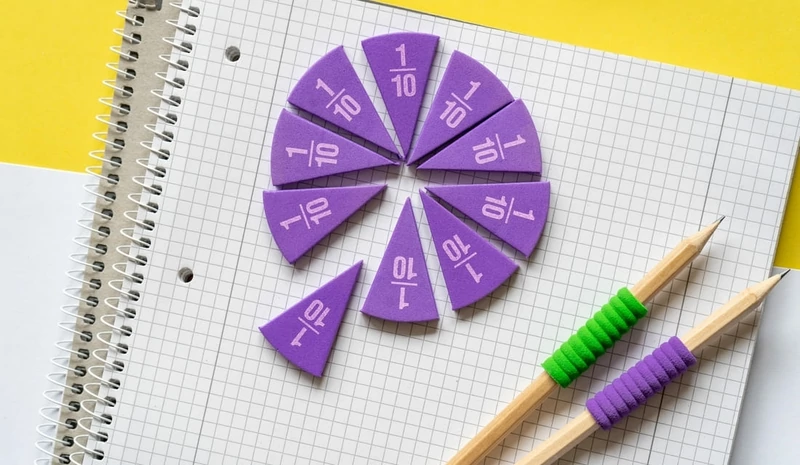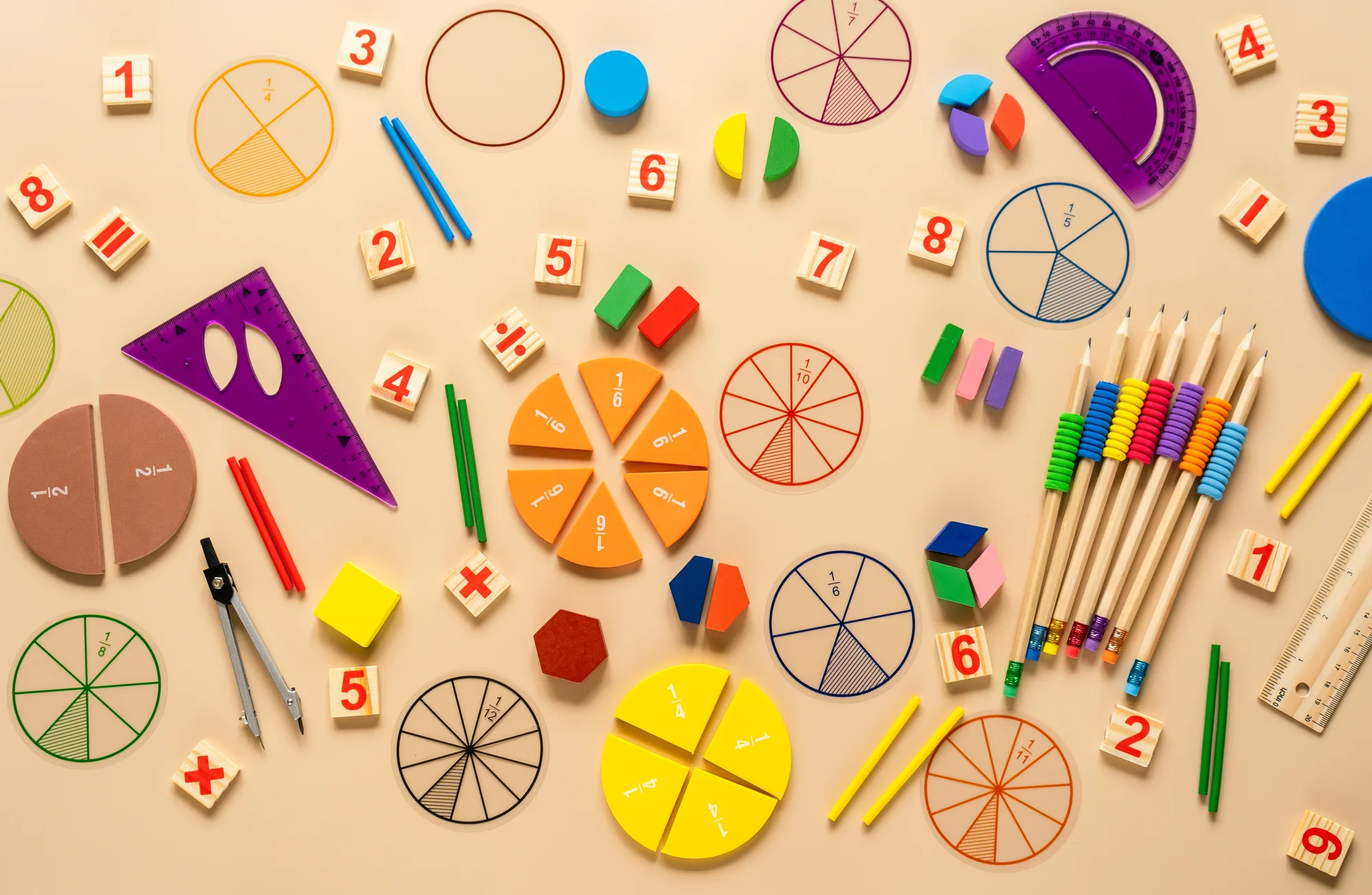






A fraction whose numerator is one.
A unit fraction is any fraction with 1 on top. The denominator can be any whole number greater than 1, but the numerator is always 1.
Some examples of unit fractions:
-
\(\frac{1}{2}\) (one half)
-
\(\frac{1}{3}\) (one third)
-
\(\frac{1}{4}\) (one quarter)
-
\(\frac{1}{8}\) (one eighth)
Unit fractions represent exactly one equal part of a whole. If a shape is divided into 5 equal parts, one of those parts is \(\frac{1}{5}\), which is a unit fraction.
Unit fractions are the building blocks of all other fractions. Any fraction can be broken down into unit fractions. For example, \(\frac{3}{4}\) is the same as three copies of \(\frac{1}{4}\):
\(\frac{1}{4}\) + \(\frac{1}{4}\) + \(\frac{1}{4}\) = \(\frac{3}{4}\)
This way of thinking about fractions helps students understand what the numerator and denominator actually mean, rather than treating a fraction as just two separate numbers.
When Do Students Learn About Unit Fractions?
Unit fractions are among the first fractions students encounter, introduced as soon as they begin dividing shapes and groups into equal parts.
Grades 1–3 – Introduction to Unit Fractions
Students learn to identify and name unit fractions by dividing shapes into equal parts and shading one section. Fractions like 1/2, 1/3, and 1/4 are introduced here.
Grades 4–5 – Unit Fractions as Building Blocks
Students use unit fractions to understand and build non-unit fractions, add and subtract fractions with like denominators, and work with fractions on a number line.
Grades 6+ – Unit Fractions in Operations and Algebra
Students work with unit fractions in more complex operations, including division of fractions, ratios, and algebraic expressions.