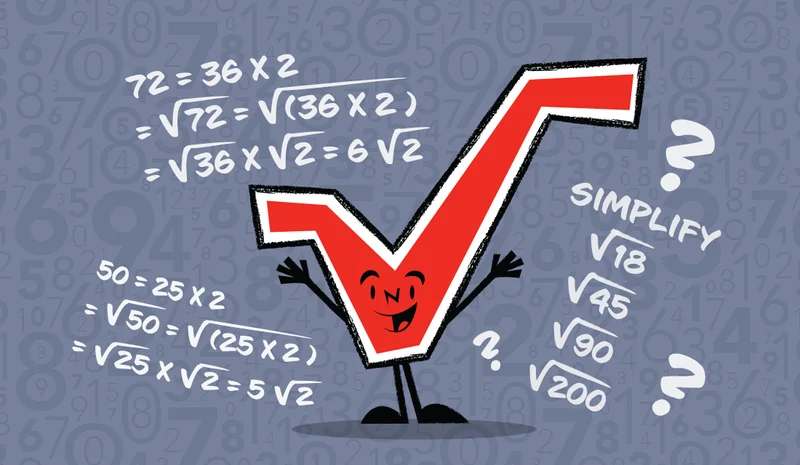
We simplify expressions in math all the time, like when reducing fractions or combining like terms in algebra. We do it to make numbers easier to work with, easier to compare, and easier to use in further calculations. The same idea works for square roots.
Today, we’ll walk you through why we simplify square roots, how to do it step by step, and give you a chance to practice. We'll also answer the questions students ask most about this topic along the way.

Let's Review First: What Are Square Roots?
A square root of a number is a value that, when multiplied by itself, gives that number. In other words, it answers one question: what number times itself equals this?
For example:
-
\(\sqrt{9} = 3\), because 3 × 3 = 9
-
\(\sqrt{25} = 5\), because 5 × 5 = 25
-
\(\sqrt{64} = 8\), because 8 × 8 = 64
These are called perfect squares or numbers whose square roots are whole numbers.
Not every number works out that cleanly, though. \(\sqrt{2}\), \(\sqrt{5}\), and \(\sqrt{72}\) don't give us whole numbers. And that's exactly where simplification comes in.
📕 You May Also Like: What Is a Perfect Square in Math? A Complete (& Easy) Guide
Why Do We Simplify a Square Root?
When a square root doesn't give us a whole number, the result can be difficult to read, compare, or use in further calculations. Simplification fixes that.
Take \(\sqrt{72}\). On its own, that number is hard to work with. But once we simplify it to \(6\sqrt{2}\), we can immediately see that it's 6 times the square root of 2, which is a much cleaner expression that's easier to handle in equations and build on in more advanced math.
Simplifying also helps us spot relationships between numbers that wouldn't be obvious otherwise. Two square roots that look completely different might simplify to the same thing, and we'd never know without simplifying.
How Do We Simplify a Square Root?
Let's use \(\sqrt{72}\) as our example, the same one from before.
What we need to do here is break the number inside the root into two factors: the largest perfect square that divides into it, and what's left over.
Step 1: Find the largest perfect square factor
We look inside the root and ask, "Can we write 72 as a product of two numbers, where one is a perfect square?
72 = 36 × 2
36 is a perfect square and the largest one that divides evenly into 72, so that's our factor.
\(\sqrt{72} = \sqrt{(36 × 2)}\)
Step 2: Separate the two factors under the root
We separate the two factors, giving each its own root symbol:
\(\sqrt{(36 × 2)} = \sqrt{36} × \sqrt{2}\)
Step 3: Simplify the perfect square
\(\sqrt{36} = {6}\), so we bring that out in front and leave \(\sqrt{2}\) as it is:
\(\sqrt{72} = 6\sqrt{2}\)
That's the simplified form, and from here, it's much easier to use in any calculation.
📕 You May Also Like: How to Reduce Fractions - A Kid-Friendly Guide
Simplifying Square Roots: Solved Examples
We'll work through two more examples together: one to reinforce the steps, and one with a slightly bigger number to build confidence before you go solo.
Example 1: Simplify \(\sqrt{50}\)
What perfect square hides inside 50? Let's find out.
Step 1: Find the largest perfect square factor
Can we write 50 as a product of two numbers, where one is a perfect square?
50 = 25 × 2
25 is a perfect square and the largest one that divides evenly into 50.
\(\sqrt{50} = \sqrt{(25 × 2)}\)
Step 2: Split the root into two parts
\(\sqrt{(25 × 2)} = \sqrt{25} × \sqrt{2}\)
Step 3: Simplify the perfect square
\(\sqrt{25} = 5\), so 5 comes out in front:
\(\sqrt{50} = 5\sqrt{2}\)
Example 2: Simplify \(\sqrt{108}\)
Let's try a slightly bigger number.
Step 1: Find the largest perfect square factor
Can we write 108 as a product of two numbers, where one is a perfect square?
108 = 36 × 3
36 is a perfect square and the largest one that divides evenly into 108.
\(\sqrt{108} = \sqrt{(36 × 3)}\)
Step 2: Split the root into two parts
\(\sqrt{(36 × 3)} = \sqrt{36} × \sqrt{3}\)
Step 3: Simplify the perfect square
\(\sqrt{36} = 6\), so 6 comes out in front:
\(\sqrt{108} = 6\sqrt{3}\)
Your Turn: Can You Simplify These Square Roots?
Now you take the wheel. Use what we've worked through today and simplify these square roots on your own.
Challenge 1: Simplify \(\sqrt{18}\)
Challenge 2: Simplify \(\sqrt{45}\)
Challenge 3: Simplify \(\sqrt{98}\)
Challenge 4: Simplify \(\sqrt{200}\)
Once you're done, scroll down to the bottom of the guide to check your answers.
📕 You May Also Like: Partial Fraction Decomposition - Beginner-Friendly Guide
FAQs About Simplifying Square Roots
These are the questions we get from our students when we cover simplifying square roots.
1. Can you simplify square roots with variables?
Yes. For a variable under a root sign, we look for the largest even power, since even powers are perfect squares.
For example, \(\sqrt{x^4} = x^2\) because \(x^2 × x^2 = x^4\).
When variables and numbers appear together under the root, we simplify each part separately and combine the results. This typically comes up in algebra, once students are comfortable simplifying square roots with numbers alone.
2. Can you add or subtract square roots before simplifying?
It depends. If the square roots are like terms, meaning they have the same number under the root sign, they can be added or subtracted directly. \(\sqrt{5} + \sqrt{5} = 2\sqrt{5}\), for example.
But if the roots look different, it's always worth simplifying first. Two square roots that appear different might simplify to the same form, making addition or subtraction possible after all.
\(\sqrt{8} + \sqrt{2}\) looks like two different terms, but \(\sqrt{8}\) simplifies to \(2\sqrt{2}\). Then, \(2\sqrt{2} + \sqrt{2} = 3\sqrt{2}\).
So the short answer: simplify first, then check if the terms can be combined
3. What if the number inside the root has no perfect square factors?
Then the square root is already in its simplest form. Numbers like \(\sqrt{2}\), \(\sqrt{3}\), \(\sqrt{5}\), and \(\sqrt{7}\) have no perfect square factors other than 1, so there's nothing to pull out from under the root sign. We leave them exactly as they are, as they're already as simple as they can get.
4. When do students first learn to simplify square roots?
Most students are introduced to simplifying square roots in 8th grade, when they begin working more formally with radicals and irrational numbers.
The concept builds on a solid understanding of perfect squares and factors, which students typically develop in 6th and 7th grade. From there, simplifying square roots becomes an important skill in algebra and geometry.

Mathnasium uses personalized learning plans and interactive teaching techniques to help students build a deep understanding of any math skill, including simplifying square roots.
How Mathnasium Helps Students Master Any Math Skill
Mathnasium is a math-only learning center empowering K-12 students of all skill levels to excel in math.
We've worked with thousands of middle schoolers, helping them navigate everything from broad fields like algebra and geometry to specific skills like simplifying square roots.
Whatever they need support with, we don't rely on rote drills or memorization; we rely on a proprietary teaching approach called the Mathnasium Method™.
This time-tested method is designed to build a deep understanding of any concept through:
-
Personalization on a granular level: Each student begins with a diagnostic assessment. This helps us identify their strengths as well as potential knowledge gaps. Using these insights, we create a learning plan customized to each student’s needs.
-
Teaching for understanding: We use natural, everyday language to phrase math concepts. We also employ a mix of verbal, visual, mental, tactile, and written teaching techniques to help students truly make sense of the concepts they’re learning.
-
Caring, supportive tutors: Our tutors are specially trained in math as well as the technical and emotional aspects of teaching. This means they know how to encourage a student who’s overwhelmed and how to challenge one who’s ready to advance.
-
Problem-solving and critical thinking skills: During sessions, we always allow time for productive struggle, then rejoin students to check and correct their processes. This helps them learn to rely on their own thinking. We guide them through both the how and the why behind each math problem, not only the final answer. This approach develops the problem-solving and critical thinking tools they’ll use in math and beyond.
-
A supportive, fun learning environment: Our activities are often game-based, giving students a chance to earn rewards along the way. This keeps them engaged and truly enjoying the process. We celebrate every step of progress, big or small, so confidence grows with every session.
Our method brings measurable results:
-
94% of parents report an improvement in their child's math skills and understanding
-
93% of parents report an improved attitude towards math after attending Mathnasium
-
90% of students saw an improvement in their school grades
Whether your student is looking to catch up, keep up, or get ahead in math, your local Mathnasium center can help. Start by scheduling a diagnostic assessment, and together we'll create a personalized plan for math mastery.

Pssst! Your Answers Are Here
If you’ve given our challenges a try, check your answers here.
Challenge 1: \(\sqrt{18} = \sqrt{(9 × 2)} = 3\sqrt{2}\)
Challenge 2: \(\sqrt{45} = \sqrt{(9 × 5)} = 3\sqrt{5}\)
Challenge 3: \(\sqrt{98} = \sqrt{(49 × 2)} = 7\sqrt{2}\)
Challenge 4: \(\sqrt{200} = \sqrt{(100 × 2)} = 10\sqrt{2}\)