2D shapes like rectangles, triangles, and circles are some of the first shapes we learn to measure. When we’re working in two dimensions, there’s usually just one surface to focus on and one formula to apply. It’s handier to follow because everything stays on the same flat plane.
But once we step into three dimensions, things start to change. A rectangular prism (think: box) has six sides, not just one. That means more parts to look at, and if we move too quickly, we can easily mix them up or miss a step.
This is why surface area calls for a bit more focus. It’s not harder, just more layered.
Today, we’ll take a closer look at what surface area of a rectangular prism really means, how to find it, walk through a few practice problems, and answer common student questions so you can feel confident working with it.

Let’s Review: What Is a Rectangular Prism?
A rectangular prism, also called a cuboid, is a three-dimensional shape with six flat sides. Each of those sides is a rectangle.
You can think of it as a solid shape, like a shoebox, a hardcover book, or a cereal package.
So what exactly gives a rectangular prism its shape? Let’s break it down:
-
6 faces, all rectangles
-
12 edges, where the faces meet
-
8 vertices, or corners, where the edges come together
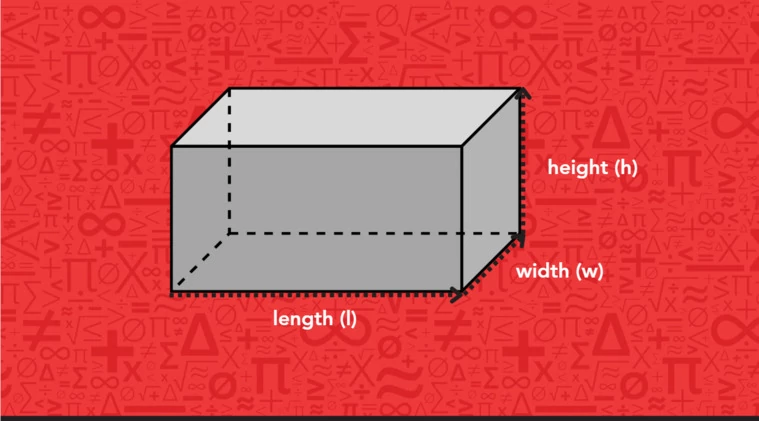
Here’s an example:
Looking at the diagram, we notice how the opposite faces of the prism always match in size. The top and bottom are the same. The front and back are the same. The two sides are the same.
📕 You May Also Like: What Are Vertices, Edges, and Faces? A Complete Overview
What Is the Surface Area of a Rectangular Prism?
A rectangular prism is made of six rectangles. When we talk about surface area, we mean the total area of all six of those rectangles added together.
One way to picture this is to imagine “unfolding” the prism. If we cut along the edges and lay the faces flat, we would see every rectangle at once. This unfolded version is called a net.
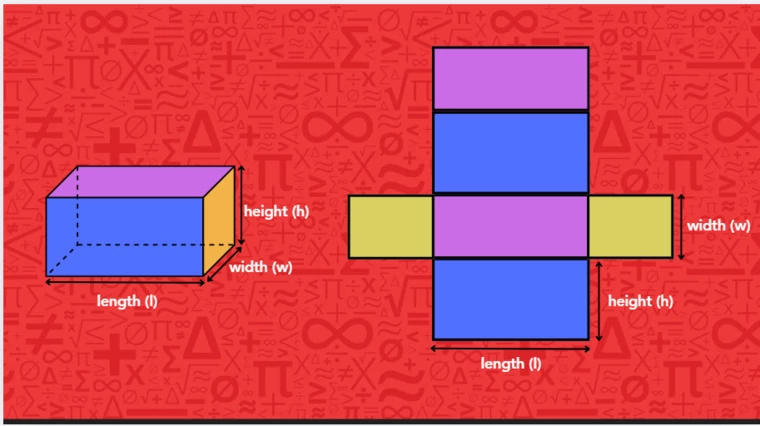
Notice how the faces match up in pairs: the top and bottom, the front and back, and the two sides. When we add all of these rectangles together, we get the total surface area.
📕 You May Also Like: What Is Area in Math? A Complete & Kid-Friendly Guide
How to Find the Surface Area of a Rectangular Prism
To find the surface area of a rectangular prism, we add up the areas of all its faces. Since opposite faces always match, we can group them in pairs.
-
The top and bottom are the same size. Each one has an area of length × width. Together, they give us 2 × (l × w).
-
The two sides match as well. Each has an area of width × height. Together, they give us 2 × (w × h)
-
The front and back are also the same size. Each one has an area of length × height. Together, they give us 2 × (l × h).
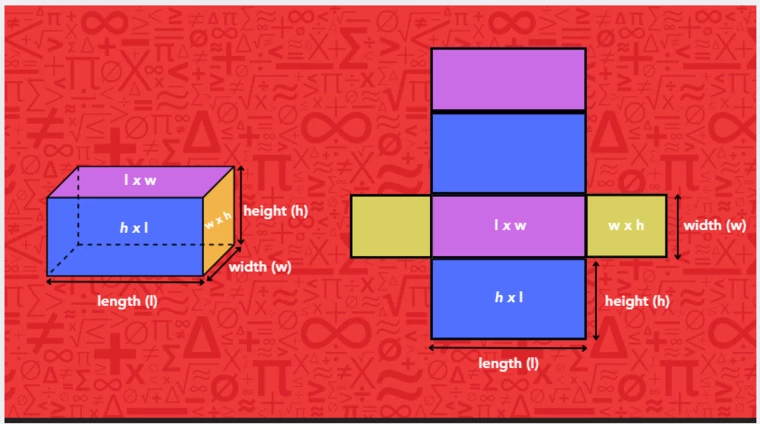
When we combine all of these, we get the total surface area:
Surface Area = 2 (lw + wh + lh)
For example, let’s say the prism has a length of 8 inches, a width of 3 inches, and a height of 4 inches.
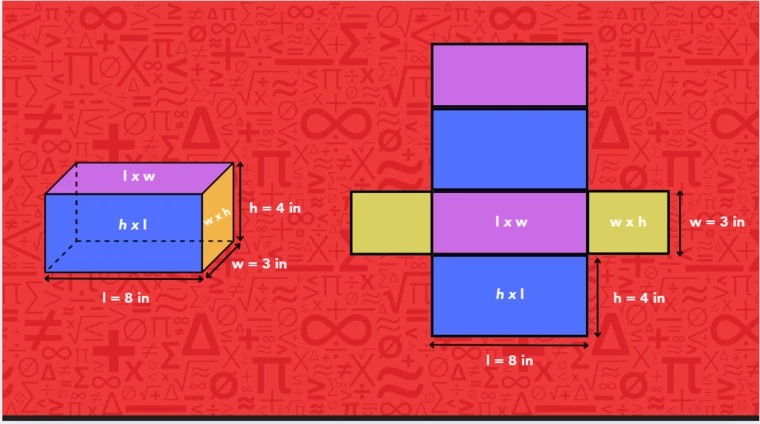
To find its surface are we substitute the values in like so:
Surface Area = 2 × ((8 × 3) + (3 × 4) + (8 × 4))
= 2 × (24 + 12 + 32)
= 2 × 68
= 136 in2
And that’s how we find the area of rectangular prisms. Once you see how each pair of faces adds up, the process feels much simpler.
Surface Area Quiz: Test What You Know
You’ve worked through what a rectangular prism is, how its parts fit together, and what surface area means. Now see how much you remember. Each question has four possible answers. Choose the one you think is correct.
When you’re done, check your answers at the bottom of the guide.
1. Which of these objects is shaped like a rectangular prism?
A. A soccer ball
B. A matchbox
C. An ice cream cone
D. A tent
2. How many faces, edges, and vertices does a rectangular prism have?
A. 4 faces, 6 edges, 4 vertices
B. 6 faces, 12 edges, 8 vertices
C. 8 faces, 12 edges, 6 vertices
D. 12 faces, 6 edges, 8 vertices
3. What does the surface area of a rectangular prism measure?
A. The distance around the base
B. The amount of space inside the prism
C. The total area of all the outer faces combined
D. The sum of its length, width, and height
4. A prism has length = 6 in, width = 4 in, and height = 5 in. What is its surface area?
A. 148 in2
B. 152 in2
C. 164 in2
D. 172 in2
5. A rectangular prism has a length of 12 in and a width of 5 in. Each of the side faces has an area of 60 in2. What is the prism’s surface area?
A. 264 in2
B. 300 in2
C. 340 in2
D. 528 in2
FAQs About the Surface Area of a Rectangular Prism
When students begin working with the surface area of rectangular prisms, it’s natural for questions to come up. At Mathnasium of Hyde Park, we welcome these moments of curiosity because they often lead to deeper understanding.
Here are some of the most common questions students ask, along with clear answers to help clear up any confusion.
1. When do students learn the surface area of a rectangular prism in school?
In most schools, students are introduced to the surface area of rectangular prisms in 6th grade. By this point, they have already practiced finding the area of 2D shapes and the volume of rectangular prisms, which makes them ready to connect those ideas to surface area.
2. What’s the difference between the surface area and volume of a rectangular prism?
The surface area of a prism is the total space on the outside. You can think of it as the amount of wrapping paper needed to cover the prism.
The volume of a prism is the amount of space on the inside. It tells you how much the prism can hold if it were filled up.
So surface area measures covering, while volume measures capacity. Both use the dimensions of the prism, but they answer very different questions.
3. What if all sides are the same?
When all the sides of a rectangular prism are the same length, the shape is called a cube. A cube still follows the same surface area idea, but since every face is a square, the calculation is even simpler.
Each face has an area of side × side, and there are six faces. So the surface area of a cube is:
Surface Area = 6s2 where s is the side length of the cube.
4. Why do we use square units for surface area?
Because each face is a flat 2D shape. When we measure that space, we use square units like in2 or ft2, just like with any other area problem.
Master Geometry with Top-Rated Tutors at Mathnasium
Mathnasium is a math-only learning center dedicated to helping K–12 students reach their full potential.
Whether a student is struggling with geometry topics like the surface area of rectangular prisms, doing fine but wanting to improve, or excelling and looking for more challenge, Mathnasium can help.
At the heart of our work is our proprietary teaching approach, the Mathnasium Method™.
The Mathnasium Method™ begins with a diagnostic assessment that shows us what a student already understands, where their strengths lie, and where they may have gaps. Using the assessment insights, we create a personalized learning plan tailored to each student’s needs and learning style.
Our specially trained tutors follow that plan closely, adapting in real time. Instruction is delivered in a nurturing, engaging environment using a mix of Socratic questioning and direct teaching to help students master any math concept, including the area of rectangular prisms.
When a student feels overwhelmed by a concept, we break it into manageable pieces and guide them to see both the how and the why. This builds independent thinkers who can approach math with confidence, whether it’s for a classroom assignment or a standardized test.
Mathnasium tutors provide personalized, face-to-face instruction in a supportive environment that helps students understand both the how and why behind math concepts like the area of rectangular prism.

Mathnasium tutors provide personalized, face-to-face instruction in a supportive environment that helps students understand both the how and why behind math concepts like the area of rectangular prism.
Our Results
Families choose Mathnasium because the approach works:
-
94% of parents report an improvement in their child’s math skills and understanding
-
90% of students see better grades in school
-
93% of parents notice a more positive attitude toward math
Mathnasium of Hyde Park: A Trusted Cincinnati Center
Mathnasium operates over 1,000 learning centers across the U.S., bringing personalized instruction and top-rated tutors to families nationwide.
For families in the Cincinnati area, Mathnasium of Hyde Park is a trusted local resource. Parents value our experience, our flexible in-center and online options, and the lasting results students achieve.
If you want to see your child succeed not only on tests but also in building skills that last a lifetime, schedule a free diagnostic assessment at Mathnasium of Hyde Park today. Watch their confidence grow session by session.
📅 Schedule a Free Diagnostic Assessment at Mathnasium of Hyde Park
Not near Hyde Park?
📍 Find a Mathnasium Learning Center Near You
Pssst! Check Your Answers Here
If you’ve given our quiz a try, check your answers below.
1. Which of these objects is shaped like a rectangular prism?
B. A Matchbox
2. How many faces, edges, and vertices does a rectangular prism have?
B. 6 faces, 12 edges, 8 vertices
3. What does the surface area of a rectangular prism measure?
C. The total area of all the outer faces combined
4. A prism has length = 6 in, width = 4 in, and height = 5 in. What is its surface area?
A. 148 in2
5. A rectangular prism has a length of 12 in and a width of 5 in. Each of the side faces has an area of 60 in2. What is the prism’s surface area?
D. 528 in2


 (513) 832-8773
 (513) 832-8773