Math homework often puts two words back to back: "equation" and "function."
Both have letters and numbers, and both have an equal sign in the middle. So why do they get treated like two completely different things?
Middle schoolers hit this exact wall every year, right around the time algebra starts using more letters than numbers.
Our Mathnasium tutors love untangling exactly this kind of mix-up. We're going to walk through clear definitions, a side-by-side comparison, real-life examples, a quick quiz, and a few FAQs. By the end of this guide, you will know exactly which one is which.

What Is an Equation in Math?
An equation is a math sentence that says two things are equal. It uses an equal sign (=) to show us that what's on the left has the same value as what's on the right.
For example, 5 +5 = 10. Both sides land on the same value, so the equation holds true.
Now, let’s picture a scale with three bananas sitting on each pan, perfectly level. Neither side dips nor rises. That's an equation.
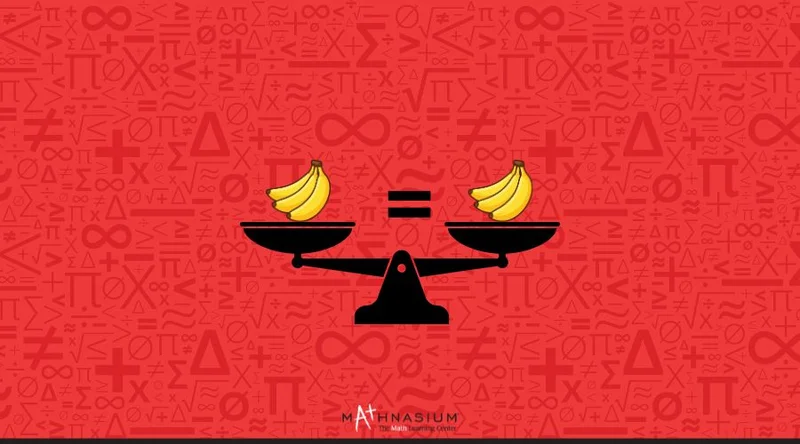
Equations also use variables (like x, y, or any other letter), and, in that case, we often solve the equation to find a variable.
For example, Jason wants a game expansion pack, and it costs $20. He has saved up $8 so far. How much more does Jason need? That is our variable, and the equation can help us find it.
8 + x = 20
📕 You May Also Like: How to Solve Basic Equations — A Parent and Student Guide
What Is a Function in Math?
A function is a math rule that takes an input, transforms it, and gives back exactly one output every time. In a function:
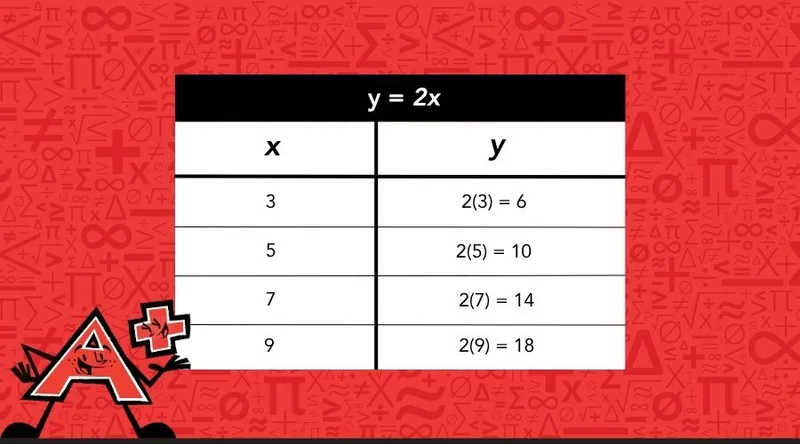
For example, y = 2x. If we put in 3, we get 6. Put in 5, and we get 10, and so on. Whenever we feed the function a new input, it uses its rule to calculate a brand-new output.
Think of a vending machine. You press code B3 and get a granola bar. Press B3 again tomorrow, and you get a granola bar again. Press it a hundred times, same granola bar every time. The machine follows the same rule every time: same code, same snack.
That's exactly how a function works. same input, same output, every time.
Let's check one more example of a function in action.
Every box of sour candy at the movie theater costs $4. Maria buys 1 box, so she owes $4. Her brother buys 3 boxes, so he owes $12. The rule stays the same. We multiply the number of boxes by $4.
📕 You May Also Like: How to Find Domain and Range: A Step-by-Step Guide
So, What Is the Difference Between an Equation and a Function?
With an equation, there’s one fixed answer (variable) we need to find, while a function shows us how two values change together (input and output).
That single sentence covers it, but let's break down exactly what sets them apart.
1. Solving for one value vs. using a rule many times
When we work with equations in class, we’re often trying to find one specific value that makes the equation true.
For example, in 7 + x = 16, there is only one number that keeps the equation balanced: x = 9.
A function uses the same rule over and over for many different inputs. In y = 2x, we can plug in 1, 2, 3, or 300, and each input creates a new input–output pair that follows the rule.
2. How values depend on each other
With most equations we solve, we care about making both sides equal at a particular moment. After we’ve found the missing value, the puzzle is done.
With functions, we care about the ongoing relationship; the output depends on the input. If we change the input, the output must change in a predictable way.
Think about a school fundraiser where each candy bar sells for $2.
The rule “total money = 2 × bars sold” tells us that selling 3 bars raises $6 and selling 10 bars raises $20. The total money only appears when we plug in a number of bars.
3. How equations and functions work together
We often use equations to write the rule of a function in a clear way.
Take the instruction “double the input and add three.” As an equation, that looks like y = 2x + 3. This equation spells out the rule, and the function uses that rule to turn many different inputs x into matching outputs y.
Let's compare functions and equations side by side.
| Feature |
Equations |
Functions |
| Main Objective |
Find the variable |
Watch how an output changes with an input |
| Number of Answers |
One missing value |
An infinite number of combinations |
| Variables Used |
Letters hide one static number |
Letters track changing inputs and outputs |
| Core Analogy |
A balanced scale |
A vending machine |
📕 You May Also Like: Independent & Dependent Variables — Explained for 6th Grade
Quiz: Check Your Knowledge of Functions vs. Equations
Before you go, take this quick quiz to see how well you can tell functions and equations apart. Answers are waiting at the end of the blog.
1. Mark is trying to find the one exact value of a missing variable, x. Is he looking at an equation or a function?
-
Equation
-
Function
2. Mona buys a snack using code 5 on Monday and gets a granola bar. On Tuesday, she uses code 5 again and gets a bag of chips instead. Is this true or false for a function?
3. An equation is like a balanced seesaw. What's the best analogy for a function?
-
A locked treasure chest
-
A vending machine
-
A single scale
-
A jigsaw puzzle
4. Fill in the blank: We use an _________ to write down the specific rule of a function.
-
Variable
-
Equation
-
Output
-
Input
5. Look at y = 4x. If this describes how a total price (y) changes based on how many shirts Sheldon buys (x), what math concept is it modeling?
-
An equation
-
A function
6. A dog walker Joe earns $10 per walk. If Joe completes 𝑥 walks, what expression shows Joe’s earnings?
FAQs About Functions vs. Equations
Here are some of the most common questions about functions and equations we hear from our students, and the answers to help clear up any lingering confusion.
1. Can an equation exist without being a function?
Yes. With a simple equation like 5 + 5 = 10 or 2x = 8, we are just checking that the two sides match. We aren’t tracking any changing relationships, so it never becomes a function.
2. Why do equations and functions matter in real life?
Equations help us solve for something unknown when we already know how the numbers should balance out, like figuring out how many minutes we have left on a phone plan or how many raffle tickets we need to sell to hit a fundraising goal.
Functions help us describe patterns and predict results. For example, if your favorite store charges the same price per item, a function can show how the total changes as you buy more.
3. What comes next after learning functions and equations?
Next, you'll start graphing functions and equations on a coordinate plane, building tables of values, and solving problems that use both together. This is where algebra really opens up, right around the same time most students hit these topics in grades 7 and 8.

At Mathnasium, our tutors build personalized learning plans and use interactive techniques to help students make sense of concepts like functions and equations.
Master Any Math Concept With Mathnasium
Mathnasium is a math-only learning center that helps K-12 students catch up, keep up, and get ahead in math.
We teach concepts like functions and equations not through rote memorization but through a proprietary teaching approach called the Mathnasium Method™, designed around each student's individual needs and learning style.
Each student starts their Mathnasium journey with a diagnostic assessment that helps us spot current skills and knowledge gaps, then builds toward a personalized learning plan with a session frequency that fits their pace.
We phrase math in plain, everyday language instead of heavy jargon, blending verbal, visual, mental, tactile, and written techniques so each concept truly lands.
Our tutors are trained in both math and the emotional side of teaching, so they know how to support a student who feels overwhelmed and how to challenge one who's ready to move ahead.
We also give students room for productive struggle before stepping back in to check their reasoning, teaching both the how and the why behind the math so they build critical-thinking skills that carry into future courses.
Sessions often don't look like lectures. Games, earned rewards, and steady celebration of progress keep learning enjoyable and help students grow in confidence with every visit.
And the results speak for themselves:
-
94% of parents report an improvement in their child's math skills and understanding
-
93% of parents report their child's improved attitude toward math after attending Mathnasium
-
90% of students saw an improvement in their school grades
With more than 1,100 learning centers, Mathnasium brings top-rated math instruction close to your home.
For families in and around Cincinnati, OH, Mathnasium of Hyde Park is a trusted local center with experience helping students build lasting confidence and math skills.
Our center has been recognized for the quality of instruction we bring to the community:
Whether your student is looking to catch up, keep up, or get ahead on their math journey, our team is ready to help!
📅 Schedule a Free Diagnostic Assessment at Mathnasium of Hyde Park
Not near Hyde Park?
📍 Find a Mathnasium Learning Center Near You
Pssst! Check Your Answers Here
If you gave our quiz a try, the answers are:
-
A) Equation
-
False, a function has to be predictable every time
-
B) A vending machine
-
B) Equation
-
B) Function
-
y = 10x
How did you do?


 (513) 832-8773
 (513) 832-8773