

Riverside South
3771 Spratt Rd
, Building D, Unit 8
Gloucester, ON K1V 2N8
Gloucester, ON K1V 2N8
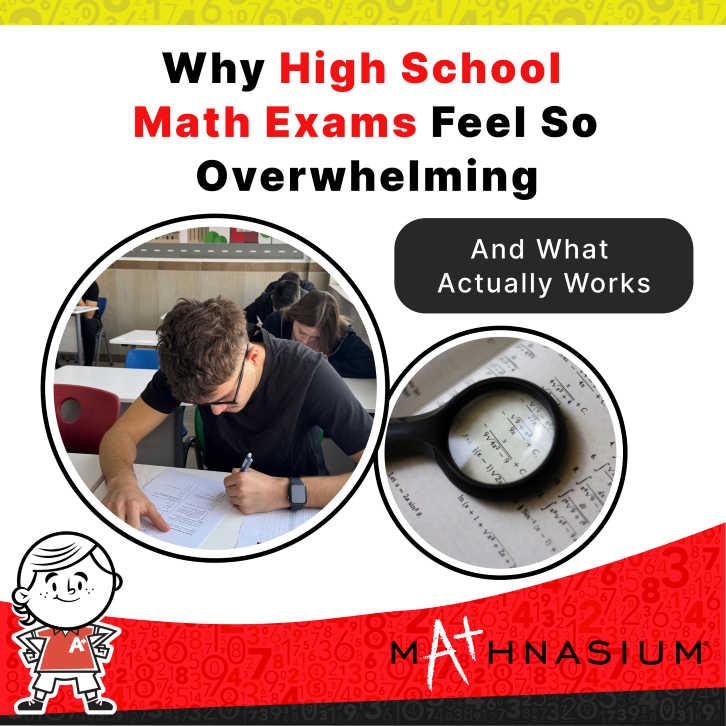
Ask any high school student which upcoming exam causes the most dread, and nine times out of ten the answer is math.
Throughout the semester, many students manage to get by. They study the night before a chapter test, memorize the specific steps for that week's topic, write the quiz, and walk away with a respectable mark. They tell themselves—and their parents—that things are fine.
Then the comprehensive exam arrives.
Suddenly, five months of material is compressed into a single two-hour assessment. The binder is three inches thick, the review package is forty pages long, and looking at the material triggers immediate overwhelm.
Why do high school math exams cause so much panic, why does the strategy that worked all semester suddenly fail, and what can a student actually do about it?
The biggest shock for students preparing for a high school math exam is discovering that their usual study habits don't scale.
During the regular school term, a unit test only covers one focused topic. If the class is studying quadratics, the student knows every question on the test is about quadratics. If they are studying trigonometry, they know they need the sine law or cosine law.
Because the context is narrow, students can often rely on short-term memorization:
They memorize what the problem looks like.
They memorize the mechanical steps to produce the answer.
They execute those steps without necessarily understanding why they work.
On a cumulative exam, this illusion of competence collapses.
An exam doesn't announce what topic each question belongs to. Questions from September, October, November, and December are mixed together. When a question twists the presentation even slightly, students who relied on memorized patterns freeze because they can’t tell which "recipe" to use. Memorizing answers to specific questions is manageable for twenty pages of homework; memorizing five months of disconnected patterns under exam conditions is impossible.
When students feel overwhelmed during exam prep, they often blame the later units. They assume Unit 4 or Unit 5 was simply "way too hard."
In reality, math is strictly cumulative. If a student had even a 15% gap in early factoring or exponent laws back in September, they might have scraped through that early quiz. But when those same skills were required to simplify rational expressions or solve trigonometric proofs in November, every single problem required double the cognitive effort.
Trying to study for a final exam with unaddressed foundational gaps feels like trying to build the third floor of a house when the ground floor is missing pillars. It leads to quick mental fatigue and intense burnout.
It is worth observing the students who walk into math exams feeling calm and prepared. They aren't necessarily geniuses. What sets them apart is how they approached the material throughout the term:
They learned the "why," not just the "how": When you understand the underlying concept, you don't need to memorize ten different problem types. You simply apply the principle to whatever problem appears.
They kept up with gaps in real time: When they didn't understand a concept on a Tuesday, they addressed it that week rather than letting it snowball into the next month.
They practiced retrieval, not review: They didn't just passively read over their class notes or stare at worked examples; they routinely closed their books and tried problems from scratch.
If an exam is only a week or two away and a student is severely underprepared, cramming everything is not an option. Pushing through 14-hour study marathons usually leads to panic and exhaustion on exam day.
Here is how to triage study time effectively under pressure:
Reading over old notes, highlighting formulas, or watching math videos creates a false sense of security. It feels like studying, but it doesn't prepare the brain to retrieve information independently. The only study technique that reliably moves the needle in math is putting pencil to paper. Do practice problems with the solutions hidden.
Don't get bogged down spending three hours trying to understand one obscure, highly complicated question from the end of the semester. Focus first on the fundamental skills that appear everywhere: basic algebraic manipulation, core graphing rules, and central formulas. Securing 70% of the foundational marks is far better than chasing 10% of the hardest questions while leaving basic errors on the table.
When doing practice exams, don't just check the answer and move on. Keep a small piece of paper next to you. Every time you get a question wrong, write down why: Was it a careless arithmetic slip? A sign error? Or did you genuinely not know how to begin? Reviewing that one sheet of recurring pitfalls is ten times more useful the morning of an exam than skimming a textbook.
Studying past midnight before a math exam is counterproductive. Math requires working memory, attention to detail, and logical precision. A tired brain misreads negative signs, drops decimals, and misinterprets instructions. Sleep is an essential part of exam prep.
Let's be completely candid about emergency exam prep: even if a last-minute crunch helps a student pass the exam, that knowledge will almost certainly evaporate over the holiday or summer break.
Next year, the next math course will assume all of that material was permanently mastered. The cycle of confusion, anxiety, and last-minute panic simply starts over, usually worse than before.
At Mathnasium, our approach is built around breaking this cycle. Rather than helping students scramble to memorize steps for this Friday's test, our priority is identifying and filling the underlying learning gaps that cause confusion in the first place. When students build genuine number sense and understand the reasoning behind math, exams stop feeling like an impossible memory test—and become an opportunity to demonstrate what they truly know.
Year-round math consistency doesn't mean spending your entire life doing worksheets; it means keeping the foundation solid so that when exam season rolls around, stress stays low and confidence stays high.
Mathnasium of Riverside South is a math-only learning centre for K-12 students in Gloucester, ON. Trusted by over a million parents, Mathnasium uses personalized learning plans and the proprietary Mathnasium Method™ to help students catch up, keep up, and get ahead on their math journey.
Our specially trained tutors deliver face-to-face instruction in a supportive and fun small-group environment, working with students both in centre and online to develop a deep understanding of math, build confidence, and improve academic performance.
Schedule Free Assessment
 (613) 794-9449