For curious kids who are ready for more, the richest math experiences don't come from extra problems — they come from connecting numbers to the world around them.
Barrington families know that real learning goes deeper than grades. When a child genuinely understands something — not just how to get the right answer, but why it works — they carry that insight everywhere. Math is no different. The students who develop true mathematical fluency aren't the ones who did the most worksheets. They're the ones who encountered math through multiple lenses until it became part of how they see the world. Here are three of the most powerful lenses you can offer at home.
When Math Meets Art, Understanding Goes Deeper for Creative and Visual Thinkers
Ask a child to define a fraction and you might get a blank stare. Ask them to fold a piece of paper into four equal sections and color three of them in — and suddenly they own the concept. That's the power of visual and creative engagement: it transforms abstract ideas into something a child can see, touch, and remember.
Geometry, symmetry, proportion, pattern, and scale all have natural homes inside art. When children draw, design, and create, they're building spatial reasoning and number sense at the same time — without it feeling like a math lesson at all. For kids who are already drawn to creative work, this is often the fastest path to mathematical confidence.
Try at Home
-
Challenge your child to draw only using straight lines and right angles — then count and classify every shape they created
-
Mix paint in deliberate fractions: three parts blue, one part white — what changes if you flip the ratio?
-
Fold paper into increasingly complex origami and name each fraction as a new crease appears
-
Try "math journaling" — sketch a real object and annotate it with measurements, angles, and estimates
-
Recreate patterns from nature (pinecones, sunflowers, shells) and look up the Fibonacci sequence hiding inside them
Younger children (ages 4–6) build number sense by counting sides, sorting shapes, and tracing patterns. Elementary students (ages 7–10) can explore tessellations, line symmetry, and area through design. Older and gifted learners can investigate perspective drawing, the golden ratio, or the mathematics behind architecture and graphic design.
The Brain Learns Better When the Hands Are Involved | For Hands-on and Kinesthetic Thinkers
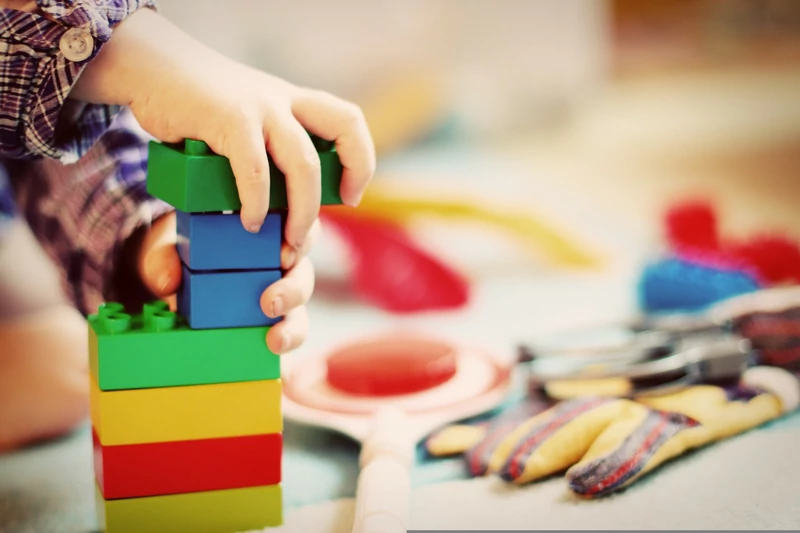
There's a reason the most enduring math concepts were originally discovered by people who arranged physical objects — stones, beads, tiles, rods. The hands and the brain are deeply connected. When a child builds something, rearranges it, and feels the result, the learning registers differently than when they copy a procedure from a board.
Educators call this concrete learning, and research consistently shows that students who start with physical materials — before pictures, before symbols, before equations — develop stronger conceptual understanding and make fewer errors when the abstraction finally arrives. The key insight: manipulation isn't a shortcut. It's the foundation.
The Mathnasium Method™ is built around this: Our instructors at Barrington are trained to meet students at the concrete level first — letting ideas take shape in their hands before ever picking up a pencil. It's one reason our students don't just pass tests; they understand math.
Try at Home
-
Use a handful of pennies to act out word problems before writing a single number down
-
Build multiplication visually: arrange equal rows of objects and count the total — arrays make the concept undeniable
-
Cut fruit or playdough into equal pieces to make fractions something your child can eat (literally)
-
Use LEGO bricks to model place value — single bricks, rows of ten, flat plates of one hundred
-
Measure everything during a baking session — doubling a recipe is a fraction and ratio lesson hiding in plain sight
For the youngest learners (ages 4–6), simple counting objects and sorting activities lay surprisingly deep foundations. Elementary students (ages 7–10) can work with fraction bars, base-ten blocks, and tangrams. Advanced or older students benefit from algebra tiles, geometric solids, and hands-on probability experiments that make statistics feel real.
Math Has a Beat — and Some Kids Hear It Before They See It | For Auditory and Rhythmic Thinkers
For children who process the world through sound, rhythm, and movement, traditional math instruction can feel like trying to read a map in a foreign language. But give them a beat, a pattern, or a melody to attach numbers to, and the same concepts land completely differently. That's not a quirk — it's actually neuroscience.
Musical thinking and mathematical thinking share the same cognitive infrastructure. Both require recognizing patterns, understanding sequences, working with ratios, and holding structure in your head over time. Children who gravitate toward music, dance, or spoken word are often natural mathematical thinkers who just haven't been taught that way yet.
Try at Home
-
Turn skip counting into a call-and-response game — one person claps the beat, the other calls the multiples
-
Set a timer for one minute and see how many times a simple rhythm can be halved or doubled — that's fractions in real time
-
Compose a "multiplication song" together for a tricky times table — the weirder the tune, the better it sticks
-
Explore how different time signatures (3/4, 6/8, 4/4) are just fractions organizing musical time
Young children (ages 4–6) absorb number sequencing naturally through songs and rhymes. Elementary students (ages 7–10) can connect clapping rhythms to multiplication patterns and use time signatures to explore fractions. Older and musically advanced learners can explore the actual math of harmonics, pitch ratios, and why certain musical intervals feel resolved while others feel tense.
The Enrichment Mindset for Barrington Youth
What unites all three of these approaches is that they treat math as something to be understood deeply — not just performed correctly. For Barrington families who want more for their children than grade-level compliance, that distinction matters.
A child who encounters math through art, through their hands, and through rhythm isn't just learning more ways to arrive at an answer. They're developing the kind of flexible, connected mathematical thinking that prepares them for advanced coursework, creative problem-solving, and a genuine relationship with numbers that lasts well beyond the next exam.
Pick one approach this week and explore it together. You may be surprised how quickly a child who "isn't a math person" starts to look like one.
Mathnasium of Barrington
Give your child the math foundation they deserve. Whether your child is looking to catch up, keep pace, or push into advanced territory, our team in Barrington builds a personalized learning plan around how they actually think. Center Director Colleen Major brings a background in elementary education and STEAM instruction — so enrichment isn't an afterthought here. Start with a free assessment and let's build something together.
Location: 106 N Northwest Hwy, #C, Barrington, IL 60010
Phone: (224) 634-6284
Grades served: K–12 · In-center and online
First step: Free diagnostic assessment — no commitment required
Mathnasium of Barrington is located at the corner of Main Street and N Northwest Highway, just east of downtown Barrington. We proudly serve families in Barrington, Deer Park, North Barrington, Lake Zurich, Lake Barrington, Fox River Grove, and surrounding communities across school districts 220, 95, 3, and 96.


 (224) 634-6284
 (224) 634-6284