The XII at the top of a grandfather clock face, the VIII in Henry VIII, and the LIX on the Super Bowl logo all have something in common.
They're all Roman numerals.
Developed over 2,000 years ago, they're still in active use around the world today.
In Texas classrooms, Roman numerals typically come up briefly in early elementary, either as part of number sense or as an additional activity in math class.
But the story behind them, where they came from, how they work, and why they never quite went away is worth a closer look.
That's exactly what Mathnasium tutors are here to uncover.

Where Did Roman Numerals Come From?
Roman numerals have been around a lot longer than Rome's math classes. Their story starts well before Rome became an empire, roughly in the 8th or 9th century BC, around the time the city itself was founded.
And here's something that might surprise you: the system wasn't entirely Roman in origin.
It descended from ancient Etruscan numerals, which were themselves adapted from Greek Attic symbols.
The Etruscans were the dominant civilization in central Italy before Rome rose to power, and the early Romans borrowed heavily from them. This kind of cultural borrowing was pretty common in the ancient world, actually.
In other words, numbering systems, like languages, rarely emerged in isolation.
And how did the symbols get their specific shapes?
Two theories tend to come up most often:
-
The tally stick theory: shepherds used to cut notches into sticks to count cattle. A single notch became I, every fifth notch was a double-cut (V), and every tenth was a cross-cut (X).
-
The hand signal theory: I, II, and III matched single raised fingers, V was a spread thumb with fingers held together, and X was made by crossing both thumbs. This one is particularly interesting because it suggests the system was built into everyday gestures before it was ever written down.
So which theory is right?
Nobody knows for sure. But both point to the same thing: this was a practical counting system, built for ordinary people long before it became the official notation of an empire.
📕 You May Also Like: 7 Amazing Facts About PI Every Math Student Should Know
Who Invented Roman Numerals? (And Why That's a Tricky Question)
This is a question that sounds simple but doesn't have a clean answer.
There was no single inventor.
No mathematician sat down one day and designed the system from scratch. Roman numerals evolved gradually, shaped by different cultures and practical needs over centuries:
-
8th – 9th century BC: The system emerges in early Rome, borrowing from Etruscan and Greek traditions.
-
6th – 3rd century BC: Rome expands across Italy, and Roman numerals become the standard for trade and record-keeping.
-
1st century BC – 4th century AD: At the height of the Roman Empire, the system traveled across three continents, appearing on monuments, coins, and official records from Britain to the Middle East.
-
Middle Ages: Roman numerals remain in widespread use across Europe for commerce and administration.
-
13th – 15th century: Arabic numerals gradually take over, better suited for complex calculation.
📕 You May Also Like: Who Invented Math – A Timeline of How Math Took Shape
How the Roman Number System Works
When you understand the logic behind Roman numerals, they're easy to read. There are seven symbols, and everything else is built from them.
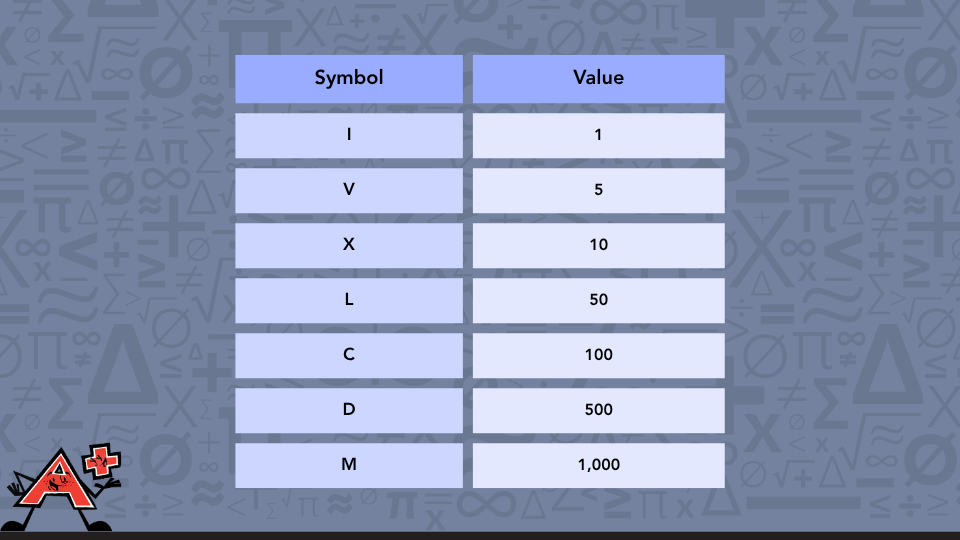
It’s as simple as that. The seven symbols, I, V, X, L, C, D, and M, stand respectively for 1, 5, 10, 50, 100, 500, and 1,000, and every number is a combination of those building blocks.
Symbols are usually added together from left to right, starting with the highest value.
Any exceptions to this rule? Only one.
If a lower value symbol appears directly before a higher one, you subtract it instead.
-
IV means 5 minus 1, so 4.
-
IX means 10 minus 1, so 9.
This subtractive principle was added on later.
Earlier versions of the system simply used IIII for 4 and VIIII for 9, which can still be seen on traditional clock faces today.
It's a system based on logic, not memorization.
And what about zero?
Simply put, it doesn't exist in this system. That's one of the key reasons Arabic numerals eventually took over.
Try It Yourself: Read and Write Roman Numerals
Now that you know the reasoning behind the Roman numerals, let’s see if you can use them. Try these exercises on your own.
When you’re done, find the answers at the bottom of the guide.
Challenge 1
Convert these numbers to Roman numerals:
-
9
-
44
-
99
-
2026
-
3,749
Challenge 2
Now go the other way. What numbers are these?
-
XIV
-
XL
-
CDLX
-
MCMXC
-
MMCDXLIV
Where You Still See Roman Numerals Today and Why It's Worth Knowing Them
Roman numerals outlasted the empire that created them. We didn’t stop using them even after Arabic numerals took over.
Today, you'll find them in more places than you realize:
-
Clocks and watches: The Roman numeral clock face has been a design staple for centuries and remains common today.
-
Books: Front-matter pages (introductions, prefaces, tables of contents) are numbered in Roman numerals, separate from the main text.
-
Film and television: Production companies have long used Roman numerals in copyright years, and film sequels use them in their titles.
-
Major events: The Super Bowl is probably the most recognizable example. The annual sporting event presents a puzzle for fans who are not familiar with the number system.
-
Royalty and religion: Kings, queens, and popes have used Roman numerals to distinguish themselves (Henry VIII or Pope Benedict XVI).
-
Medicine and science: Roman numerals appear in pharmaceutical dosing, music theory, seismology, and other fields.
There's also an educational benefit to learning this system.
Roman numerals have no zero and no place value, and that gap is what makes them useful in the classroom. When students work with a system that doesn't have these elements, they can appreciate why our current number system is built the way it is.
For students working on number sense or preparing for more advanced math, that perspective shift can be very useful.
In other words, studying a number system that has no zero and no place value turns out to be one of the best ways to understand why our current system works the way it does.
📕 You May Also Like: 5 Ethiopian and Eritrean Math Learning Traditions You Should Know About

Whether through games, hands-on activities, or fun math stories, Mathnasium keeps students engaged and excited about learning.
How Mathnasium Makes Math Learning Fun
Mathnasium is a math-only learning center helping K-12 students of all skill levels learn and master math.
No two learners are the same, and the way they learn math shouldn't be either. Some students love seeing the logic behind a concept. Others need something hands-on and tangible. And some connect best through a good story, like the one we explored today.
Our proprietary teaching approach, the Mathnasium Method™, is designed around how each student learns differently.
It begins with a diagnostic assessment that helps us pinpoint what a student already knows and where they need support. With those insights, we build a learning plan customized to their needs and goals.
With the plan in place, our specially trained tutors deliver face-to-face math instruction in an engaging and supportive setting. We use natural, everyday language rather than math jargon and combine verbal, visual, mental, tactile, and written techniques to help students truly make sense of what they're learning.
When students get stuck, we break concepts down into manageable steps and explain both the how and the why. Over time, they develop the critical thinking and problem-solving skills to work independently.
Fun is a core part of the approach. Whether through stories, game-based activities, or real-world exploration, learning never feels like a chore. We celebrate progress at every level, building confidence session by session.
The results speak for themselves:
-
94% of parents report an improvement in their child's math skills and understanding
-
93% of parents report their child's improved attitude toward math after attending Mathnasium
-
90% of students saw an improvement in their school grades
We operate over 1,100 learning centers, bringing our proven approach close to your home.
For families in and near Carrollton, TX, Mathnasium of Castle Hills is a trusted local center with years of experience building confident math thinkers.
Our community recognizes our impact and has honored us with:
Whether your child is looking to catch up, keep up, or get ahead, our team is ready to help.
Ready to get started?
📅 Schedule a Free Diagnostic Assessment at Mathnasium of Castle Hills
Not near Castle Hills?
📍 Find Mathnasium Learning Centers Near You
Check Your Answers Here
If you’ve given our exercises a try, check how you did below.
-
IX
-
XLIV
-
XCIX
-
MMXXVI
-
MMMDCCXLIX
-
14
-
40
-
460
-
1,990
-
2,444


 (972) 939-6284
 (972) 939-6284