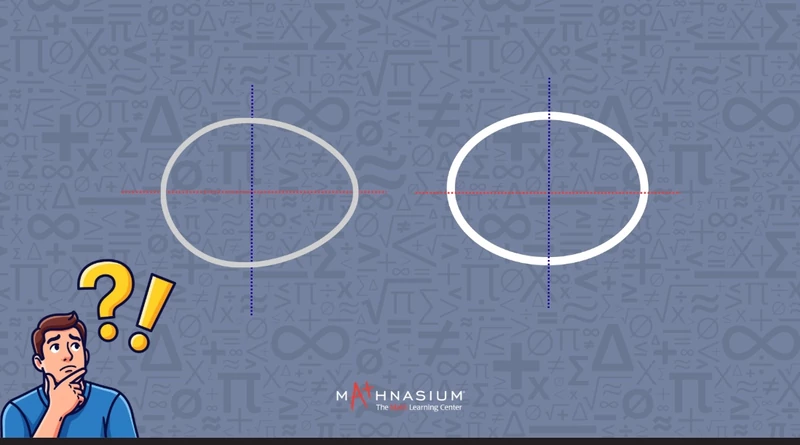
Your child probably called it an oval long before they ever heard the word ellipse. In kindergarten and first grade, they were naming shapes such as eggs, footballs, stretched circles, and "oval" covered all of them just fine.
Then, somewhere around fourth or fifth grade, their teacher introduced the word ellipse. Maybe it came up in a geometry lesson or a science class about how planets move. Either way, your child likely thought, "Wait, isn't that just an oval?"
By middle school, the two terms start pulling apart. Under Common Core math standards, students work with axes, symmetry, and precision, and ellipses start to mean something very specific.
Let's break it down, starting with what each of these terms represents, looking at examples, and comparing and contrasting them. By the end, you'll have the language and understanding to help your child see the difference clearly.
What Is an Oval?
An oval is a smooth, closed shape that curves gently all the way around. There are two kinds:
-
Egg oval: One end tapers sharply, the other stays rounder (lopsided look).
-
Football oval: Both ends taper to points, but still smooth, not sharp.
If your child folds an oval in half, they'll typically find only one way the two sides match up perfectly. That single line of symmetry sets ovals apart from ellipses.
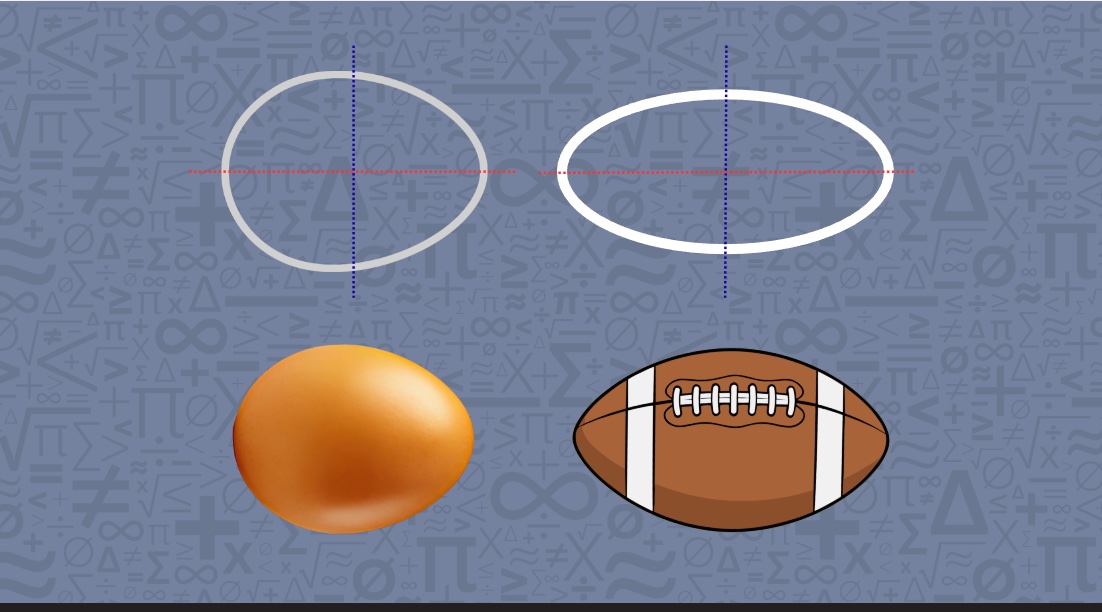
Ovals don't follow a strict mathematical rule. Your child can draw one freehand, and it will still count as long as it's smooth, closed, and rounded.
📕 You May Also Like: What is Symmetric Property? Everything You Need to Know
What Is an Ellipse?
An ellipse is a stretched circle, perfectly balanced, with two lines of symmetry instead of one. Fold it in half along the horizontal axis, and both sides match. Fold it in half along the vertical axis, and both sides still match.
A simple activity can make this a lot easier for your child. Have them pin two points on a piece of paper, loop a string around both, pull it taut with a pencil, and trace all the way around. The path the pencil follows? That's an ellipse.
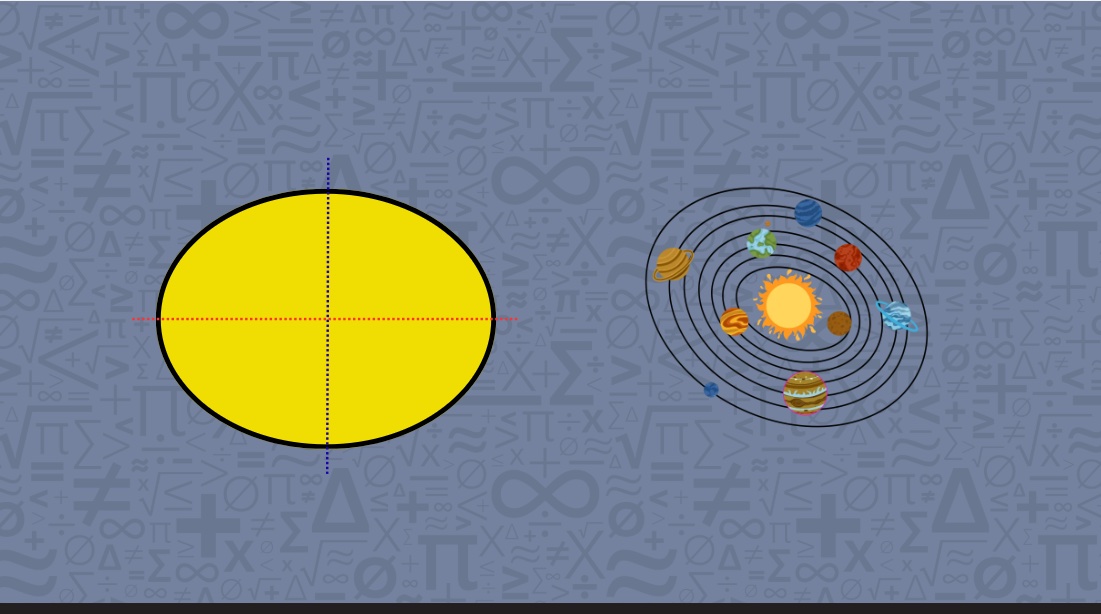
As another example, imagine slicing through a cone at an angle. The outline of that cut is an ellipse. It's a shape that shows up in nature more than most people realize, including the path every planet takes around the sun.
How Are They Different?
Now that you have a clear picture of both shapes, here's a side-by-side comparison covering three key areas:
-
How each shape is described
-
How many lines of symmetry it has
-
Where you'll spot it in everyday life
|
Feature
|
Oval
|
Ellipse
|
|
Shape
|
Egg-like, one end may taper
|
Stretched circle, balanced both ways
|
|
Symmetry Lines
|
Usually 1
|
Always 2
|
|
How to Make
|
Draw freehand
|
Use string + 2 pins
|
|
Everyday Examples
|
Egg, football
|
Racetrack, planets’ orbits around the Sun
|
📕 You May Also Like: What Is a Line of Symmetry? A Complete, Kid-Friendly Guide
The Symmetry Test: A Simple Way to Tell Them Apart
Most of our students find symmetry to be the easiest way to tell ovals and ellipses apart. Here's a simple test your child can try:
-
Fold it in half one way and ask ‘’Do both sides match perfectly?’’
-
Now fold it the other way and ask, ‘’Do both sides still match?’’
If both folds work, you have an ellipse. If only one fold works, you have an oval.
Next time your child comes across one of these shapes, have them draw it on paper and put the fold test to work. Sketch a football shape, a racetrack, and a planetary orbit, then fold and see what happens. It's a quick, satisfying way to confirm what they already know.
FAQs About Ovals and Ellipses
Here are some questions we hear most from our students.
1. Is every ellipse an oval?
Yes. Every ellipse is an oval. It's smooth, closed, and rounded. The difference is that an ellipse also meets a stricter set of rules, like having exactly two lines of symmetry. Think of ellipses as a more precise version of ovals, which is why the term tends to show up later in your child's math journey.
2. Is every oval an ellipse?
No. Ovals don't have to follow the same precise rules as ellipses. An oval can have just one line of symmetry and still be a valid oval. For a shape to qualify as an ellipse, both folds of the symmetry test need to work perfectly. Horizontal and vertical.
3. Is a circle a type of ellipse?
Yes! A circle is actually a special kind of ellipse where both axes are exactly the same length. If your child stretches it slightly in one direction, it becomes a regular ellipse. It's a concept that tends to surprise students and parents the first time they hear it.
4. Why does an ellipse have two lines of symmetry, but an oval usually has one?
An ellipse follows strict mathematical rules that force it to be balanced in both directions along its longer axis and its shorter axis. Ovals don't follow those same rules, so they can taper more on one end, leaving them with just one line of symmetry.
A helpful way to explain this to your child is to think of an ellipse as a shape that has to pass the fold test twice.
5. Why do planets orbit in ellipses and not circles?
Gravity pulls planets toward the Sun, but planets also carry momentum from when the solar system first formed. These two forces together produce a stretched, balanced path, an ellipse.
It's a great real-world example to share with your child when ellipses come up in class, because it goes beyond just a geometry concept and shows how the universe actually moves.
Mathnasium instructors break down the difference between ovals and ellipses step by step, building lasting confidence in geometry.
How Mathnasium Helps Students Master Geometry
Mathnasium is a math-only learning center dedicated to helping K-12 students catch up, keep up, and get ahead in math.
Shapes like ovals and ellipses are concepts that can feel fuzzy for years until someone explains them the right way. At Mathnasium, our specially trained tutors break down geometry concepts step by step, helping students build the clarity and confidence they need to move forward.
We do this through the Mathnasium Method™, our proprietary teaching approach. Each student starts with a diagnostic assessment that helps us identify their current skills, knowledge gaps, and goals. From there, we build a personalized learning plan that introduces concepts gradually and builds on what they already know, so nothing feels out of reach.
Once the plan is set, our instructors follow it closely, delivering face-to-face math instruction in a supportive and engaging setting.
We use plain, everyday language to explain math and geometry concepts rather than relying on heavy jargon and draw on a mix of verbal, visual, mental, tactile, and written techniques so students can approach each concept from different angles.
Our sessions are fun by design. Games and hands-on activities keep learning enjoyable, and we track every student's progress along the way. Every win gets celebrated, big or small, and that consistent recognition grows confidence with each session.
And the results speak for themselves:
-
94% of parents report an improvement in their child's math skills and understanding
-
93% of parents report their child's improved attitude toward math after attending Mathnasium
-
90% of students saw an improvement in their school grades
With over 1,100 centers, we bring the Mathnasium Method™ close to your community.
For families located in or near Chester, VA, Mathnasium of Chester is a trusted local center with years of experience helping K-12 students excel in math.
Whether your child is looking to catch up, keep up, or get ahead in math, our team is happy to help. Ready to get started?
📅 Schedule a Free Diagnostic Assessment at Mathnasium of Chester
Not near Chester?
📍 Find Mathnasium Learning Centers Near You


 (804) 706-4321