Knowing how to compute and knowing how to solve a problem are two different things, and it is possible to have one without the other.
A student can add, subtract, multiply, and divide with complete accuracy and still get stuck on a word problem or an unfamiliar multi-step question. Why? Because those require a different skill: figuring out what to do before you do it.
And like any skill, this one can be taught.
Today, Mathnasium instructors share four problem-solving strategies that help students figure out what to do when a problem does not have an obvious path forward. They work across grade levels, and each one gives students something concrete to reach for instead of giving up.

Strategy 1: Draw a Picture or Diagram
Some problems are hard to hold in your head all at once.
There are multiple quantities and conditions that all need to be satisfied at the same time. Trying to track all of that mentally while also figuring out what to do is a lot to manage.
Drawing the problem out transfers that load off working memory and onto the page, and it often reveals relationships that were not obvious in the text.
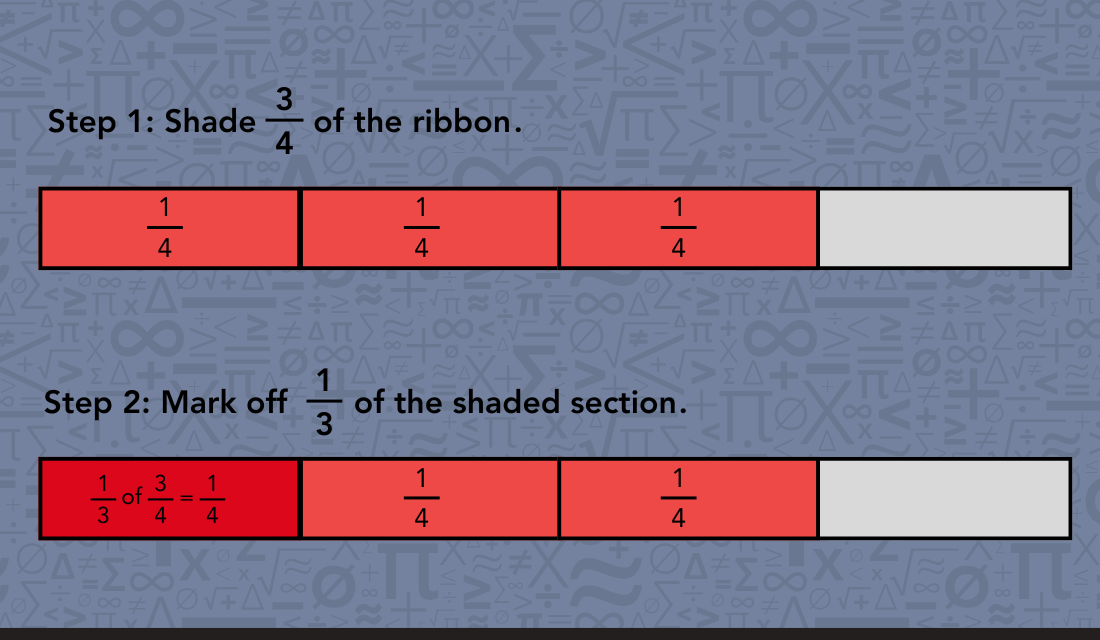
Take this example: Maya has a ribbon.
She uses \(\Large\frac{1}{3}\) of \(\Large\frac{3}{4}\) of it for a project. How much of the ribbon did she use?
When a student sketches a rectangle, shades \(\Large\frac{3}{4}\) of it, and then marks off a third of that shaded section, they can see that the answer is \(\Large\frac{1}{4}\) of the ribbon before they have written a single equation. The drawing is doing the thinking.
This strategy works across a wide range of problem types: distance and rate problems, fraction comparisons, geometry, and multi-part word problems.
The drawing does not need to be accurate or artistic. It is a thinking tool, and even a rough sketch can get the job done.
This one is worth trying first whenever a problem describes a situation with multiple parts that are hard to picture from the text alone.
📕 You May Also Like: 5 Practical Ways to Use Diagrams and Drawings for Math Problems
Strategy 2: Rewrite the Problem in Your Own Words
Word problems often contain information that has nothing to do with the calculation.
Decorative details, extra context, and loosely related facts can make a problem feel more complex than it actually is.
The strategy is simple: before attempting a solution, rewrite the problem in one or two plain sentences, keeping only the numbers and the question.
For example, imagine you got the following word problem:
“Liam is setting up a prize booth at the school fair. There are 4 prizes, and each prize bag contains 3 chocolates, 2 stickers, and 1 small toy. Chocolates cost 50c each, stickers cost 20c each, and small toys cost $1.50 each. If Liam has $20 to spend, how much money will he have left after buying everything?"
A student should rewrite this as "Each bag costs (3 × 50c) + (2 × 20c) + $1.50, and there are 4 bags, so I need to find the total cost and subtract it from $20."
This has already done most of the hard work.
The school fair, the prize booth, and the list of items are irrelevant to the calculation. What remains is a straightforward multi-step problem.
This strategy is very useful in standardized tests and exams, where word problems are commonly written with extra information to test whether a student can identify what actually matters.
📕 You May Also Like: How to Nurture Confident Math Thinkers, Not Just Answer-Getters
Strategy 3: Create a Placeholder Example
Formulas and rules are easy to forget under pressure, especially in an exam.
This strategy gives students a way to reconstruct a rule they cannot quite remember.
The idea is to commit one concrete, easy-to-verify example of a concept to memory and use it to work back to the underlying rule when needed.
Take the Pythagorean theorem.
Say a student cannot remember whether the formula combines the two shorter sides using addition or multiplication.
To check, they recall their placeholder: a right triangle with sides 3, 4, and 5.
-
Testing addition: 3² + 4² = 9 + 16 = 25, and the square root of 25 is 5, which matches the hypotenuse.
-
Testing multiplication: 3² x 4² = 9 x 16 = 144, and the square root of 144 is 12, which does not.
Addition is correct, and the formula is confirmed.
The same approach works across geometry, fractions, algebra, and more.
The simpler the placeholder, the more reliably this one works.
Strategy 4: Substitute Numbers for Unknowns
Algebra and abstract problems can feel impenetrable when letters and symbols are standing in for quantities that have no obvious value yet.
A useful move is to temporarily replace those unknowns with simple numbers, work through the problem with those numbers to understand what it is actually asking, and then apply the same logic back to the original.
Here is what this looks like when simplifying 2(x + 3):
-
Swap x for 5: 2(5 + 3) = 2 x 8 = 16
-
Now try it without brackets: 2 x 5 + 2 x 3 = 10 + 6 = 16
-
The results match, and you can now see what the brackets were doing: distributing the 2 across both terms inside
-
Applying that back to the equation gives us the answer: 2(x + 3) = 2x + 6
The substitution made the structure of the problem visible, which is often all a student needs to take the next step.
This strategy is particularly useful in algebra, but it applies anywhere a problem feels abstract before the numbers are in place.
Students can also use this method to quickly check whether their answers make sense, which is a big plus.
📕 You May Also Like: How to Solve Basic Equations — A Parent and Student Guide

Mathnasium instructors always make sure to connect new concepts to ones the student already understands.
How Mathnasium Helps Students Become Better Problem Solvers
Mathnasium is a math-only learning center dedicated to helping K-12 students catch up, keep up, and get ahead in math.
Problem-solving is one of the clearest examples of why the approach inside our centers goes beyond computation.
Supporting a student so that they can think their way through an unfamiliar problem requires more than drilling procedures. It requires developing reasoning and the kind of metacognitive habits that the four strategies above are built around.
That is exactly what we focus on at Mathnasium.
To help students expand their mathematical thinking, we use the Mathnasium Method™, our proprietary teaching approach built around six core principles:
-
Personalization on a granular level: Each student begins with a diagnostic assessment that identifies their strengths, knowledge gaps, and how they approach math. Instructors then follow personalized learning plans that guide steady, structured progress.
-
Teaching for understanding: We explain math using clear, everyday language and support each concept with visual, verbal, written, mental, and hands-on techniques so students develop a deep understanding of math rather than a surface familiarity with procedures.
-
Caring instruction: Our instructors provide caring guidance in a fun group environment where students feel supported as they tackle challenging material, including the kinds of unfamiliar problems that tend to knock confidence most.
-
Independent problem-solving and critical thinking: Each session includes time for students to work through problems on their own. Instructors guide them to understand both how and why a concept works, building the reasoning habits that transfer across every topic they will encounter.
-
Singular focus on math: Our program spans thousands of pages and has been continuously refined over the past 20 years. That singular focus allows us to take a deep dive into how students best absorb, learn, and retain mathematical concepts.
-
Empowering, fun learning environment: Our materials are game-based, and students have the chance to earn rewards as they advance. It is an environment designed to keep kids motivated and engaged, session after session.
And the results? They speak for themselves:
-
94% of parents report an improvement in their child's math skills and understanding
-
93% of parents report an improved attitude toward math after attending Mathnasium
-
90% of students saw an improvement in their school grades
With over 1,100 centers, we bring the Mathnasium Method™ close to your community.
For families based in or near Chester, VA, Mathnasium of Chester is a trusted local center with years of experience helping students reach their goals in math.
Whether your student is looking to catch up, keep up, or even get ahead in math, our learning center is delighted to help.
Ready to get started?
📅 Schedule a Free Diagnostic Assessment at Mathnasium of Chester!
Not near Chester?
📍 Find Mathnasium Learning Centers Near You


 (804) 706-4321