Think of two numbers: say, 10 and 20. What’s halfway between them?
If you guessed 15, you’re already working with the idea of a midpoint. You added the two numbers together, then divided by 2. That’s the average, and it’s the same method we use to find the exact center between two points on a number line or a graph.
Understanding midpoints starts with something simple: splitting a distance evenly. Whether it’s between two numbers, two places, or two points on a graph, the idea stays the same.
Today, our tutors are breaking it down step by step so you can learn what a midpoint really means and how to find it with ease, both visually and using a simple formula.

What Is a Midpoint in Math?
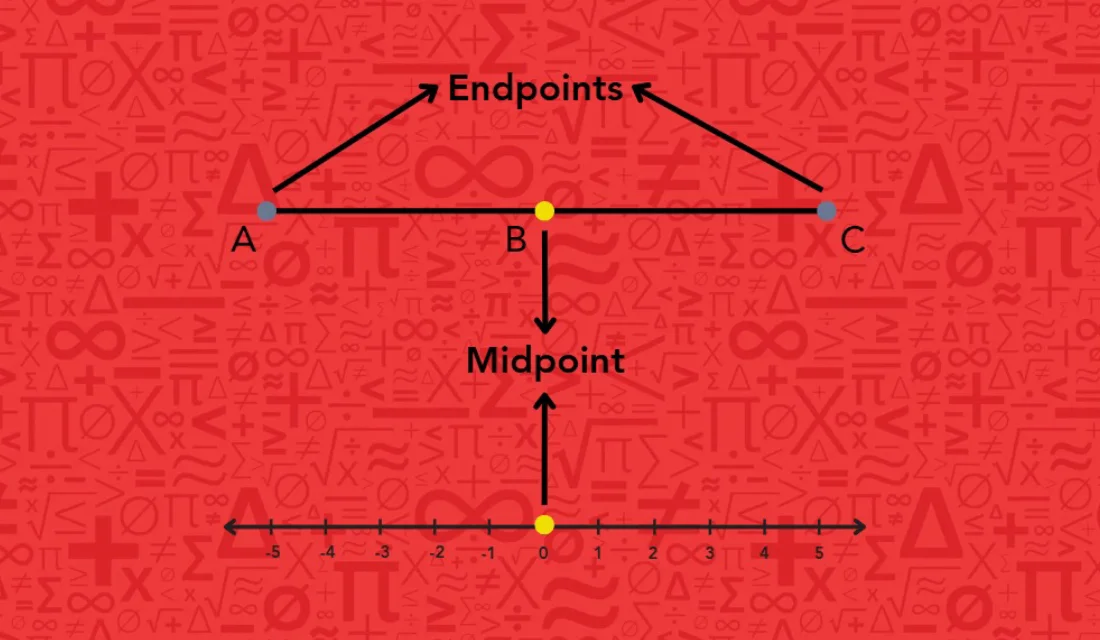
A midpoint is the exact center between two values or two points. It’s the halfway mark, equal distance from both ends.
In math, we usually talk about the midpoint of a line segment. That means a straight path connecting two points. The midpoint sits right in the middle, splitting the segment into two equal parts.
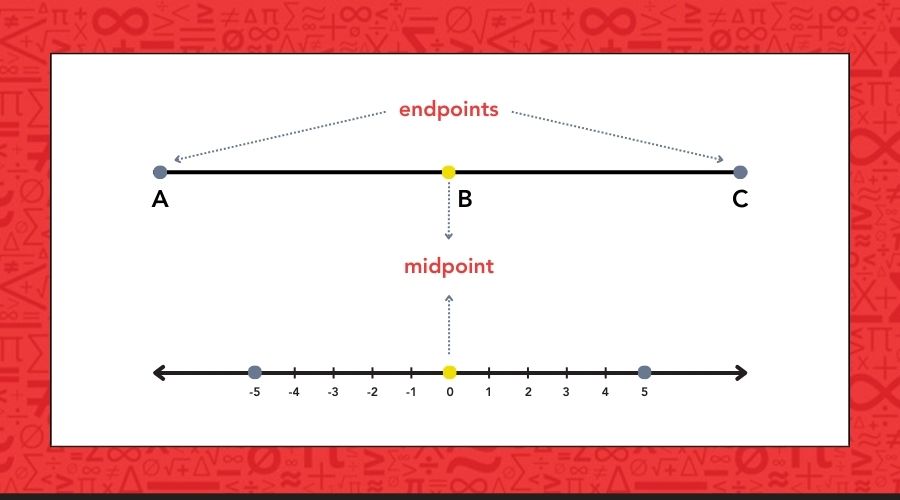
You’ve seen this idea before, even outside of math class. Think about walking halfway across a bridge or marking the center of a number line.
On a graph, the midpoint is the dot that’s perfectly balanced between two others, the same distance left and right, up and down.
Whether you’re measuring distance, drawing shapes, or solving problems on a coordinate plane, midpoints help you find balance and symmetry.
📕 You May Also Like: What Are Mean, Mode, Median & Range in Math?
How to Find the Midpoint of a Line Segment
There are two ways to find a midpoint: one you can see, and one you can calculate.
-
If you’re working with a graph, you can often spot the midpoint just by looking at where the center falls between two points.
-
If you're working with coordinates, there's a quick formula that shows you the exact midpoint using simple math.
Let’s walk through each approach step by step.
1. Using a Graph
When we’re given coordinates, we can find the midpoint visually on the graph.
We’ll take it step by step, starting with horizontal and vertical line segments, then moving to a diagonal.
That way, we can see exactly how the midpoint works in each case.
A. Horizontal Line Segment
Let’s start with a segment where both points lie on the same horizontal line.
We’re given two coordinates:
A at (2, 4) and B at (6, 4)
Let’s find the midpoint.
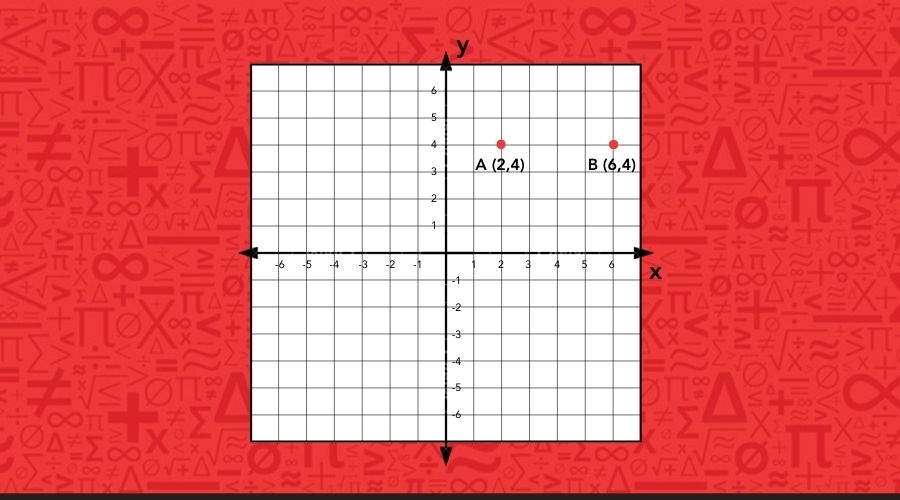
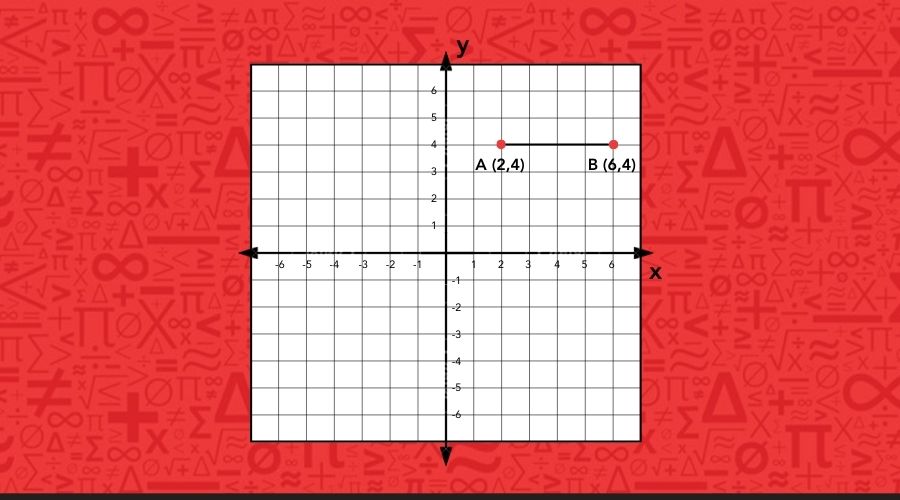
The x-values go from 2 to 6, a total of 4 units. Halfway between 2 and 6 is 4. The y-value stays the same.
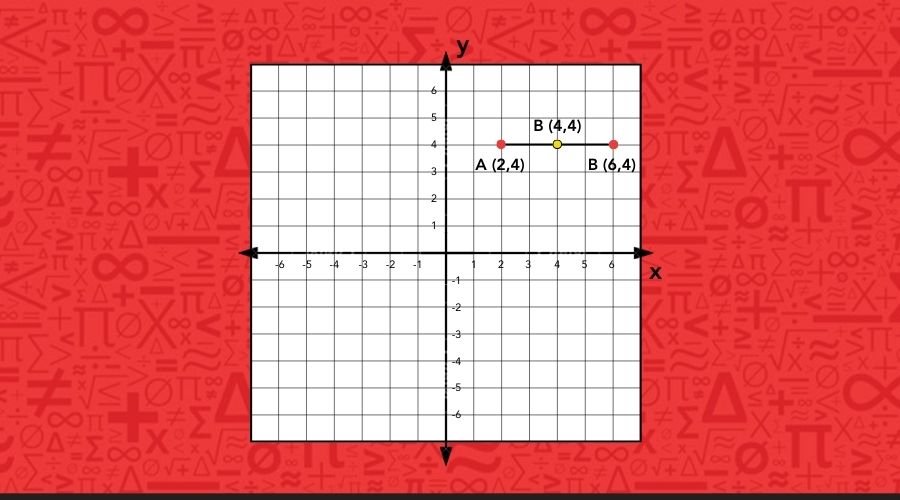
So, the midpoint is (4, 4).
B. Vertical Line Segment
This time, both points share the same x-value, but their y-values are different.
We have two pairs of coordinates:
A at (3, 2) and Point B at (3, 6)
Let’s see what the midpoint is.
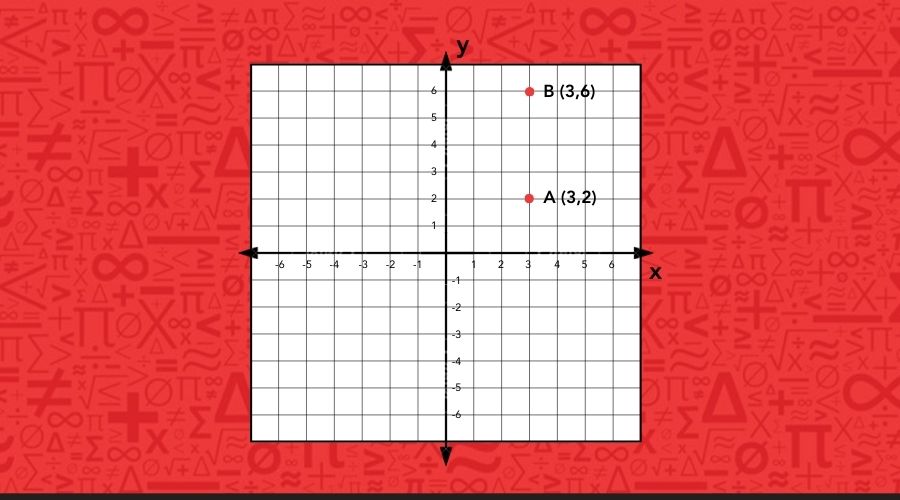
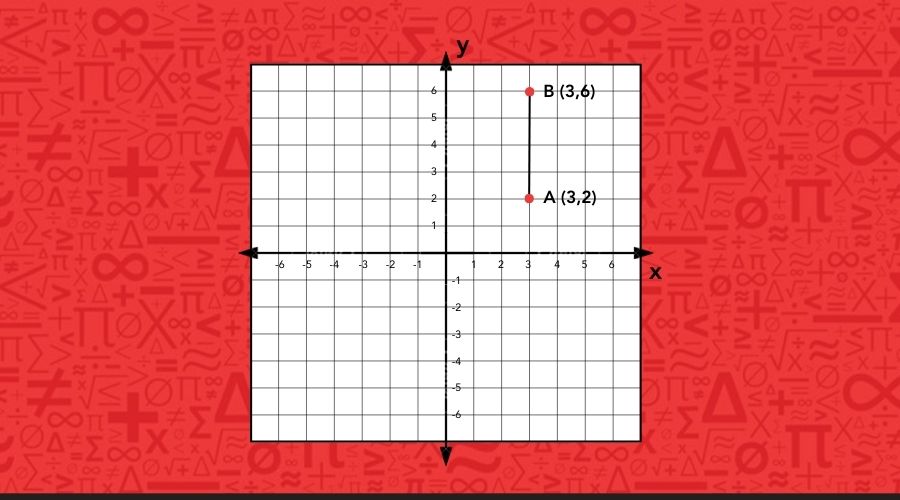
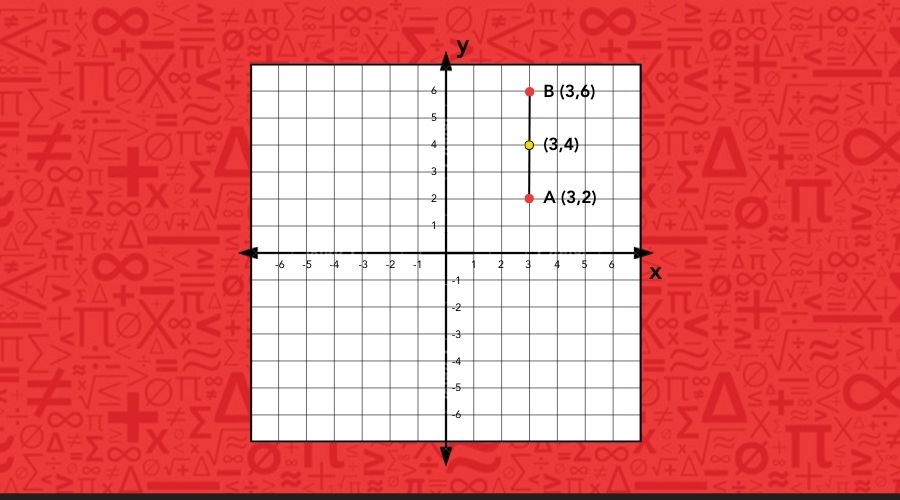
So, the midpoint is (3, 4).
What do both of these examples have in common?
In each one, we found the midpoint by taking the number halfway between the coordinates that changed, whether it was x or y.
But what if both the x-values and y-values change?
Let’s try that next.
C. Diagonal Line Segment
Now we’re working with a segment where both the x-values and y-values are different.
We’re given two coordinates:
A at (–4, 2) and B at (2, –2)
To find the midpoint, we can:
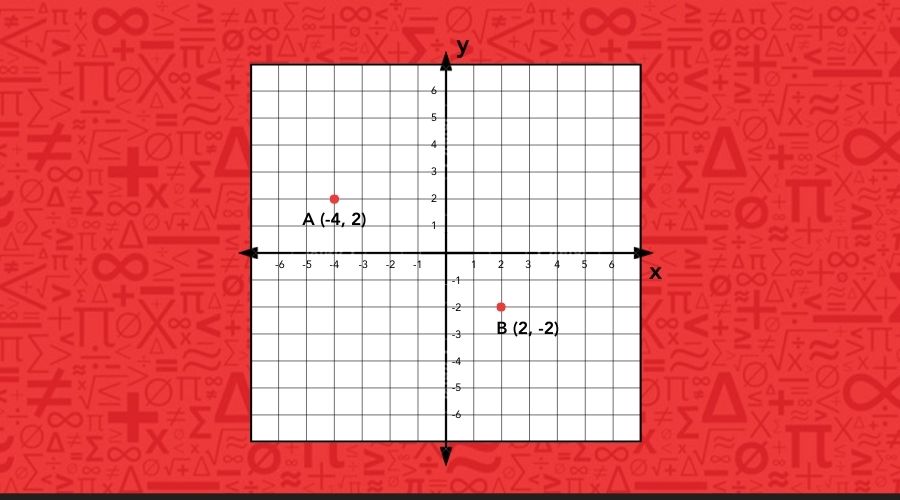
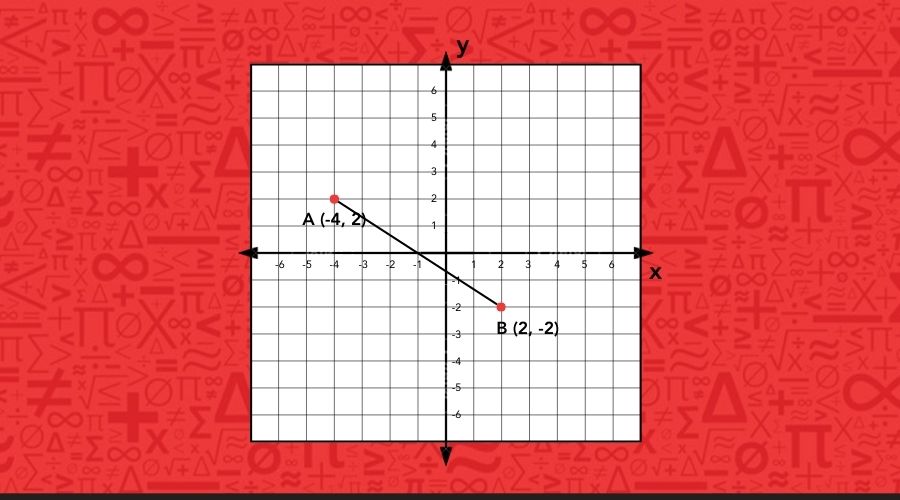
The x-values go from –4 to 2, which is a distance of 6 units. Halfway between –4 and 2 is –1.
The y-values go from 2 to –2, a distance of 4 units. Halfway between 2 and –2 is 0.
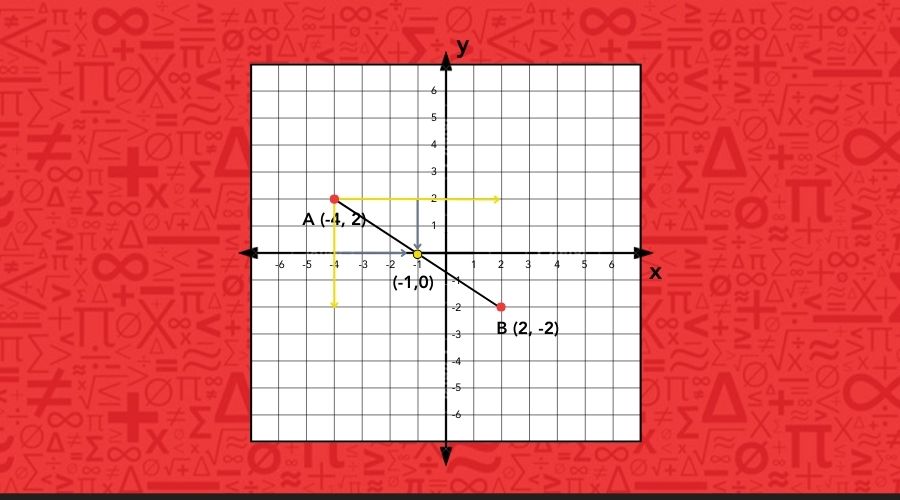
That gives us a midpoint of (–1, 0).
📕 You May Also Like: What Is a Line Segment? A Complete & Kid-Friendly Guide
2. Using the Midpoint Formula
Now that we’ve looked at all three types of line segments on a graph, take a moment to think about what’s been true every time we found the midpoint:
-
When only the x-values changed, we found the midpoint by taking the value halfway between them.
-
When only the y-values changed, we did the same: found the number halfway between the two y-values.
-
When both x and y changed, we found the midpoint by finding halfway points in both directions.
So basically, we were finding the average of the two x-values and the average of the two y-values.
That’s exactly what the midpoint formula does:
xm, ym = \((\Large\frac{x_1 + x_2}{2}\) , \(\Large\frac{y_1 + y_2}{2})\)
Shall we test it?
Let’s take the same coordinates we used in the third example:
A at (–4, 2) and B at (2, –2)
We’ll plug them into the midpoint formula:
xm, ym = \((\Large\frac{-4 + 2}{2},\Large\frac{2 + (-2)}{2}) = (\Large\frac{-2}{2}, \Large\frac{0}{2}) = (-1, 0)\)
And just like that, we land on the same midpoint we found on the graph: (–1, 0).
Your Turn: Practice with Midpoints
Time to practice what you’ve learned. Try these midpoint challenges on your own.
When you’re done, check your answers at the bottom of the guide.
Challenge 1
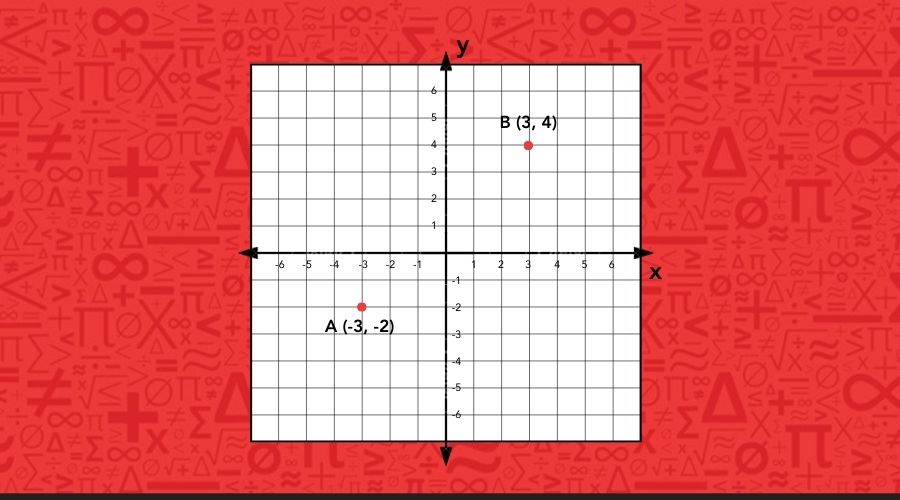
Below, you’ll see two points plotted on a coordinate grid: A at (–3, –2) and B at (3, 4).
Can you find the midpoint on the graph?
Challenge 2
Sarah and her family are driving 120 miles to visit her grandma. After some time on the road, they stop at a gas station 40 miles into the trip.
How far is the gas station from the midpoint between their home and Grandma’s house?
Frequently Asked Questions About Midpoint
Learning about the midpoint doesn’t come without questions. We’ve gathered a few that often come up at our Mathnasium centers and answered them clearly below.
1. When do students first learn about the midpoint?
Students are introduced to midpoint thinking (as “in the middle” or “halfway between”) early on, usually on number lines in upper elementary. The formal idea of midpoint on a coordinate grid typically appears in middle school, during pre-algebra or early geometry.
2. Can the midpoint be a decimal?
Yes. When the numbers don’t split evenly, the midpoint will be a decimal or a fraction. That just means it still falls exactly between the two points, even if the values aren't whole.
3. Do I need a graph to find the midpoint?
No, but it helps. A graph makes it easier to see what’s happening, especially early on. Once you’re comfortable, you can find the midpoint using the formula or mental math—no graph needed.
4. Is the midpoint always part of the line segment?
Yes. The midpoint lies right on the segment, exactly between the two endpoints.
How Mathnasium Helps Students Learn and Master Any Math Concept
At Mathnasium, we believe true understanding doesn’t come from memorizing steps or relying on formulas alone. In fact, insisting on them, without first building understanding, can make math feel confusing and rigid.
That’s why we don’t take a one-size-fits-all approach. Instead, we use our proprietary teaching method: the Mathnasium Method™.
It all begins with a diagnostic assessment. When students come to us for math support, this assessment gives us a window into what they know, where they’re struggling, and how they learn best.
From there, we design a personalized learning plan, whether the focus is on geometry, algebra, or building stronger number sense.
To help students truly grasp ideas like midpoint, we break down the concept into manageable parts and teach it using a blend of visual, verbal, mental, tactile, and written methods. If something doesn’t click right away, we adjust the approach, guiding students toward both the how and the why behind each concept.
Many of our activities are game-based, and we use frequent rewards to keep students engaged, motivated, and confident in their progress.
Working with our specially trained instructors, students see measurable results:
-
94% of parents report an improvement in their child's math skills and understanding
-
93% of parents report an improved attitude towards math after attending Mathnasium
-
90% of students saw an improvement in their school grades
If your student is looking to catch up, keep up, or get ahead in math, Mathnasium can help. Find your local learning center and contact them. We’ll schedule a diagnostic assessment and carve a personalized plan to put them on the best path to math mastery.

Pssst! Check Your Answers Here
If you’ve tried our challenges, check your answers here.
Challenge 1 Solution
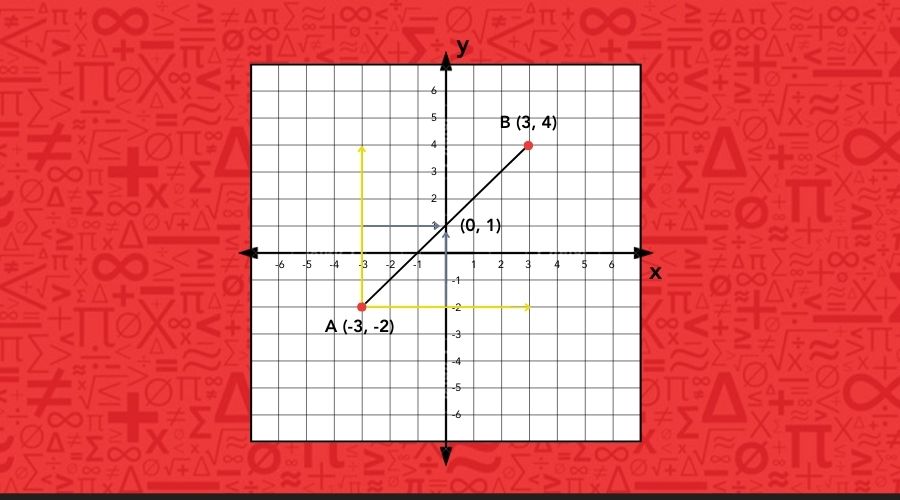
Using the graph, we see that the midpoint is (0,1).
The midpoint formula gives us the same midpoint:
xm, ym = \((\Large\frac{-3 + 3}{2},\Large\frac{-2 + 4}{2}) = (\Large\frac{0}{2}, \Large\frac{2}{2}) = (0, 1)\)
Challenge 2 Solution
The midpoint of the trip is halfway between 0 and 120 miles, which is 60 miles.
Since the gas station is at 40 miles, it’s 60 − 40 = 20 miles before the midpoint.
Answer: The gas station is 20 miles from the midpoint.


 (704) 883-5355