If we want to measure an area of a common 2D shape, we usually need just one or two measurements. Squares are the easiest; we measure one side and double it to find the area. To calculate the area of a rectangle, we need its length and width, while for triangles, we need the base and height.
But circles? They don’t have corners, sides, or edges, so how do we figure out their size?
That’s where the diameter comes in.
In this guide, we’ll explore what a diameter is, different ways to measure it, and real-life examples. You’ll also get a chance to practice your skills and answer some of the most common questions students have about diameters.

What Is a Diameter?
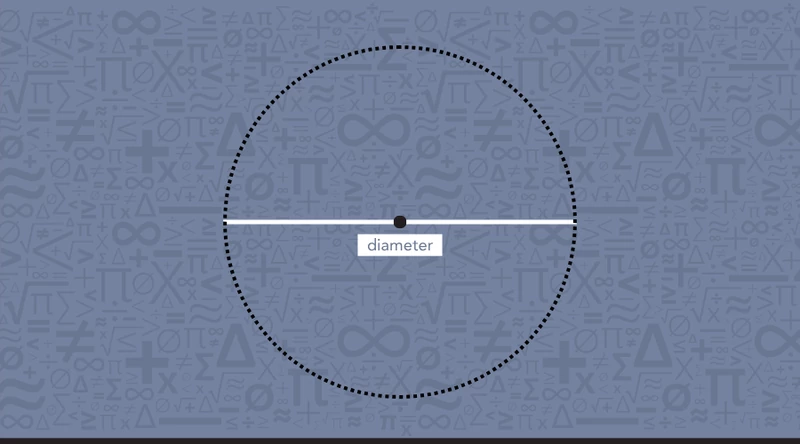
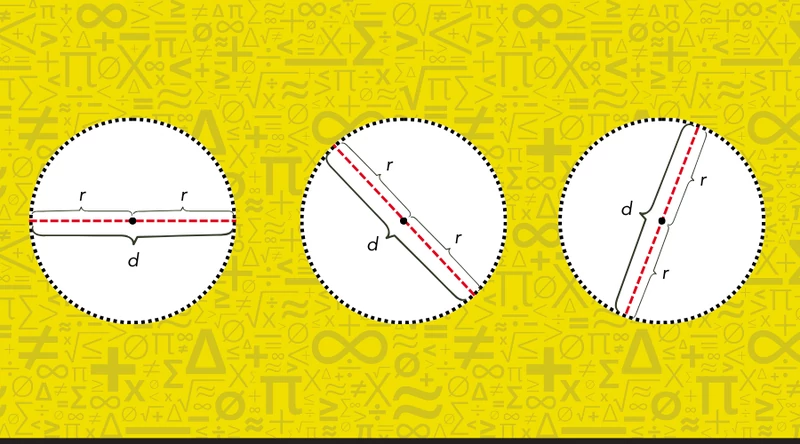
The diameter of a circle is the straight distance from one side to the other through the center of the circle.
In other words, the diameter shows how wide the circle is, but only when that line goes through the center. It’s the longest line you can draw across a circle, and it helps us understand the circle’s overall size.
We see diameters in everyday life, often without even realizing it.
Think about slicing a circular cake right down the middle, measuring across a round dinner plate, or designing a wheel that needs to spin just right. In each case, you’re dealing with the diameter.

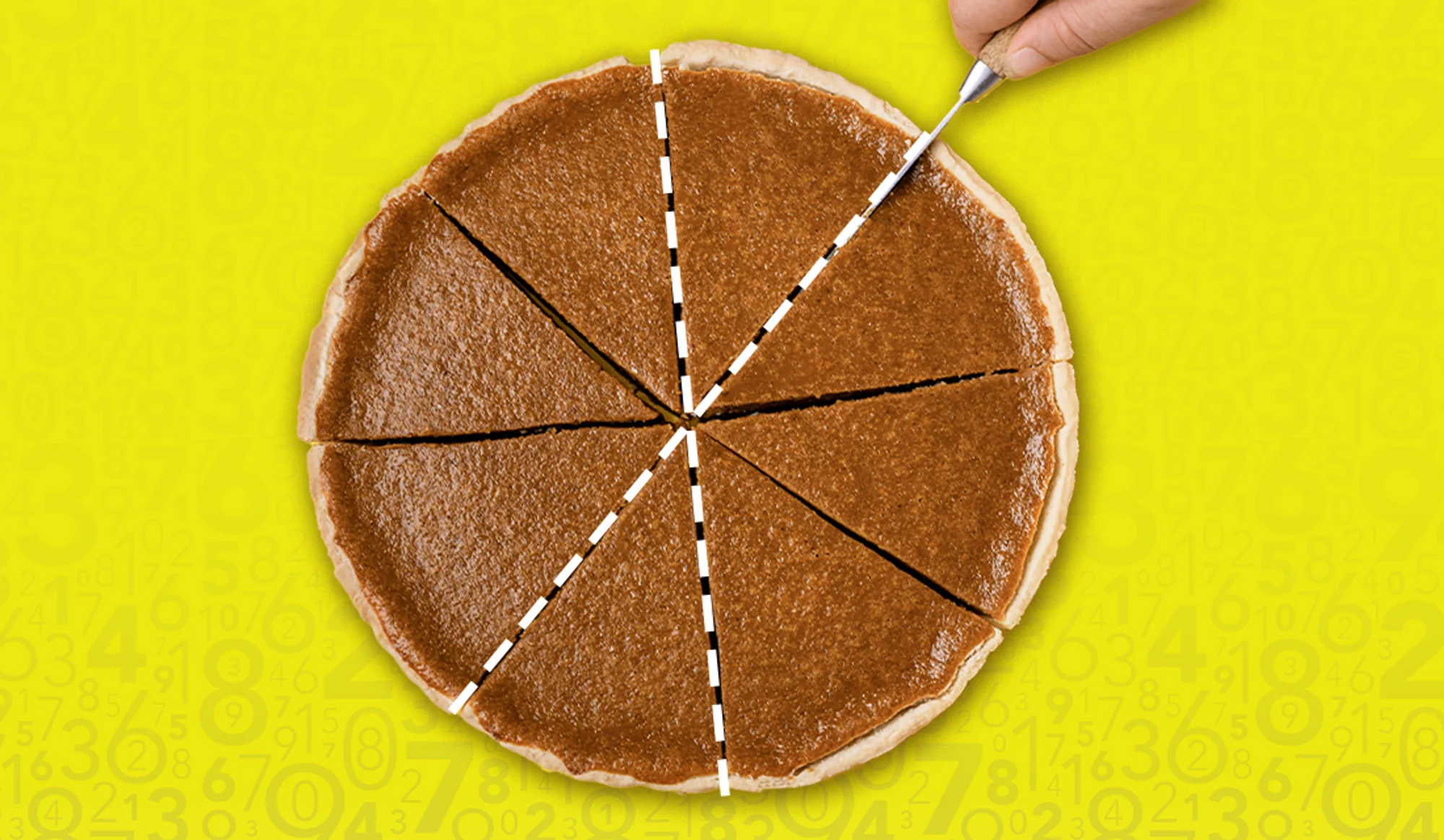
Each time we cut a cake, pie, or pizza from side to side down the middle, we are cutting along the diameter
In math, we use d to represent diameter. This helps us write and understand circle measurements more easily, especially in math problems or diagrams.
So if we see something like d = 5 inches, that tells us the circle is 5 inches wide from one side to the other, going straight through the center.
Diameter, Chord, Radius, Circumference – What’s the Difference?
Diameter is often measured alongside other important parts of a circle, the radius, the circumference, or a chord.
Since these terms can sometimes be mixed up, let’s take a moment to break each one down.
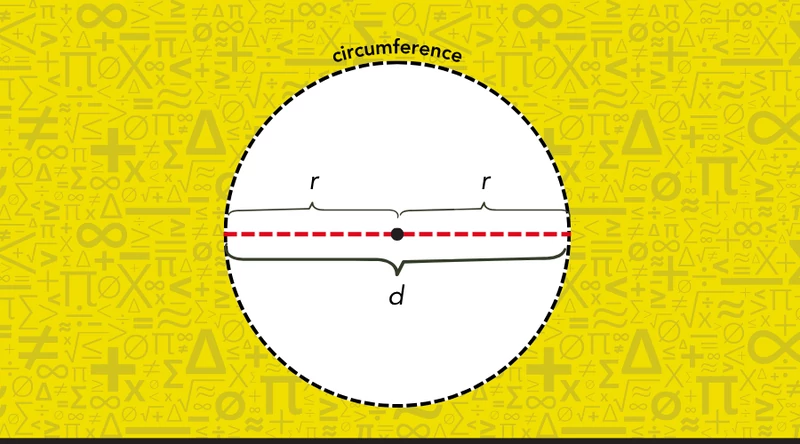
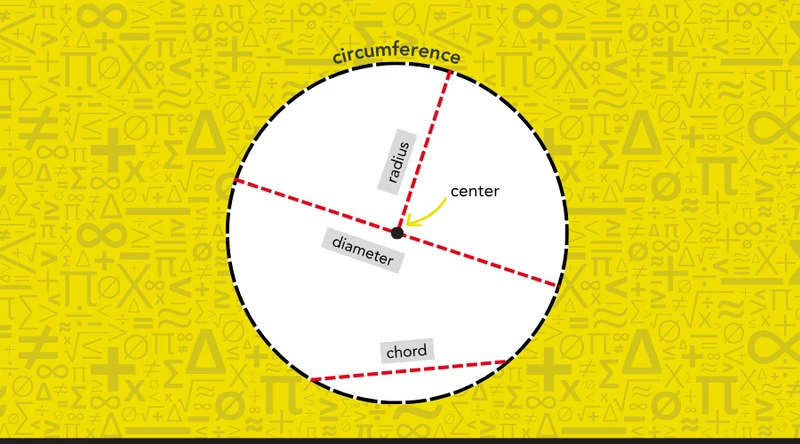
- Circumference: The total distance around the outside of the circle, like the circle’s version of a perimeter.
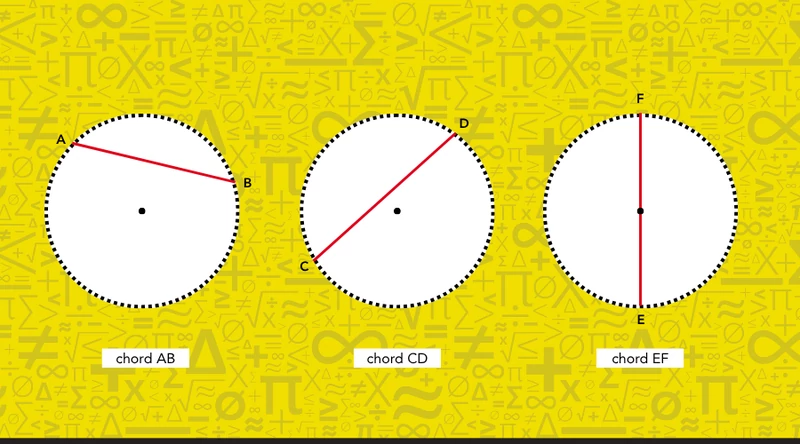
- Chord: A straight line that connects any two points on the circumference of a circle. It doesn’t have to pass through the center.
- Radius: The distance from the center to the outside of the circle. The radius is always half the diameter.
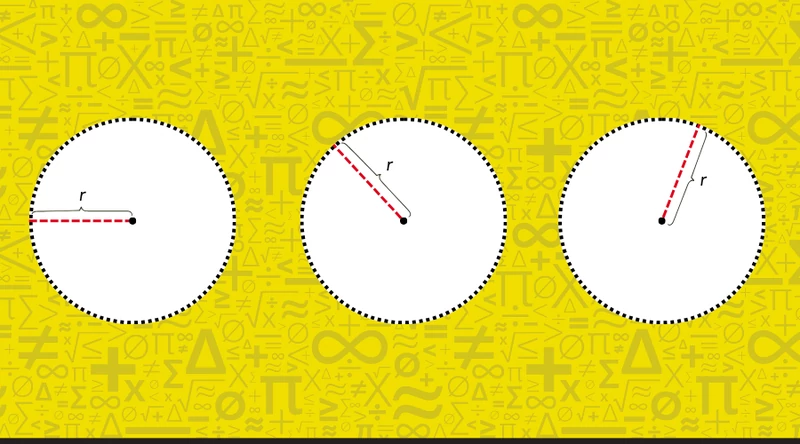
- Diameter: A line that goesthrough the center of the circle from one side to the other. It is made of two radii joined together in a straight line.
And there we have it!
The anatomy of a circle:
How Do We Measure the Diameter?
There are a few different ways we can measure the diameter of a circle, depending on what we already know or can measure. Let’s go over the three most common methods:
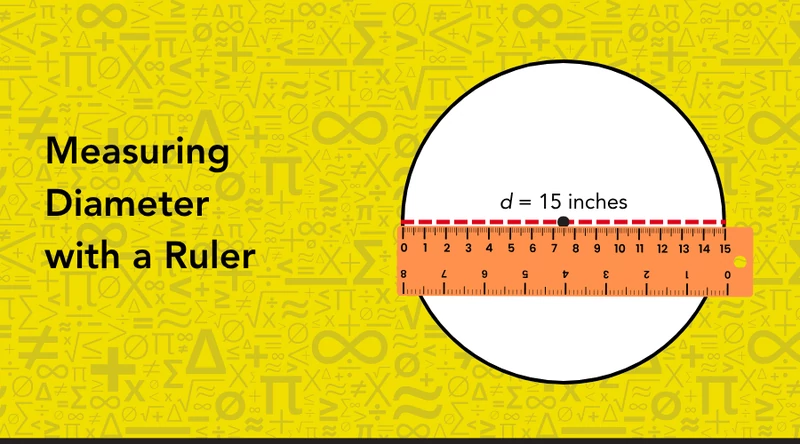
1. Measuring with a Ruler
If you have a drawing or a real object shaped like a circle, and you can see the full distance across, you can simply use a ruler to measure it. Just make sure your line goes through the center.
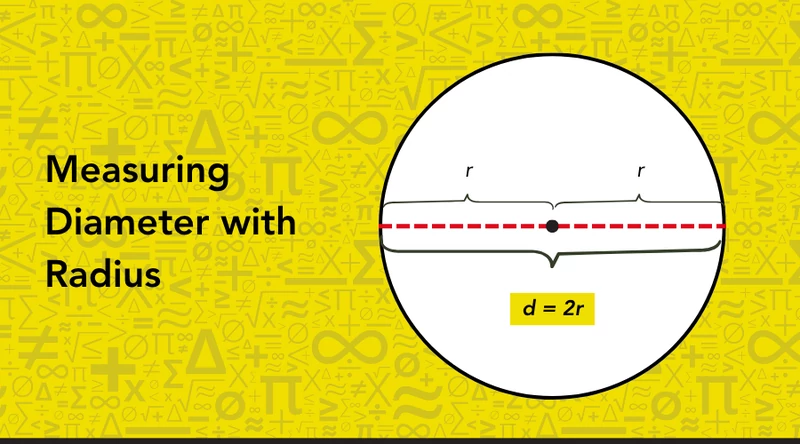
2. Using the Radius
We’ve learned that the radius is half the diameter, so what does that tell us about how to find the diameter?
If the radius is half the diameter, the diameter is double the radius, right?
d = 2r
Diameter equals two radii (yes, the plural of “radius” is “radii”).
For example, if the radius is 5 inches, the diameter would be:
d = 2 × 5 inches
d = 10 inches
3. Using the Circumference
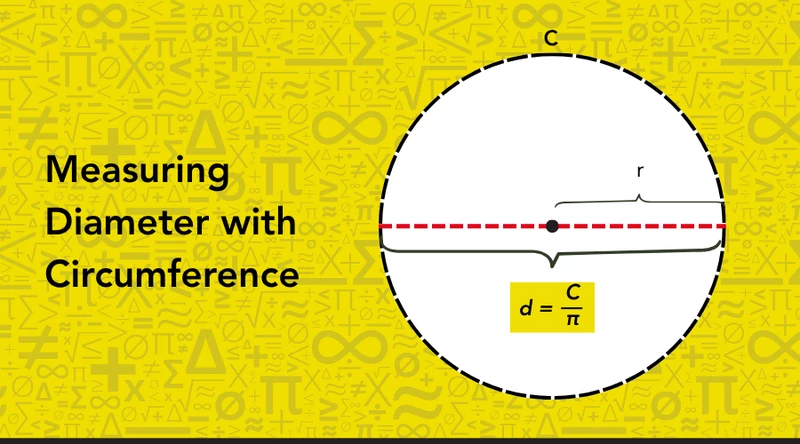
Another way to find the diameter is by using the circumference, which is the distance around the outside of the circle.
To do that, we use a number called pi, written as π.
Pi is a number that comes from dividing the circumference of any circle by its diameter. We express that with the formula π = \(\Large\frac{C}{d}\).
No matter the size of the circle, that ratio is always about 3.14.
If you divide the circumference by π, you get the diameter. That gives us the formula d = C ÷ π (which we can also express as: d = \(\Large\frac{C}{pi}\)).
For example, if the circumference is 31.4 inches:
31.4 ÷ 3.14 = 10 inches
d = 10 inches
Real-Life Examples and Uses of Diameter
We don’t only use diameter in math class; it comes up in everyday life all the time.
1. Pizza
When you order a pizza, the menu says it’s a “12-inch pizza” or a “16-inch pizza.” That number is the diameter, the distance across the middle of the pizza.
Knowing the diameter helps you figure out how many slices you can share with your friends. A bigger diameter means more pizza for everyone.

The diameter of this pizza is 16 inches, the straight line going through the center from one side to the other. It tells us how wide the pizza is!
2. A Hula Hoop
Hula hoops are big, colorful circles you spin around your waist. The diameter tells us how wide the hula hoop is. A kid’s hula hoop might have a diameter of 28 inches, so it’s easier to use. A grown-up’s hula hoop might be 40 inches across.
Stores use the diameter to make sure they sell the right size hoop for you.
3. A Water Bottle Cap
Look at the cap on your water bottle, it’s a small circle. The diameter of the cap may be 1 inch across, and is measured to make sure it fits tightly on the bottle.
Companies check the diameter when they make caps so they don’t leak and screw on just right.
4. A Car Tire
Car tires are big circles, and their diameter is important. A tire might be 25 inches across.
Mechanics measure the diameter to choose the right tire for a car. A bigger diameter helps the car drive differently, like going faster or carrying more weight.
5. A Round Table
At school or home, you might eat at a round table. The diameter, like 32 inches across, tells you how big the table is.
Stores list the diameter so you can tell if the table fits your space and how many people can sit around it comfortably.
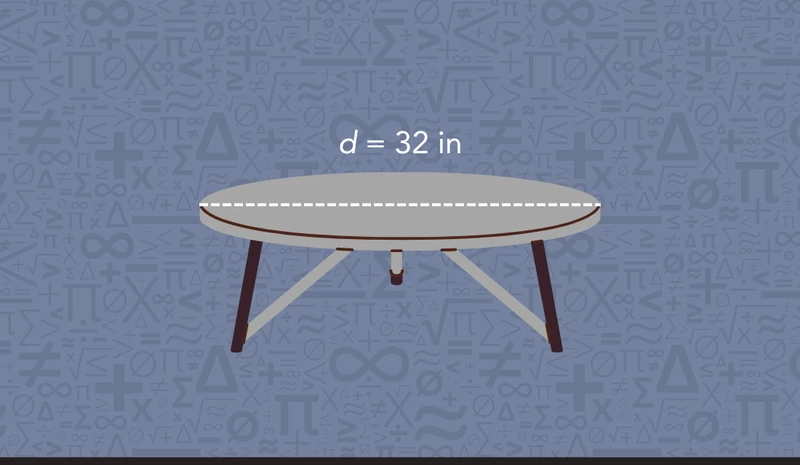
The diameter of this round table is 32 inches, measured straight across through the center.
Flash Quiz - Check How Well You Understand the Diameter
Ready to put your knowledge to the test? Try these questions to test your understanding of diameter. Circle the correct answer.
1. What does the diameter of a circle measure?
A. The distance halfway around the circle
B. The distance from the center to the outside of the circle.
C. The distance across the circle through the center
D. The distance from one point on the circumference to another without passing through the center
2. Which of these is always true about the radius and diameter?
A. Radius is twice the diameter
B. Diameter is half the radius
C. Radius and diameter are always the same
D. Diameter is twice the radius
3. Which of these is an example of using diameter in real life?
A. Measuring the height of a round table
B. Measuring the thickness of a textbook
C. Measuring across the middle of a round clock
D. Measuring the length of a bookshelf
4. If a circle’s radius is 13 meters, how long is its diameter?
A. 26 meters
B. 6.5 meters
C. 7.5 meters
D. 39 meters
5. A circle has a circumference of 21.98 ft. What is its diameter?
A. ~7π feet
B. ~7 feet
C. ~9 feet
D. ~9π feet
FAQs About Diameter
Learning about diameter in math class doesn’t come without questions. We’ve gathered a collection of questions we often hear at Mathnasium, along with clear answers to help you feel more confident and clear up any confusion.
1. When do students learn about diameter in school?
Students are introduced to circles and basic geometric terms like radius and diameter in upper elementary school, usually around Grade 4 or Grade 5.
In middle school, especially in Grade 6 and Grade 7, students start working with diameter more formally in formulas for area, circumference, and word problems.
By Grade 8, diameter may be used in more advanced geometry, like coordinate planes or solving equations involving π.
2. Can a diameter be vertical or horizontal?
Yes, it can be either. A diameter can go up and down (vertical), side to side (horizontal), or even diagonally.
As long as it goes straight through the center and connects two points on the edge of the circle, it’s a diameter, no matter what direction it’s drawn.
3. What’s the difference between diameter and width?
Great question. These words are sometimes used the same way, but in math, they’re not always equal.
-
Diameter is a specific circle measurement; it’s the distance across a circle through the center.
-
Width can describe how wide something is in general, and it doesn’t always have to go through the center or apply to a circle.
So while diameter tells us width in a circle, not all widths are diameters.
4. Is the diameter the longest line you can draw in a circle?
Yes. The diameter is the longest straight line that fits inside a circle because it stretches all the way across through the center. No other chord in the circle is longer.
5. Are all diameters chords, and are all chords diameters?
A diameter is a type of chord, so yes, all diameters are chords.
But not all chords are diameters.
A chord is any line that connects two points on the edge of a circle. If it doesn’t pass through the center, it’s just a chord.
Only the chord that goes through the center is called a diameter.
Learn & Master Math with Top-Rated Math Tutors at Mathnasium
Mathnasium is a math-only learning center dedicated to helping K-12 students of all skill levels excel in math.
Using the Mathnasium Method™, a proprietary teaching approach that combines personalized learning plans with proven instructional techniques, Mathnasium helps students develop strong foundational skills, deepen their mathematical thinking, and grow to love learning math.
At Mathnasium, we assess each student’s current understanding and design personalized learning plans tailored to their unique needs, ensuring they gain the skills to succeed in math and beyond.
Mathnasium’s specially trained tutors work with students in an engaging group setting to help them understand and master any math concepts, like the diameter of a circle, typically covered in elementary and middle school math.
Whether your student needs help catching up, keeping up, or is ready to get ahead, find a Mathnasium Learning Center near you and schedule a free diagnostic assessment today!

Psst... Check Your Answers!
1. C
2. D
3. C
4. A
5. B


 (720) 524-4763
 (720) 524-4763