Imagine you're sharing a pizza with friends. You want to cut it into equal slices with none left over, no awkward half-pieces, no one getting shortchanged. All the ways you can divide it equally with nothing left over are what we call factors.
So today, Mathnasium tutors guide you through what a factor actually is, three methods for finding every factor of any number, with examples you can follow step by step, and practice problems to try on your own.

What Is a Factor in Math?
A factor is a whole number that divides another number evenly, with no remainder. Factors always come in pairs of two numbers that we multiply together to get the original number.
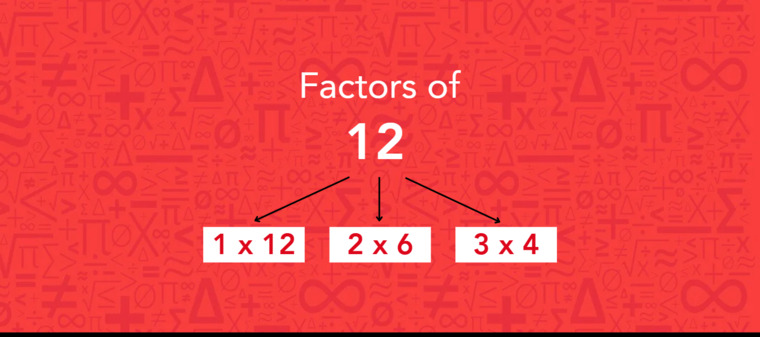
Let’s take the number 12 and find its factors together, starting from 1. First, we ask ourselves, ‘’Does 1 divide evenly into 12?’’
12 ÷ 1 = 12
The answer is yes, because there is no remainder. So, both 1 and 12 are factors. Since we can multiply 1 by 12 and get our original number, these numbers are factor pairs.
Next comes 2. We ask the same question, "Does 2 divide evenly into 12?" The answer again is yes.
12 ÷ 2 = 6
So, we add another pair of factors, 2 and 6, to our list. What’s the situation with 3? If we do the math 12 ÷ 3 = 4, we can safely say that 3 and 4 are factors as well.
Now, what about 5? If we divide 12 by 5, we get 2 with a remainder of 2. Since it doesn't divide evenly, 5 is not a factor of 12. The same goes for the numbers between 6 and 12. None of them divides 12 evenly:
-
12 ÷ 7 = 1 remainder 5
-
12 ÷ 8 = 1 remainder 4
-
12 ÷ 9 = 1 remainder 3
-
12 ÷ 10 = 1 remainder 2
-
12 ÷ 11 = 1 remainder 1
That brings us to 12 itself, 12 ÷ 12=1 with no remainder, so 12 is a factor of itself.
So the factors of 12 are: 1, 2, 3, 4, 6, and 12.
📕 You May Also Like: What Is a Factor in Math? Explain It to a 9-Year-Old
How to Find All the Factors of a Number
There are three methods we can use to find all the factors of any number:
Let's walk through each one together.
1. The Multiplication Method (with Solved Examples)
The multiplication method finds factors by looking for pairs of numbers that multiply together to give you the original number.
Let's find all the factors of 24 together. We start with 1 and work our way up, asking ourselves: "What do we multiply this number by to get 24?"
| Number |
Calculation |
Factor pairs |
| 1 |
1 × 24 = 24 |
1 and 24 are a factor pair. |
| 2 |
2 × 12 = 24 |
2 and 12 are a factor pair. |
| 3 |
3 × 8 = 24 |
3 and 8 are a factor pair. |
| 4 |
4 × 6 = 24 |
4 and 6 are a factor pair. |
Do we need to check every single number? Not always. A few handy shortcuts help us rule numbers out quickly, without doing any long division:
-
Rule for 2: Is the number even? If it ends in 0, 2, 4, 6, or 8, then 2 is a factor.
-
Rule for 3: Add the digits together. If the sum is divisible by 3, then 3 is a factor. For 24, we get 2 + 4 = 6 and 6 ÷ 3 = 2. So, 3 is a factor.
-
Rule for 5: Does the number end in 0 or 5? If not, we can skip 5 entirely.
-
Rule for 6: If both the rules for 2 and 3 work, then 6 is a factor too.
-
Rule for 9: Add the digits. If the sum is divisible by 9, then 9 is a factor. For 24, we get 2 + 4 = 6, and 6 is not divisible by 9, so we skip it.
How do we know when to stop? We stop when our pairs start repeating. After 4 × 6, the next pair is 6 × 4, the same pair in reverse. Once that happens, we have found them all.
The factors of 24 are: 1, 2, 3, 4, 6, 8, 12, and 24.
📕 You May Also Like: Divisibility Rule for 7: Definition, Practice, and FAQs
2. The Division Method (with Solved Examples)
The division method finds factors by dividing the original number by whole numbers, starting from 1 and working up. Every time we get no remainder, we have found a factor.
Let's find all the factors of 36 using division. We start with 1 and work our way up:
| Number |
Calculation |
Is the number a factor? |
| 1 |
36 ÷ 1 = 36 |
Yes |
| 2 |
36 ÷ 2 = 18 |
Yes |
| 3 |
36 ÷ 3 = 12 |
Yes |
| 4 |
36 ÷ 4 = 9 |
Yes |
| 5 |
36 ÷ 5 = 7, remainder 1 |
No |
| 6 |
36 ÷ 6 = 6 |
Yes |
Notice something familiar? Every time division gives us a clean result, we get two factors at once: the number we divided by and the result. For example, 36 ÷ 3 = 12 gives us both 3 and 12.
How do we know when to stop? We stop when the result becomes smaller than the number we are dividing by. After 36 ÷ 6 = 6, the next number to test is 7, but our result is already 6. That tells us our pairs have crossed over, and we have found them all.
The factors of 36 are: 1, 2, 3, 4, 6, 9, 12, 18, and 36.
📕 You May Also Like: How to Do Long Division with Remainders - A Kid-Friendly Guide
3. The Rainbow Method (with Solved Examples)
The rainbow method works alongside the multiplication and division methods, and only helps us organize the factors we have found and catch anything we might have missed. We cannot use it to find any factors.
So, right after we have our list of factors, we write them in order from smallest to largest and draw arcs connecting each pair. The arcs form a rainbow shape, which is how the method gets its name.
Let's organize the factors of 36 :
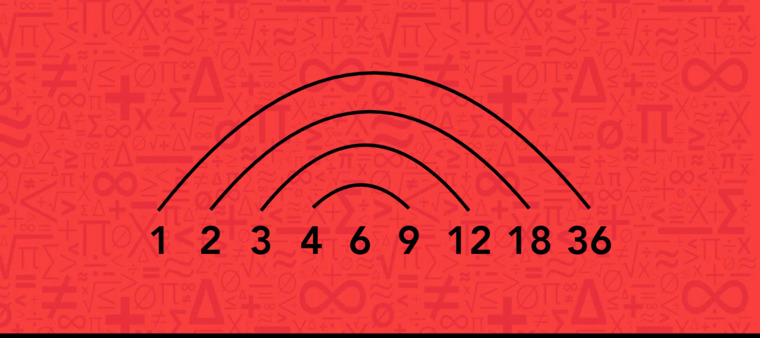
We connect them in pairs:
Each arc should have a matching partner on the other side. If a number is left without a pair, that is our signal to go back and check our work.
The rainbow method is especially useful with larger numbers, where it is easy to lose track of which pairs we have already found.
Now that we know how it looks visually, let's double-check the factors for 24 once more. The factors of 24 are: 1, 2, 3, 4, 6, 8, 12, and 24. Let’s connect them:
-
1 and 24
-
2 and 12
-
3 and 8
-
4 and 6
Since there is no number without a pair, we successfully used the rainbow method to check our work.
Your Turn! Check Your Knowledge of Finding Factors
Ready to practice what we’ve covered? Try these practice problems on your own and check your answers at the bottom of the guide.
Don’t forget to use the rainbow method as well to double-check your work. If every factor has a partner and none are left out, your rainbow is correct.
-
Find all the factors of 18 using the multiplication method.
-
Find all the factors of 30 using the multiplication method.
-
Find all the factors of 28 using the division method.
-
Find all the factors of 48 using the division method.
Frequently Asked Questions About Finding Factors
Here are some of the questions we often hear from our students while finding factors, with their answers to clear out any confusion.
1. What is the smallest factor of any whole number?
Since we can always divide any number by 1 without a remainder, the smallest factor is always 1.
2. Is every whole number a factor of itself?
Yes. We can always divide any number by itself and get 1 with no remainder. That makes the number itself the largest factor in its list. For example, let’s take 48 and 125 and do the division:
48 ÷ 48 = 1 (no remainder)
125 ÷ 125 = 1 (no remainder)
3. Can a factor be larger than the number it divides into?
No. Factors are always smaller than or equal to the number they divide into. So when we look for factors of 12, for example, we never need to test any number larger than 12.
4. How many factors does every whole number have?
Apart from 0 and 1, every whole number has at least two factors: 1 and the number itself.
5. Does every number have a limited number of factors?
Yes. No matter how large the number, the factor list always ends. For example, 10 has exactly four factors: 1, 2, 5, and 10.
 Mathnasium's specially trained tutors guide students through the factoring process in a supportive, engaging environment.
How Mathnasium Helps Students Master Factors (And Any Math Concept)
Mathnasium is the only math-only learning center helping K-12 students of all skill levels learn and master math, factors included.
To help students build a deep understanding of any math concept or skill, we don’t rely on a one-size-fits-all curriculum but on our proprietary teaching approach, the Mathnasium Method™.
Each student starts with a diagnostic assessment that helps us identify their current skills, knowledge gaps, and learning goals. From there, we build a personalized learning plan tailored to their needs and pace.
Our specially trained tutors use natural language to phrase concepts and a combination of verbal, visual, mental, tactile, and written techniques to help students understand the math they are working with.
When students get stuck on a concept like factors, we break it down into manageable steps and teach both the how and the why behind it. Students gradually learn to do the same independently, walking out of our centers with the problem-solving skills and critical thinking tools they can use in math and beyond.
Fun is an important part of how we work. Sessions often include game-based and hands-on activities that keep students engaged and learning enjoyable. Students earn rewards along the way, and every bit of progress gets celebrated, so confidence grows alongside mastery.
The results speak for themselves:
-
94% of parents report an improvement in their child's math skills and understanding
-
93% of parents report their child's improved attitude toward math
-
90% of students saw an improvement in their school grades
With over 1,100 learning centers, Mathnasium brings top-rated math instruction close to your community.
For families in and around Denver, Mathnasium of Denver Highland is a trusted local center with years of experience helping students build the math skills and confidence they need to succeed at every grade level.
Here’s what one Denver parent shared about their experience with Mathnasium:

Ready to take the first step?
📅 Schedule a Free Assessment at Mathnasium of Denver Highland
Not located near Denver?
📍 Find a Mathnasium Learning Center Near You
Pssst! Check Your Answers Here
If you worked through the practice problems, here are the answers:
-
The factors of 18 are: 1, 2, 3, 6, 9, and 18.
-
1 × 18 = 18
-
2 × 9 = 18
-
3 × 6 = 18
-
The factors of 30 are: 1, 2, 3, 5, 6, 10, 15, and 30.
-
1 × 30 = 30
-
2 × 15 = 30
-
3 × 10 = 30
-
5 × 6 = 30
-
The factors of 28 are: 1, 2, 4, 7, 14, and 28.
-
28 ÷ 1 = 28
-
28 ÷ 2 = 14
-
28 ÷ 4 = 7
-
The factors of 48 are: 1, 2, 3, 4, 6, 8, 12, 16, 24, and 48.
-
48 ÷ 1 = 48
-
48 ÷ 2 = 24
-
48 ÷ 3 = 16
-
48 ÷ 4 = 12
-
48 ÷ 6 = 8
How did you do?


 (720) 524-4763
 (720) 524-4763