When homework hits a snag or test prep stirs up stress, who steps in first?
Parents, no doubt.
You jump in with the best intentions, doing everything you can to help. And that’s perfectly natural. Young learners often need someone right there with them. But as students get older, this support calls for a more thoughtful approach.
What works in elementary school can start to backfire in middle school if it doesn’t evolve. Without space to struggle productively, students miss the chance to develop the independence that high school math demands.
So how should that support change?
We asked seasoned Mathnasium tutors to weigh in.
Here’s why building math independence matters by high school and what healthy support can look like at every stage.

Why Math Independence Is Essential by High School
Math independence means a student can work through problems, explore new ideas, build their understanding, and show what they know, without needing someone to walk them through every step.
In the early years, it makes sense for parents to be closely involved with their child’s math journey. Sitting at the table together, walking through homework and test prep, and checking answers can feel like the right support.
As students move closer to high school, the pace changes. Math starts to feel less guided, with fewer worked-out examples and more focus on figuring things out on your own.
By ninth grade, the role of the teacher starts to change, and so does the student’s. In line with Common Core standards, this is the stage where students are expected to take more ownership of their learning.
Sure, core instruction still happens in class, but now the real challenge is what comes next. Students are asked to take what they’ve learned and run with it.
Whether they’re modeling a math problem or working through something more layered, the goal becomes helping them think through it on their own, with support nearby, but only stepping in when the challenge really demands it.
And for those who haven’t had their share of working independently, this transition can feel overwhelming.
Just think of a student who’s used to checking every step with a parent or teacher. When that support is no longer right there, it’s easy to second-guess or freeze altogether. It has less to do with math ability and more to do with having the chance to think and work through problems on their own.
That’s why a gradual handoff matters, not all at once, and not without support, but in small, intentional steps that give students the confidence to trust their own thinking.
📕 You May Also Like: How to Nurture Math Thinkers, Not Just Answer-Getters
How to Encourage Math Independence, Grade by Grade
The smartest way to foster independence changes at different milestones. As children start gaining more experience, parents are generally encouraged to start stepping back and be more of a guiding force than the main problem-solver.
Every child is also different, meaning that they might require more, less, or a different kind of support. But in our tutor’s experience, this is how parents can generally approach their children’s independence across different grades leading up to high school.
Elementary School (Grades K–2): Getting Comfortable Trying
In the earliest grades, math focuses on number sense, patterns, and basic reasoning. At this stage, independence begins with helping children feel comfortable attempting problems on their own.
So what does this look like in everyday scenarios?
-
Kindergarten: Encourage them to show their thinking in different ways. If your child is building a pattern (like red-blue-red-blue), ask: “Can you draw what comes next?” or “Can you show me the same pattern using different things?” This builds confidence in starting problems without relying on examples.
-
Grade 1: Ask open-ended questions that return the thinking to your child. When your child is sorting coins or blocks, try: “How did you decide to group them?” or “Could they go together in a different way?” Prompts like this help them think flexibly without being led to one “right” answer.
-
Grade 2: Give them space to puzzle through early place value. If they say 41 is “four and one,” hand them tens and ones blocks and ask: “Can you show me that number?” This gives them a chance to work through misconceptions instead of being corrected right away.
-
All Grades: Celebrate when they make a decision without asking for help. If they choose a way to solve a problem or estimate a measurement on their own, say: “You didn’t ask for help, you figured it out. What helped you decide?” These moments reinforce self-trust and build independence.
📕 You May Also Like: How to Nurture Algebraic Thinking in Elementary School
Upper Elementary (Grades 3–5): Beginning to Work More Independently
In upper elementary, math begins to require more than just trying. Students encounter longer word problems, multiple steps, and strategies that need to be chosen and applied thoughtfully. This is a key stage for learning how to stay with a problem long enough to understand it.
And as the challenge rises, support needs to grow more layered and offer just enough guidance while helping students take more ownership of the work.
-
Grade 3: Prompt them to check their steps before asking for help. If your child solves a problem like “12 × 3 + 4” and ends up with an answer that seems too large, avoid jumping in right away. Instead, ask: “Can you walk me through what you did?” or “Where do you think things might have gone off?” Encouraging a quick self-check builds early habits of reviewing work without relying on correction.
-
Grade 4: Let them handle one step of a multi-step problem independently. Say your child is working on a problem that involves both multiplication and subtraction: “Each box holds 8 books. There are 6 boxes. If 5 books are taken out, how many are left?” Rather than guiding them through the entire solution, ask: “Can you try the first part and tell me what you get?” This gives them space to make decisions and build momentum on their own.
-
Grade 5: Ask them to explain why a strategy makes sense. When they solve a fraction or division problem, follow up with, “Why did you choose that method?” or “Can you explain how you knew that would work?” Speaking their thinking out loud helps them catch mistakes and grow more confident in their own reasoning.
Middle School (Grades 6–8): Learning How to Use Different Resources
By middle school, math introduces new challenges in both content and workload. Students encounter abstract ideas such as ratios, negative numbers, and early algebra. Alongside this, they take on more responsibility for keeping up with assignments and managing their study habits.
To meet these demands, students need to develop academic independence. That means knowing where to look for help, using the resources they already have, and learning how to ask clear, targeted questions.
To assist them on this journey, we recommend:
-
Grade 6: Encourage them to revisit examples before asking for help. When your child gets stuck on a problem involving decimals or ratios, ask: “Have you seen anything like this in your notes?” or “Is there a similar example in your homework?” Helping them return to familiar models builds early habits of resourcefulness.
-
Grade 7: Help them plan how to review, step by step. Before a quiz on equations or integers, ask: “What kinds of problems do you want more practice with?” or “What could help you feel more prepared?” These questions support self-awareness and give them more control over how they study.
-
Grade 8: Let them lead the conversation when something doesn’t make sense. If they’re unsure about a topic like functions or graphing, ask: “Can you walk me through what you’ve done so far?” or “Where did things start to feel unclear?” Let them do the talking while you listen. Being able to pinpoint where they're stuck is a key step toward greater independence.
-
All Grades: Encourage them to track which strategies work best. After using notes, a video, or class examples, ask: “Which one helped the most?” or “Would you try that again next time?” These quick reflections help them build a personal playbook for learning and make stronger choices the next time they’re stuck.
📕 You May Also Like: Is Your Middle Schooler Ready for High School Math?

Group work is also emphasized during this stage, as students share information, strategies, and other resources.
Signs Your Child Has Grown Into an Independent Math Thinker
After years of gradual support and practice, what does full math independence actually look like when a student reaches high school?
Well, let’s establish this right away: It's not about getting every problem right or never needing help. In fact, setting up those kinds of expectations can be detrimental.
Instead, math independence is about how they approach challenges, use their resources, and trust their own thinking when the work gets hard.
Here are some signs that your child has developed strong math independence:
-
They start problems without waiting for permission or reassurance. When faced with a new assignment, they read through the problem, pull out what they know, and begin working. They might not be certain they're on the right track yet, but they're willing to try something and see where it leads.
-
They recognize when they're stuck and know what to do next. Rather than shutting down or immediately asking for help, they pause and think about their options. They might flip back through their notes, reread the problem, try a different approach, or look for a similar example. They've built a mental toolkit of strategies to pull from.
-
They can explain their thinking, even when the answer is wrong. If you ask how they solved a problem, they can walk you through their steps and reasoning. They understand what they were trying to do, which makes it easier to spot where things went off track. This clarity is a sign of real mathematical understanding.
-
They know what kind of help to ask for. Instead of saying "I don't get it," they can identify the specific part that's confusing them: "I understand how to set up the equation, but I'm not sure what to do when there's a fraction on both sides." This specificity shows they've already done the work of figuring out what they do and don't understand.
-
They can adapt what they've learned to new situations. When they encounter a problem that looks different from what they practiced in class, they don't panic. They recognize the underlying concept and think about how the same math might apply, even if the format or context has changed.
What to Do When Progress Stalls
Despite best intentions, building independence isn’t always smooth sailing.
We also have to recognize that support at home doesn’t always bring the results we hope for. And no shame in saying it, many parents don’t feel confident tracking their child’s progress, particularly when it comes to the nuances of how they’re thinking or whether key ideas are sticking.
If you’re noticing signs of struggle like these:
-
Your child avoids starting problems without help
-
They constantly ask for reassurance, even on familiar topics
-
They seem more frustrated or anxious during math homework
-
You’re not sure whether they’re actually improving
…it’s worth considering outside support.
Mathnasium’s structured program is designed to build solid foundational skills and develop flexible, independent math thinkers.
Students begin with a diagnostic assessment, so instruction starts exactly where they are. From there, they get personalized support that helps them build on what they already know, close critical gaps, and most importantly, develop reasoning skills they can rely on long after the tutoring ends.

Tutors at Mathnasium are trained to maintain that fine balance between guidance and independence.
How Mathnasium Builds Independent Math Thinkers
Students develop math independence when they are given consistent opportunities to think through problems, apply strategies, and reflect on their work with the right level of guidance.
Mathnasium is designed around this idea, providing a learning environment where students are encouraged to work independently while receiving support that helps them move forward.
As a math-only learning center, Mathnasium has helped thousands of students strengthen their math skills and develop habits that support independent learning.
Rather than relying on a one-size-fits-all program, instruction is built around the Mathnasium Method™, a proprietary teaching approach focused on understanding, problem-solving, and student ownership of learning.
To help students become independent math thinkers, our approach includes:
-
Personalization on a granular level: Each student begins with a diagnostic assessment to identify their strengths, gaps, and how they think through problems. From there, we build a customized plan that meets them exactly where they are.
-
Teaching for understanding: Our instructors use everyday language and face-to-face instruction, supported by verbal, visual, mental, tactile, and written techniques. This helps students truly make sense of the math concepts they are learning.
-
Caring, trained instructors: Our tutors are skilled in both content and connection. They know how to support students who are struggling and challenge those who are ready for more.
-
Independent thinking and critical problem-solving: Each session includes time for students to work independently before reviewing with their instructor. We teach both the how and the why, helping students build the reasoning and problem-solving tools they’ll use across all areas of math.
-
Singular focus on math: We specialize in math and math only. Our curriculum is built from thousands of thoughtfully developed materials, continually refined to reflect how students absorb, learn, and retain math best.
-
A confidence-building, fun environment: Parents often tell us Mathnasium sessions don’t feel like lectures. We use game-based activities, small wins, and reward systems to keep students engaged and proud of their progress.
This approach leads to meaningful progress for students and families. Parents report improvements not only in academic performance, but also in how their children approach math.
-
94% of parents report an improvement in their child’s math skills and understanding
-
93% of parents report an improved attitude toward math after attending Mathnasium
-
90% of students saw an improvement in their school grades
With more than 1,100 centers across the U.S., Mathnasium continues to help students build strong math foundations and independent learning habits that support long-term success.
For families based in or near Denver, Mathnasium of Highlands is a trusted local center, with years of experience transforming not only math skills, but also how students think and feel about the subject.
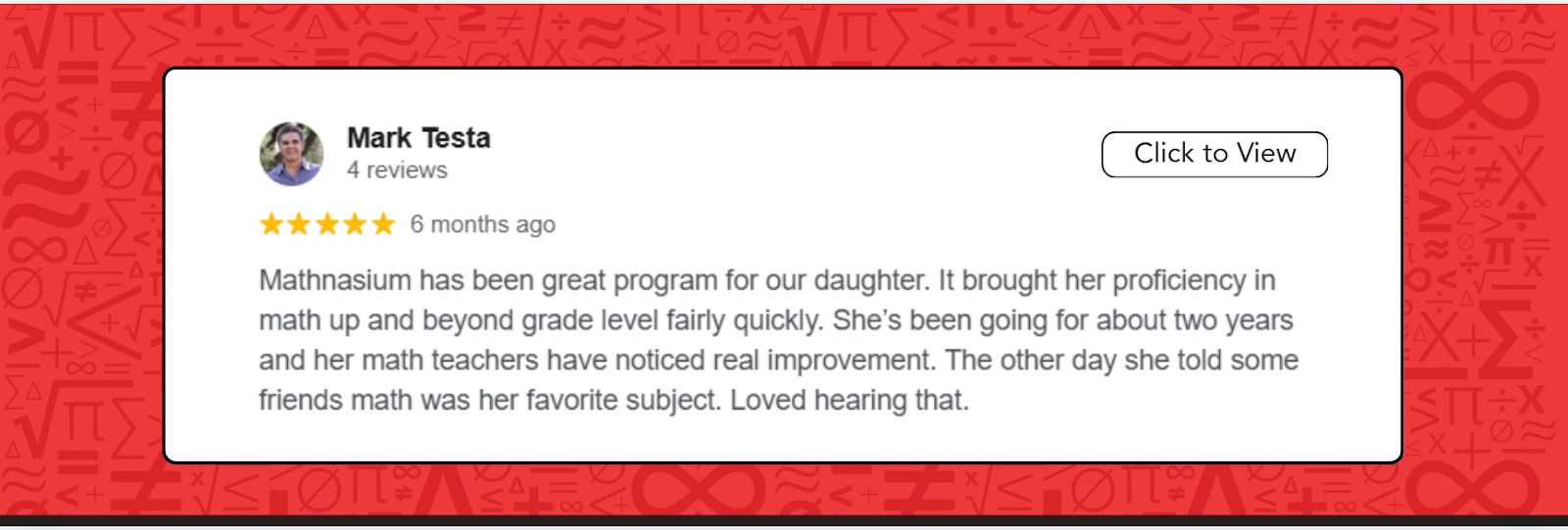
Here’s how one parent described their child’s math journey at our center:
Whether your student is looking to catch up, keep up, or get ahead on their math journey, we can help!
Ready to get started?
📅 Schedule a Free Diagnostic Assessment at Mathnasium of Highlands!
Not located near Highlands?
📍 Find Mathnasium Learning Centers Near You


 (720) 524-4763
 (720) 524-4763