You spot a hoodie you have been eyeing for weeks. The tag says 25% off, and you have $40 in your pocket. Do you have enough?
Percentage problems show up in moments like that one, at the store, at a restaurant, or at the checkout with a tax line on the receipt. In each situation, the question is the same. What is X% of this number?
Mathnasium tutors put together two methods that answer that question directly, along with a simple rule for choosing between them. We also put both methods to the test with a set of practice problems at the end.

1. The Multiply and Move Percentage Method
In this method, we multiply the percentage value and the number we want to find the percentage of as if both were whole numbers. Then we move the decimal point two places to the left to get the percentage amount.
Before we see how that works, let us remember what percent actually means.
Percent means "for every 100" or "out of 100." So when we look for a percentage of a number, we are looking for how much we get out of every 100.
Let us see that through an example. Taking 7% of 100 means we simply collect 7 out of that single group.
The same logic applies when our total is not a perfect 100.
If our total changes to 150, and we still want 7 out of every group of 100. Since 150 contains 1.5 groups of 100, we collect 7 for each of those groups.
That gives us 7 × 1.5 = 10.5.
The formula captures exactly that reasoning:
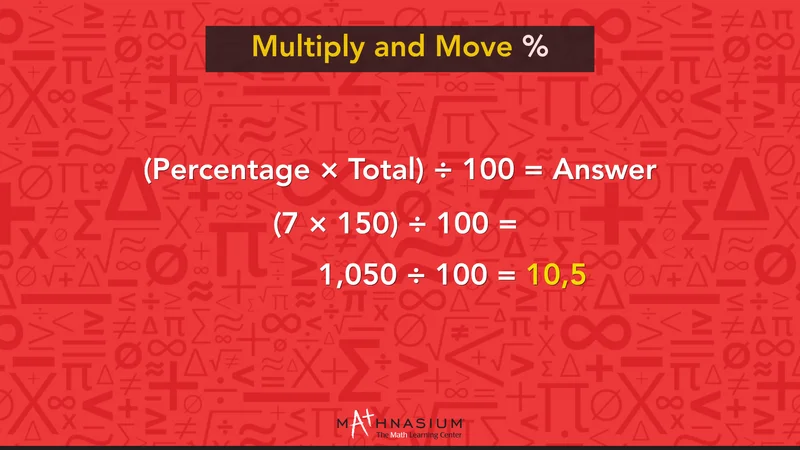
(Percentage × Total) ÷ 100 = Answer
We multiply the percentage by the total to count how many groups of 100 we have, then divide by 100 to find our proportional share.
Let us see it in action.
-
Step 1: Multiply the whole numbers together. 7 × 150 = 1,050
-
Step 2: Dividing by 100 always moves the decimal point two places to the left. 1,050 → 10.50
7% of 150 is 10.5.
Now let us bring it to the restaurant. The bill is $45, and we want to leave an 18% tip.
The tip is $8.10.
The same steps work at the store. The jacket costs $80, and the store is offering 15% off.
-
Step 1: Multiply 15 × 80 = 1,200
-
Step 2: Divide by 100. 1,200 → 12.00
The discount is $12.00, so the jacket costs $68.00.
This method works for any percentage. It is the right approach when the percentage is not one we recognize as a simple fraction.
📕 You May Also Like: How to Calculate Percentages: A Simple, Kid-Friendly Guide
2. The Fraction Shortcut Method
In this method, we recognize the percentage as a fraction and divide by its bottom number, the denominator, to get the answer.
Some percentages are fractions in disguise. Take 50% as an example. 50% means 50 out of 100.
We can write that as a fraction: \(\Large\frac{50}{100}\)
Both 50 and 100 are divisible by 50. Dividing both by 50 gives us: \(\Large\frac{50 ÷ 50}{100 ÷ 50} = \Large\frac{1}{2}\)
So that means that 50% is the same as \(\Large\frac{1}{2}\). Since the denominator is 2, finding 50% of any number means dividing it by 2.
That connection is what this method is built on. The denominator of the simplified fraction tells us exactly what to divide by. Once we simplify the percentage to a recognizable fraction, the formula follows naturally:
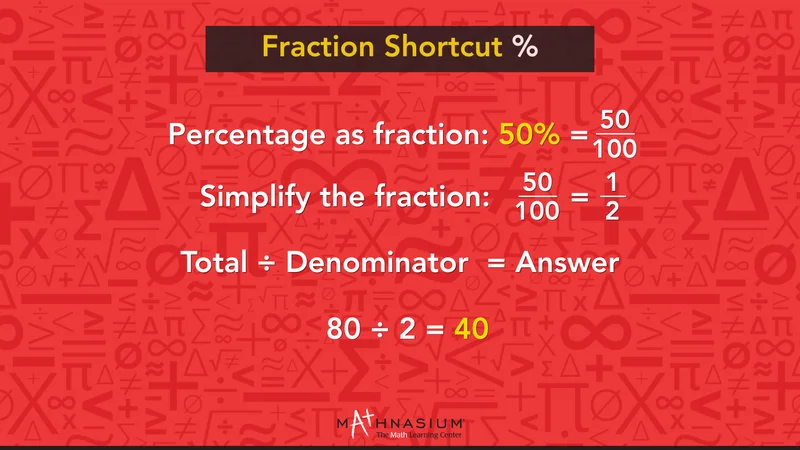
Total ÷ Denominator = Answer
Let us apply it through an example and find 50% of 80.
Step 1: Rewrite the percentage as a fraction.
50% = \(\Large\frac{50}{100}\)
Step 2: Simplify the fraction. Both 50 and 100 are divisible by 50. Dividing both by 50 gives us:
\(\Large\frac{50 ÷ 50}{100 ÷ 50} = \Large\frac{1}{2}\)
Step 3: Divide the total of 80 by the denominator.
80 ÷ 2 = 40
50% of 80 is 40.
A Shortcut for Friendly Percentages
Once the reasoning behind the method is clear, some percentages can be handled even faster. The ones below simplify to clean fractions that are worth recognizing on sight.
For these, the calculation becomes a single division step.
|
Percentage
|
Fraction
|
What to Do |
|
50%
|
\(\Large\frac{1}{2}\)
|
Divide by 2 |
|
25%
|
\(\Large\frac{1}{4}\)
|
Divide by 4 |
|
20%
|
\(\Large\frac{1}{5}\)
|
Divide by 5 |
|
10%
|
\(\Large\frac{1}{10}\)
|
Divide by 10 |
|
5%
|
\(\Large\frac{1}{20}\)
|
Divide by 20 |
Let us put the table to work with two real-life examples.
The jacket costs $120, and the store is offering 25% off. Which row in the table do we reach for?
The discount is $30, so the jacket costs $90.
Let’s do another example. The bill is $55, and there is a 10% tax.
The tax is $5.50, so the total bill comes to $60.50.
This method works best when the percentage is one we recognize as a clean fraction. When it is, it saves meaningful time and mental effort.
📕 You May Also Like: 4 Simple Tips to Help Students Figure Out Percentages
How to Choose the Right Percentage Method
To choose the right percentage method, look at the percentage first and ask whether it matches a fraction you already know.
We now have two methods for finding a percentage of a number, and the percentage itself tells us which one to reach for.
|
Recognizable Fraction?
|
Method to Use
|
What to Do |
|
Yes
|
Fraction Shortcut Method
|
Divide by the bottom number |
|
No
|
Multiply and Move Method
|
Multiply and move the decimal |
Let us try that with three quick problems.
Example 1: What is 20% of $75?
Before we calculate, does 20% simplify to a clean fraction? It does. 20% = \(\Large\frac{1}{5}\). So what number do we divide by? We divide by 5, which is the denominator.
Example 2: What is 33% of $90?
Take a moment and look at 33%. Does it simplify to a clean fraction? It does not, so we multiply and move.
-
Step 1: Multiply the whole numbers together. 33 × 90 = 2,970
-
Step 2: Divide by 100. 2,970 → $29.70
Example 3: What is 10% of $35?
We have seen 10% before. It is one of the easiest fractions to spot \(\Large\frac{1}{10}\), and that means one simple step gets us there. So what number do we divide by? We divide by 10, which is the denominator.
📕 You May Also Like: How to Calculate Percent Error – Step-by-Step Guide
Your Turn: Which Percentage Method Would You Use?
We have two methods and one question to guide us. Look at each percentage below, decide which method fits, and calculate the answer.
-
Problem 1: You are splitting a $96 restaurant bill and want to leave a 50% tip. How much is the tip?
-
Problem 2: A store is offering a 12% discount on an $85 jacket. How much do you save?
-
Problem 3: A $140 pair of sneakers is on sale for 25% off. What is the discount?
-
Problem 4: Your restaurant bill comes to $60, and the tax is 27%. How much is the tax?
-
Problem 5: A $65 backpack is marked 20% off. How much do you save?
-
Problem 6: A $110 video game console has an 8% tax. How much is the tax?
Check your answers at the bottom of the page.

Mathnasium tutors work with students in a caring and fun group environment, building lasting math confidence one session at a time.
How Mathnasium Helps Students Build Everyday Math Confidence
Mathnasium is a math-only learning center dedicated to helping K–12 students of all skill levels learn and master math.
Whether your child is finding percentages for the first time, building the fraction and decimal fluency that percentage calculations depend on, or looking to get ahead of their grade level, Mathnasium offers a personalized path forward.
We build that path forward through the Mathnasium Method™, our proprietary teaching approach, designed around each student's individual learning needs and style.
Here is how it works in practice:
-
Diagnostic Assessment and Personalized Learning Plans: Every student begins with a diagnostic assessment, a relaxed interaction that uncovers their strengths and knowledge gaps. From those insights, we build a personalized learning plan tailored to their needs and goals.
-
Teaching for Understanding: Our specially trained tutors follow that plan closely, teaching math face-to-face in a supportive and fun setting. We use plain, everyday language and a mix of verbal, visual, mental, tactile, and written techniques so concepts like percentages truly make sense rather than feeling like steps to memorize.
-
Problem-Solving and Critical Thinking: When a concept feels challenging, we break it down into manageable parts and teach both the how and the why behind it. In time, students build problem-solving skills and critical thinking tools they can use in math and in life.
-
Built-In Homework Help: Each session includes time for homework support, so your child leaves with stronger math foundations and the confidence to walk back into the classroom ready for whatever comes next.
-
A Supportive and Fun Environment: Our sessions are often game-based, students earn rewards along the way, and we celebrate every bit of progress. Learning stays enjoyable, and confidence grows with every session.
Families see measurable results:
-
94% of parents report an improvement in their child's math skills and understanding
-
93% of parents report their child's improved attitude toward math after attending Mathnasium
-
90% of students saw an improvement in their school grades
We operate over 1,100 centers across North America, bringing our proven approach to communities everywhere.
For families in and around Fort Worth, Mathnasium of Fort Worth West is a trusted local center ready to help your child build both the fluency and the understanding that math at every level demands.
Whether your child needs to catch up, keep up, or get ahead, our team is happy to help.
📅 Schedule a Free Diagnostic Assessment at Mathnasium of Fort Worth West!
Not near Fort Worth?
📍 Find a Mathnasium Learning Center Near You
Pssst! Check Your Answers Here
If you’ve given our practice problems a try, check how you did below:
-
Problem 1: 50% = \(\Large\frac{1}{2}\). Fraction Shortcut method. $96 ÷ 2 = $48
-
Problem 2: 12% is not a clean fraction. Multiply and Move method. 12 × 85 = 1,020 → $10.20
-
Problem 3: 25% = \(\Large\frac{1}{4}\). Fraction Shortcut method. $140 ÷ 4 = $35
-
Problem 4: 27% is not a clean fraction. Multiply and Move method. 27 × 60 = 1,620 → $16.20
-
Problem 5: 20% = \(\Large\frac{1}{5}\). Fraction Shortcut method. $65 ÷ 5 = $13
-
Problem 6: 8% is not a clean fraction. Multiply and Move method. 8 × 110 = 880 → $8.80


 (817) 732-6284