(860) 430-9633










Everyday Math: Where Kids Use Math Without Realizing It
Jun 2, 2026 | Glastonbury
Everyday Math: Where Kids Use Math Without Realizing It

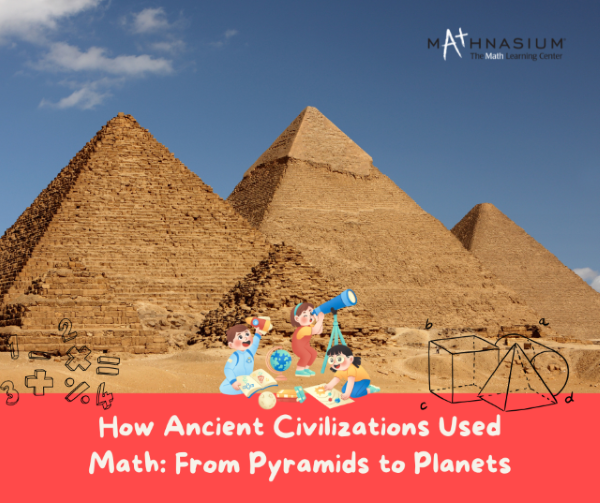
Did you know that math has been around for thousands of years? Long before calculators, computers, or even textbooks, people were using math to build cities, track stars, and trade goods. Ancient civilizations like the Egyptians, Mayans, and Greeks were some of the earliest math masters and their discoveries still help us today.
Let’s explore how these ancient people used math in clever and surprising ways.
Egyptian Math: Building Wonders with Numbers
The Ancient Egyptians lived along the Nile River over 4,000 years ago. They are most famous for building the pyramids, some of which are still standing today. But how did they manage such huge projects without modern tools?
The answer: math
Egyptians used a system based on units of 10, just like our modern decimal system.
They understood basic geometry to measure land, especially after the Nile flooded each year.
Builders used math to measure angles and straight lines, ensuring the pyramids were perfectly shaped.
They even calculated areas and volumes, helping them move and place massive stone blocks accurately.
Fun Fact: The base of the Great Pyramid of Giza is nearly a perfect square.
Mayan Math: Counting Stars and Time
The Mayan civilization lived in Central America (in places like Mexico and Guatemala) about 2,000 years ago. They were amazing astronomers and had one of the most advanced math systems of their time.
Here’s what made Mayan math special:
They used a base-20 system (instead of base-10), which helped them count in larger groups.
They created one of the first calendars using math and astronomy to track the moon and planets.
The Mayans were the first civilization to use the number zero! This was a big deal many other cultures didn’t have this concept yet.
Their calendar was so accurate that it could predict eclipses and seasonal changes with amazing precision.
Greek Math: The Birthplace of Geometry
The Ancient Greeks loved asking questions especially about nature, shapes, and logic. That’s why many people call them the founders of modern mathematics.
Here’s what the Greeks brought to math:
They developed geometry to study shapes, angles, and space. You’ve probably heard of Pythagoras and his famous theorem (a² + b² = c²)!
Euclid, another Greek mathematician, wrote a book called The Elements that organized all known math at the time. It became the world’s most-used math textbook for over 2,000 years.
Greeks also worked with prime numbers, ratios, and even infinite series.
Greek math wasn’t just for school, it was used in architecture, astronomy, and even philosophy.
What Can We Learn from Ancient Math?
Even though these civilizations lived thousands of years ago, their math discoveries still help us:
Engineers use geometry like the Egyptians did to design buildings.
Astronomers use calendars and tracking methods inspired by the Mayans.
Students (like you!) learn Greek geometry and logic in math class every year.
By studying ancient math, we understand not just numbers but how people used logic, creativity, and problem-solving to shape the world.
Want to Build Your Own Math Skills?
If ancient civilizations could master math without modern tools, imagine what you can do with the right support!
Whether you are struggling with fractions or flying through algebra, Mathnasium is here to help. At Mathnasium.com, trained instructors make learning math fun, clear, and personalized for every student.
Build confidence
Improve grades
Learn to love math (just like the Egyptians, Mayans, and Greeks)
👉 Visit Mathnasium.com to get started today!
Mathnasium of Glastonbury is a math-only learning center for K-12 students in Glastonbury, CT. Trusted by over a million parents, Mathnasium uses personalized learning plans and the proprietary Mathnasium Method™ to help students catch up, keep up, and get ahead on their math journey.
Our specially trained tutors deliver face-to-face instruction in a supportive and fun small-group environment, working with students to develop a deep understanding of math, build confidence, and improve academic performance.
Schedule Free Assessment