Between homework, extracurricular activities, and busy evenings, preparing for an end-of-unit math test can feel overwhelming.
We’ve gathered practical, easy-to-use review tips to make elementary math test prep simpler and more effective.
From common test-day mistakes to quick ways to make review time more productive, you’ll learn how to support your child without adding stress to your routine.

Focus on the Math That Slows Kids Down on Tests
One of the biggest reasons math test review falls flat is that it doesn’t always address what actually slows kids down on test day.
Students tend to understand the math during homework but struggle when a test presents problems in a slightly different way. Extra wording, unfamiliar layouts, or small twists can throw them off.
That’s why an effective elementary math test review should help kids practice how to approach unfamiliar problems.
These four common math areas show where students usually get stuck and how focused review strategies can make a real difference.
1. Multi-step Word Problems
Multi-step word problems require students to complete multiple steps that can be easy to miss. A child may know how to add or subtract but miss an extra step hidden in the story.
Review time can help by slowing the process down. Have them explain the problem before solving it. Ask them to tell you what the question is asking and how many steps they think it has. This quick pause helps students slow down and catch extra steps before they start working.
Circling key information or restating the problem in their own words helps them spot all the steps involved.
Practicing this habit during elementary math test review teaches kids to think before they solve, which reduces rushed mistakes on test day.
2. Place Value and Opposite Operations
Numbers like 15 can be tricky if your child reads the “1” as just “one” instead of “ten.” That kind of place value confusion can throw off everything from regrouping to expanded form.
The same goes for inverse operations. If your child hasn’t internalized that 64=24 also means 246=4, they struggle to move between question types. Without that connection, switching between problem types during a test can feel confusing and slow.
Practice place value and inverse operations out loud. Ask questions like, “What does the 1 in 15 stand for?” or “If 6 × 4 is 24, what division fact goes with it?”
Talking through these connections will help your young learner move between problem types more easily on tests.
3. Area vs. Perimeter
It’s easy for kids to think the bigger number always means a bigger shape. But a rectangle and a square can have the same perimeter and totally different areas.
A shape can have a large perimeter and a small area, or the same perimeter as another shape with a very different area.
Draw two shapes with the same perimeter but different areas and ask your child to measure and compare both. Seeing the difference on paper will help the concepts stick and make test questions easier to recognize.
4. Unit Fractions
Unit fractions can be tricky because kids tend to focus on the numbers they see instead of the size of the pieces. Ask your child which fraction is bigger, \(\Large\frac{1}{4}\) or \(\Large\frac{1}{3}\), and they will probably say \(\Large\frac{1}{4}\) because four is bigger than three.
This kind of thinking makes sense at first, but it can cause confusion on tests. Using hands-on examples during review helps clear that up. Draw or cut shapes into thirds and fourths and compare them side by side. Fewer pieces create larger parts, which helps fraction questions feel more intuitive on test day.
📕You May Also Like: Math Test Prep: How to Help Your Child Succeed on Exams
Clear Up Confusion During Test Prep Time
Test questions can sometimes feel harder than homework because they look and sound different. A problem may include extra words, new vocabulary, or a format your child hasn’t practiced before.
Test prep time is your chance to make those differences feel familiar. By practicing math language and test-style questions ahead of time, kids learn what to expect and approach problems with more confidence.
One part of your review should focus on helping your child recognize key math terms and feel comfortable with common test formats.
5. Get Comfortable With Math Language
Words like “product,” “sum,” or “difference” usually show up on tests, but they aren’t used much in everyday conversation. If a child forgets what the word means, they might not even try to solve the problem.
You can help by using simple math language at home. Try saying things like, “The sum of 6 and 7 is 13,” or “What’s the difference between 10 and 4?”
The more your child hears these words at home, the less intimidating they feel on test day.
6. Familiar Formats Help Reduce Stress
Tests often look different from the worksheets kids bring home. A test page might suddenly have multiple sections, smaller spaces for answers, or several types of questions mixed together. Even kids who know the math can slow down just trying to figure out where to start.
One way to help is to give them review pages that look like their real test. The goal is to make the test format feel familiar, so your child can focus on solving problems instead of feeling confused by the layout.
📕You May Also Like: How to Help Your Child Overcome Math Test Fear
7. Make Review Time Feel Safe
Getting stuck during test prep is normal. Instead of jumping in with the answer, ask your child to talk you through what they’re thinking or point out the part that feels tricky. These questions send a message that it’s okay not to get it right immediately.
Keep review time relaxed and conversational. Let your child think and work out loud. Feeling safe to make mistakes builds the kind of confidence that sticks.
📕You May Also Like: How Tutors Use Productive Struggle in Math (At-Home Guide)

Short, consistent review habits at home help kids feel prepared, confident, and calm on test day.
Build Smarter Test Prep Habits at Home
As test day gets closer, it’s easy to start second-guessing your approach. Should you be reviewing more? Adding extra worksheets? Going back over everything? The truth is, longer study sessions aren’t always the answer.
In fact, piling on more practice can sometimes leave kids feeling tired or less confident.
What actually helps most is building a short, consistent routine that strengthens memory, reinforces key skills, and encourages your child to think through problems.
These review habits take only a few minutes a day and focus on the kind of thinking that helps students stay calm on test day.
8. Start with a 5-minute Brain Dump
Before opening a book or worksheet, ask your child to write down everything they remember about the topic. This shows what they truly know and what still feels shaky.
It also helps their brain warm up before practicing.
9. Let Your Child Be the Teacher
Instead of quizzing your child, ask them to explain a problem to you, like you’re the student and they’re the teacher.
Explaining their thinking out loud shows how well they understand the steps. Moments of hesitation give you a clear signal about what needs a little more review.
10. Mix in Older Material
It’s tempting to focus only on the current unit, but bringing back a few questions from earlier topics helps strengthen memory.
Adding two or three older flashcards keeps skills fresh and prevents that “I forgot everything” feeling later on.
11. Encourage Visual Thinking
Math sometimes clicks faster if kids can see it. Simple visuals like number lines can help with addition, subtraction, and fractions by showing how numbers relate to each other.
Quick sketches or bar models can make word problems easier to understand if a lot of information is packed into one question.
Even small setup changes can help. Turning lined paper sideways so the lines run vertically makes it easier to line up numbers, which reduces alignment mistakes during multi-digit addition and subtraction.
📕You May Also Like: How to Teach Math to Visual Learners
12. Break Problems Into Parts
Long math problems can feel overwhelming because they include a lot of steps.
Help your child focus on one part of the question at a time by covering the rest with your hand and working through it step by step.
This approach builds confidence and reduces the urge to rush during tests.

Mathnasium helps students transform how they think and feel about math.
How Mathnasium Helps Students Prepare with Confidence
Mathnasium is a math-only learning center for K–12 students of all skill levels.
Students tend to feel unsure before a test because small gaps in understanding slip by unnoticed. At Mathnasium, we catch those gaps early and address them with clear explanations, hands-on tools, and steady guidance that helps concepts click.
We begin with a detailed diagnostic assessment to see exactly what your child understands and where they need support. Using the Mathnasium Method™, we create a personalized learning plan and guide your child through it with face-to-face tutoring in a supportive, small-group setting.
Review and reinforcement happen naturally as part of each session, so students are prepared long before test day arrives.
This approach helps students learn how to solve problems, explain their thinking, and approach new questions with confidence.
-
94% of parents say their child’s math skills improved
-
93% noticed a more positive attitude toward math
-
90% of students saw better performance in school overall
With over 1,100 centers nationwide, we bring top-rated tutors and our proven method close to your community.
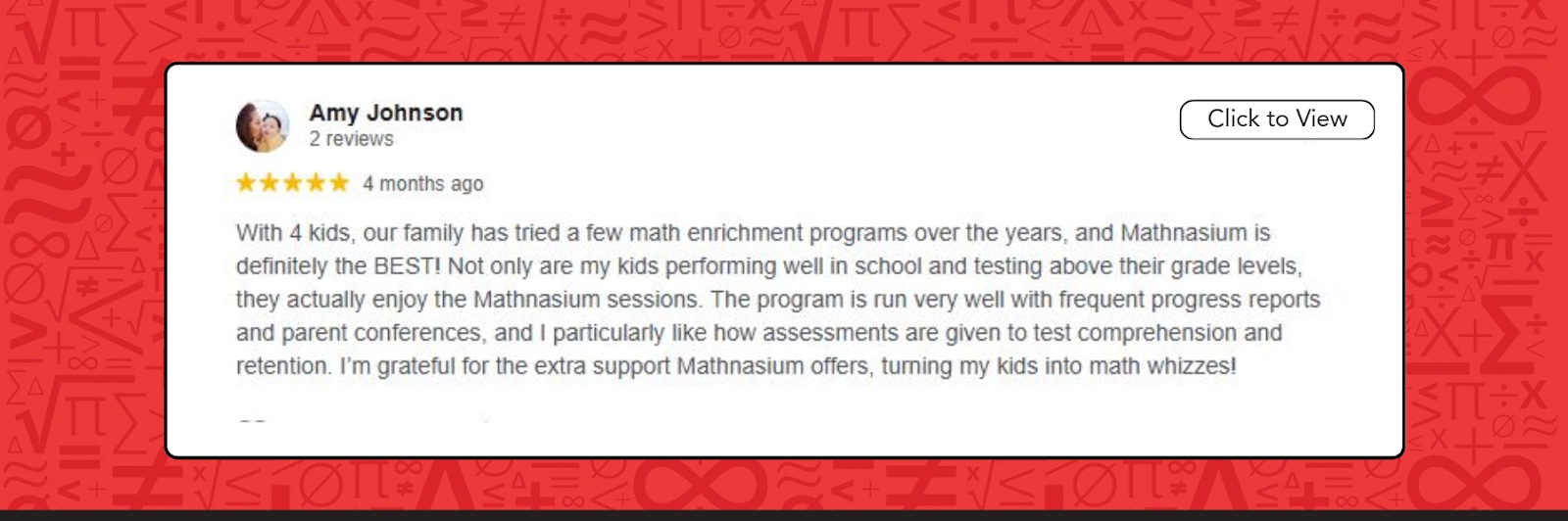
For families in and around Carlsbad, CA, Mathnasium of La Costa is a trusted local resource, earning us over 100 Google reviews from parents who’ve seen the difference.
📅 Schedule a Free Assessment at Mathnasium of La Costa
Not near La Costa?
📍 Find a Mathnasium Learning Center Near You


 (760) 452-6150
 (760) 452-6150