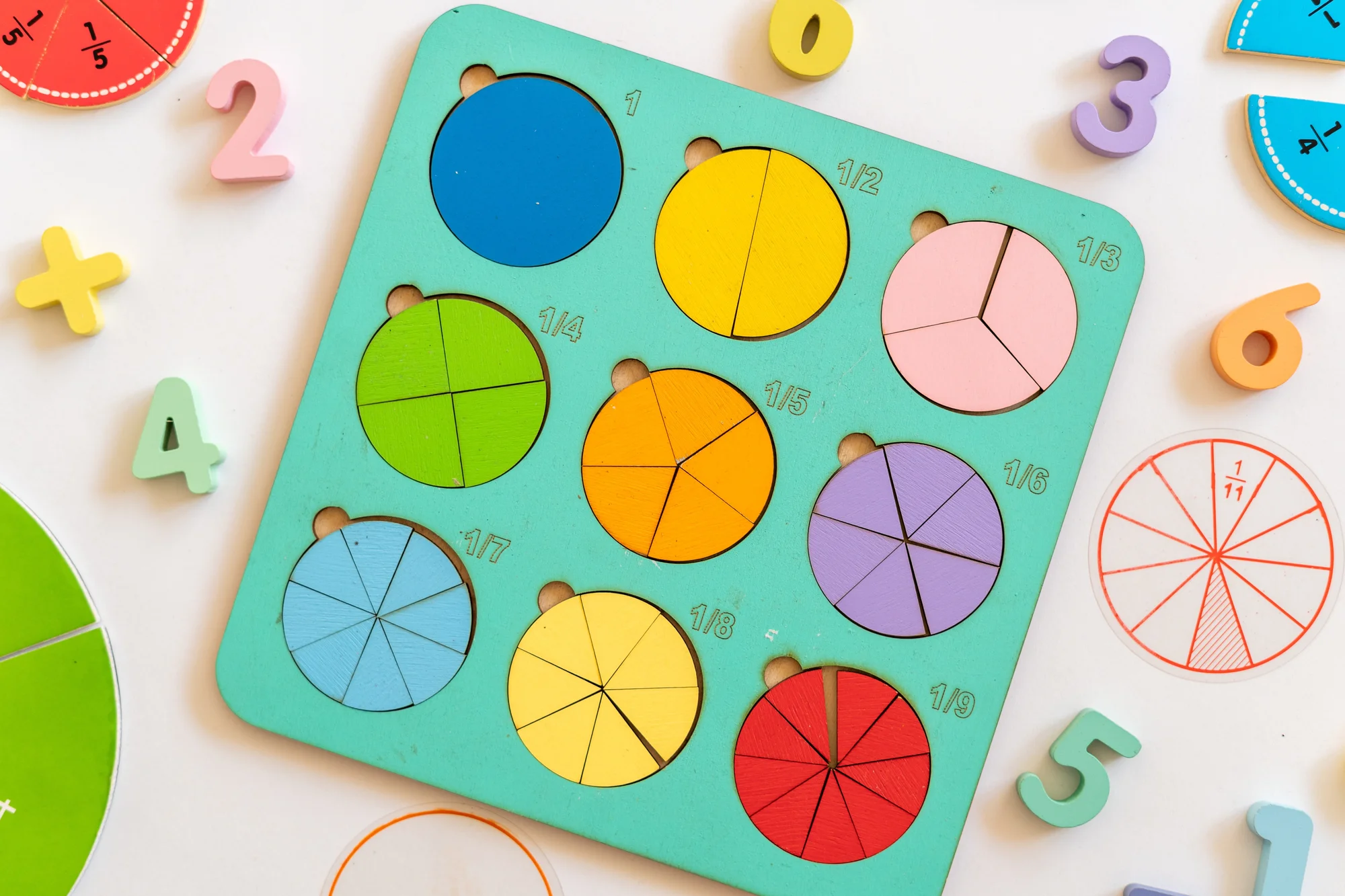
Every kid learns differently. For some, listening to a lecture is enough to absorb key concepts. Others do better with visuals and hand-on activities.
For example, a student might know how to write 34 and 23, but feel stuck when asked which is greater. When we draw two rectangles, one split into fourths, the other into thirds, and shade them, they have the a-ha moment. The numbers no longer float on the page but connect to something real.
At Mathnasium we work with a lot of visual and kinesthetic learners – students who respond best to visual and tactile teaching techniques. Today, we prepared practical tips on how to use pictures and manipulatives to transform the way your child understands and solves mathematical problems.
What Is Visual Math?
Visual math refers to the use of pictures, diagrams, and physical objects, known as manipulatives, to represent mathematical ideas.
Instead of relying solely on numbers or symbols, students work with visual models like number lines, arrays, fraction bars, or place value blocks to see what the math means.
Unlike memorization-based approaches, where students may follow steps without understanding the "why," visual math helps build real comprehension. It taps into how we naturally process information. Most of us picture quantities when planning a recipe or estimating a total.
In math, when students can’t form these mental images on their own, external visuals can bridge the gap.
What Are the Benefits of Visual Math?
Stanford professor Jo Boaler, through her YouCubed initiative, has shown that when students approach math visually, they engage more deeply, solve problems with greater flexibility, and develop stronger conceptual understanding.
Similarly, a recent meta-analysis found that visualization-based interventions significantly improved both understanding and retention in students learning mathematics.
And finally, to move from theory into practice, consider how a student might approach multiplication.
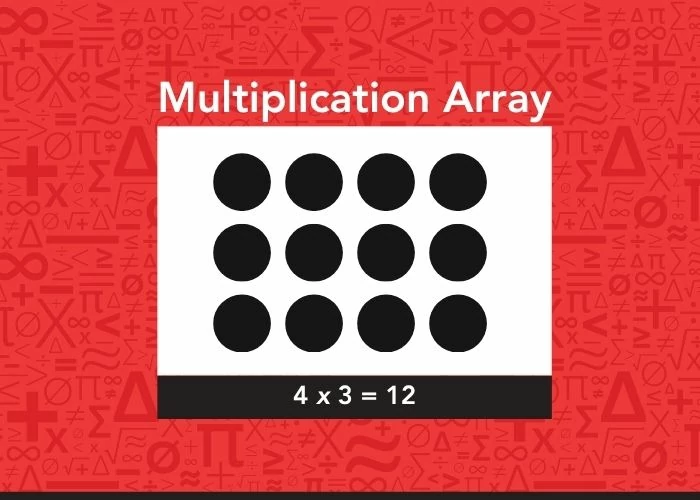
Drawing 4 × 3 as an array, four rows of three, shows why the answer is 12. Simply memorizing “4 times 3 equals 12” gives the result, but the array reveals the structure behind it.
Picture-Based Problem-Solving Strategies
Drawing gives students a way to make problems concrete before working with numbers. A quick sketch can show what a story problem is asking, how far a jump on the number line should go, or how pieces of a fraction fit together.
The following strategies highlight practical ways pictures can guide students toward clearer understanding.
1. Bar Models for Word Problems
Bar models help students untangle story problems by showing quantities as lengths.
Take this example: Sarah has 24 stickers, gives away 8, and then buys 12 more. Start by drawing a bar divided into 24 units. Cross out 8 to show what she gave away, then extend the bar with 12 new units. Counting the remaining pieces reveals the total.
When guiding your child, encourage them to label each part of the bar clearly: “start,” “taken away,” “added.” Although it may seem like a simple sketch, it slowly teaches students to break a task into smaller pieces, which makes problem-solving feel less overwhelming and more approachable.
2. Number Line Visualization
A number line lays numbers out in order, so students can see size, distance, and direction all at once.
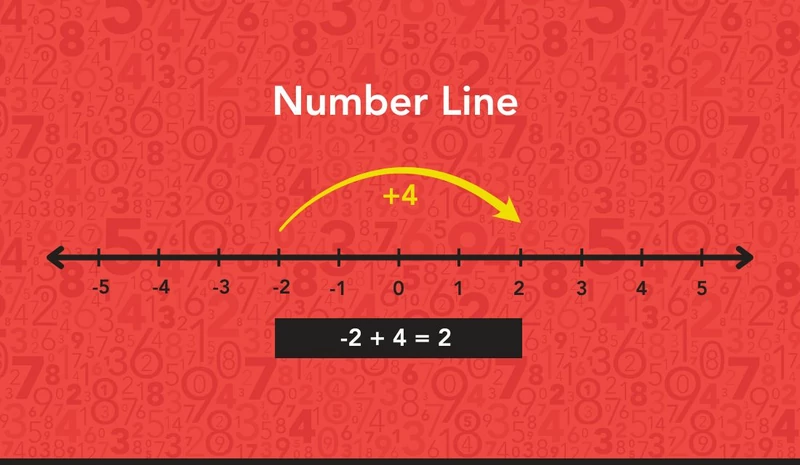
When students first work with integers, they often struggle to see how negatives and positives interact. On paper, –2 + 4 might look confusing, but the number line makes it clear: start at –2, move four steps to the right, and land on 2.
For fractions, marking \(\Large\frac{3}{4}\) and \(\Large\frac{1}{4}\) on the number line makes the subtraction easier to see, since a single step back from \(\Large\frac{3}{4}\) lands on \(\Large\frac{1}{2}\).
Number lines also connect well to real timelines, such as hours in a day or events in a week, which shows students how math mirrors familiar patterns of sequence.
3. Area Models for Multiplication
An area model is a rectangle that shows multiplication by splitting numbers into tens and ones. Each side of the rectangle is divided, and the smaller sections inside are multiplied separately.
For example, to solve 12 × 13, write 12 as 10 and 2, and 13 as 10 and 3. Draw a rectangle with four parts: 10 × 10 (100), 10 × 3 (30), 2 × 10 (20), and 2 × 3 (6). Adding them gives 156.
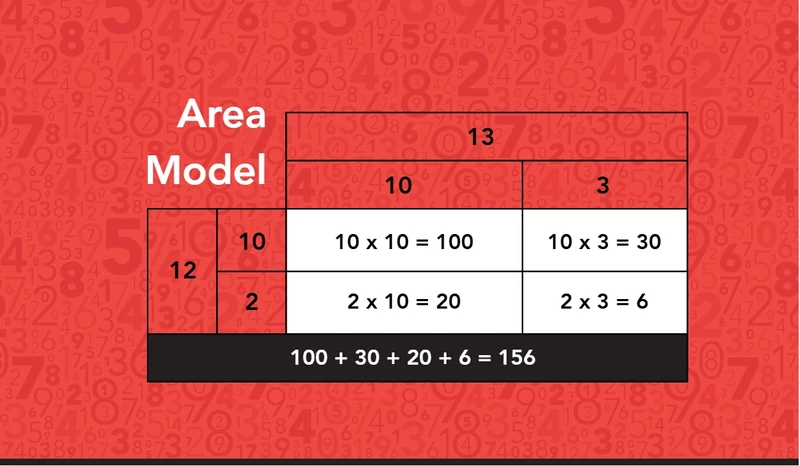
This method reveals why the standard algorithm works. The digits we “carry” are really the sums of these smaller products.
4. Fraction Pictures
Fractions often feel abstract because the numbers don’t point to a clear size. Drawing pictures helps students see what the parts really mean.
To add \(\Large\frac{2}{3}\) + \(\Large\frac{1}{3}\), sketch a rectangle divided into three equal parts. Shade two, then add one more. Seeing all three shaded makes the answer, one whole, obvious.
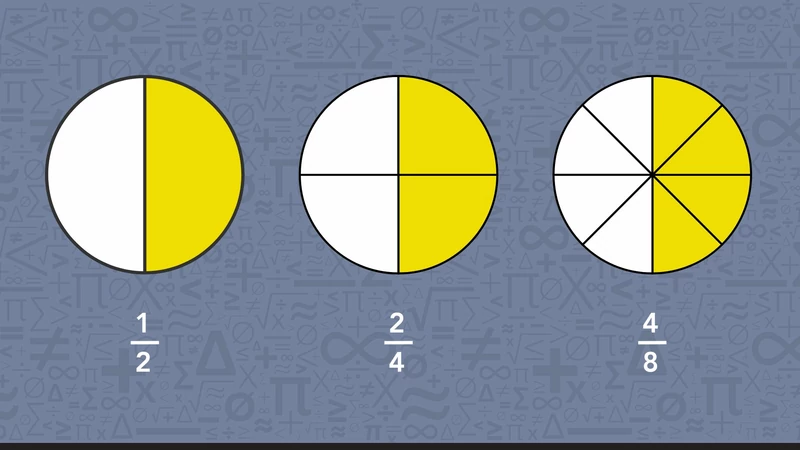
Fraction drawings also clarify equivalence. For example, shading half of a circle and then redrawing it with six parts shows that \(\Large\frac{1}{2}\), \(\Large\frac{2}{4}\), and \(\Large\frac{3}{6}\) all cover the same space.
Hands-On Manipulatives That Work
Math can be read and written, but it can also be seen and built.
Manipulatives let students give numbers shape and make ideas visible as well as tangible. By grouping, trading, and comparing objects, they notice patterns that remain hidden in symbols alone.
1. Base-Ten Blocks
Base-ten blocks are math tools where cubes stand for ones, rods for tens, and flats for hundreds.
Since they represent numbers in physical form, children use them to develop a clear sense of place value and regrouping.
Take this example: ask your child to add 46 + 18. Lay out four rods and six cubes, then add one rod and eight cubes. Now there are fourteen cubes. Instead of leaving it there, trade ten cubes for a new rod. The total shows six rods and four cubes, 64.
This simple trade is what written math calls carrying. With blocks, children see it as regrouping, not just as a rule to memorize. The same process explains borrowing in subtraction.
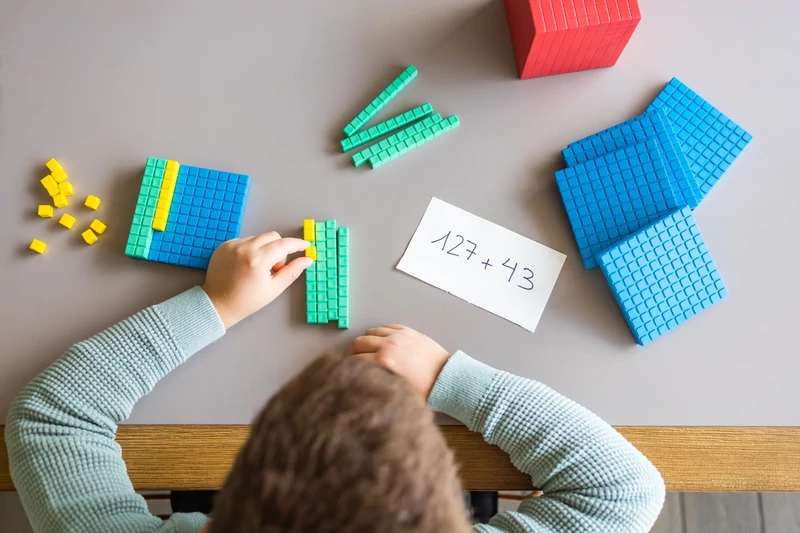
Base-ten blocks help children see place value and understand how numbers work together.
2. Fraction Tiles or Circles
Fraction tiles and circles are shapes divided into equal parts, each piece standing for a fraction of the whole.
Similar to the fraction pictures we discussed earlier, these tools give children a way to see how fractions relate, how they add up, and why they don’t always act like whole numbers.
How might that work?
Place \(\Large\frac{2}{3}\) and \(\Large\frac{3}{4}\) side by side. Your child will notice that three-fourths takes up more space than two-thirds, even though the numerators look close.
To explore addition, give them three quarter-pieces and a third-piece. Together they stretch past one whole, a natural entry point to the idea of improper fractions.
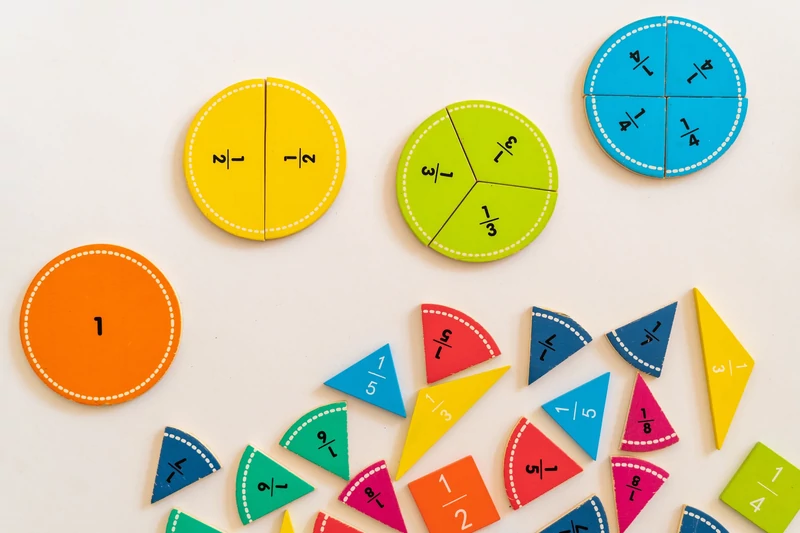
Fraction tiles let children compare pieces side by side so they can see how fractions relate, combine, and differ in size.
3. Algebra Tiles
Algebra tiles are sets of shapes that represent variables and constants. A long rectangle might stand for x, while small squares stand for ones. By arranging and moving the pieces, students can see equations take shape instead of juggling symbols on the page.
We’ve found that algebra tiles are especially helpful for middle school students beginning to solve equations.
When working with your child, start with something simple like 2x + 3 = 11. Place two x-pieces and three unit squares on one side, and eleven units on the other. Then show how removing three from both sides keeps the equation fair. What remains, two x equal to eight, can be divided evenly to reveal x = 4.
If tiles aren’t handy, coins or cards work just as well.
The Mathnasium Approach to Personalized Learning
Mathnasium is a math-only learning center dedicated to helping K–12 students of all skill levels unlock their true math potential.
We know that not every child learns math in the same way. Some are visual learners, others respond best to verbal explanations, while some need hands-on activities. That’s why our proprietary teaching approach, the Mathnasium Method™, allows students to learn math in the way that makes sense to them.
It all begins with a diagnostic assessment. We make sure it doesn’t feel like a formal evaluation. In a relaxed setting, we talk with students to uncover their strengths and areas for growth while also observing how they learn, whether by seeing concepts drawn out, listening to explanations, or using objects.
With the insights, we create a learning plan tailored to their needs. Once the plan is in place, our instructors follow it closely while adapting in real time. In a fun, confidence-building environment, our specially trained tutors go beyond rote memorization to guide students toward the how and why behind each concept. This approach develops critical thinking and problem-solving skills that extend far beyond the classroom.
The results speak for themselves:
-
94% of parents report an improvement in their child’s math skills and understanding
-
93% of parents report a more positive attitude toward math
-
90% of students see better grades in school
Mathnasium operates more than 1,100 centers across the U.S., bringing top-rated tutors and a proven approach closer to families everywhere.
For families based in Lakewood, CO, Mathnasium of Lakewood is a trusted local center.
If you want to see your child thrive in math and learn in a way that matches their style, take the first step by scheduling a free diagnostic assessment today.
📅 Schedule a Free Diagnostic Assessment at Mathnasium of Lakewood
Not near Lakewood?
📍 Find a Mathnasium Learning Center Near You


 (303) 975-6159
 (303) 975-6159