

La Jolla
915 Pearl Street
, #D/E
San Diego, CA 92037
San Diego, CA 92037

If your child can’t sit still during math homework, this may look like a challenge to solve, but actually, it’s just their minds full of wonder, exploring the world around them. Kids are wired to learn through play. Their brains thrive when their bodies are in motion—yes, including during math.
Whether it’s hopping on chalk-drawn lily pads or turning your hallway into a number line, movement transforms math from a task into an adventure. It taps into how children actually understand the world, through play and exploration.
Our math tutors have gathered some of our favorite ways to make math more physical, approachable, and fun.
At Mathnasium, we’ve seen firsthand how kids light up when math feels like play. One of the most powerful ways to spark that joy is through movement.
Movement-based learning, called kinesthetic math, taps into how some children learn best: by doing, touching, exploring, and moving. Movement can strengthen memory and focus in ways that pencil-and-paper tasks alone often can’t.
When kids learn math through physical activities, they’re combining muscle memory, spatial awareness, and problem-solving all at once. Some studies showed that in classrooms where movement is part of the lesson, children tend to show greater fluency, sharper recall, and better long-term understanding.
Movement-based learning also helps reduce math anxiety, a major barrier to progress. When kids are having fun tossing beanbags into number buckets or racing to solve a math riddle chalked on the driveway, they’re no longer focused on getting the “right” answer; they’re just exploring math.
It's a rhythm that works just as well at home as it does in a classroom or learning center. And the best part? You don’t need to be a teacher to make it happen. There’s no need for a formal lesson plan.
Just clear a little space, grab a few things you already have, like paper plates, dice, or sidewalk chalk, and jump into the game. The goal is to explore together.
📕 You May Also Like: How to Understand & Support Your Child’s Math Learning Style
You can use items you already have around the house, like paper plates, socks, or bins.
With just a few household items and a little imagination, your living room or hallway can become a space for active games that make math exciting for your kinesthetic learner.
The key is to keep the sessions short, around 10 to 15 minutes, so they stay fun and focused without overwhelming your child.
If you have more than one child, let them take turns or team up to build collaboration and keep the energy high. And if you’re working with just one child, join in as their math buddy. You’ll be surprised how much more engaging math becomes when it feels like a game you’re playing together.
Here are three movement-friendly games you can play, all from the comfort of home:
This simple, high-energy game builds math fluency while getting kids up and moving. Start by writing numbers and symbols (+, –, =) on paper plates, one number or symbol per plate. Spread them out across the floor.
Call out a math problem like “5 + 3 = 8” and have your child run to grab the correct plates and line them up in the right order. If they’re still learning their facts, you can scaffold by placing a few choices nearby to narrow it down.
For one child, the fun stays fully intact. They can collect each plate one at a time, racing back and forth to assemble the full equation.
To make it even more interactive, encourage them to “become” the equation by holding the plates in sequence, one in each hand, or wearing them like signs and shouting out the problem.
This kind of kinesthetic math strengthens number recognition, operational fluency, and sequencing skills.
📕 You May Also Like: Math And Creativity: Encouraging Your Child to Think Outside the Box
This game is a playful, physical way to explore math facts. Kids "become" the numbers and symbols in an equation by using their bodies to act them out.
A child can hold up a sign or pose as the number 4, make an arm motion like an "×," then stand next to a paper with the number 2, and finally step beside a card showing the product (8). You can use flashcards, sticky notes, or even chalk to label the parts.
If you only have one child, this works great solo! They can move from role to role, building the equation step by step.
Start by placing number cards on the floor. Ask, “Can you jump to 3, then to the multiplication sign, and then to 5? What’s the product?”
They can use their body to point, hop, or crawl from one part of the equation to the next, then solve it and shout the answer. This keeps the game active and reinforces math thinking through motion.
You can also join in as a "math partner," taking a role or calling out math challenges. As your child gets more confident, challenge them to come up with their own equations using movement.
This activity strengthens number sense, sequencing, and fluency, and because it’s based on movement learning math, it’s especially helpful for kids who learn best by doing.
Turn simple household items into a fast-paced, active math game with just a few bins, buckets, or even bowls. Label each container with a number (e.g., 2, 5, 8, 10), and have your child toss beanbags, balled-up socks, or small toys into them from a few feet away.
Once the toss is complete, they add up the numbers they landed in or, for more challenge, subtract or multiply them.
For example, if the beanbags land in bins labeled 3 and 6, ask, “What’s 3 × 6?” or “How much more do you need to make 20?”
If you have only one child, this game still works beautifully. You can:
Set a goal score (like 15 or 30) and see how many tosses it takes to reach it.
Create mini math challenges: “Land in two bins that add up to 12,” or “Can you make 24 using multiplication?”
Use a timer to add energy: “How many points can you score in one minute?”
This low-pressure, kinesthetic math game lets your child practice operations in a playful, physical way. There’s no winning or losing, just movement, problem-solving, and fun.
With these games, math becomes something your child can move through, literally.
📕 You May Also Like: 3 Ways Early Spatial Skills Impact Long-Term Math Success
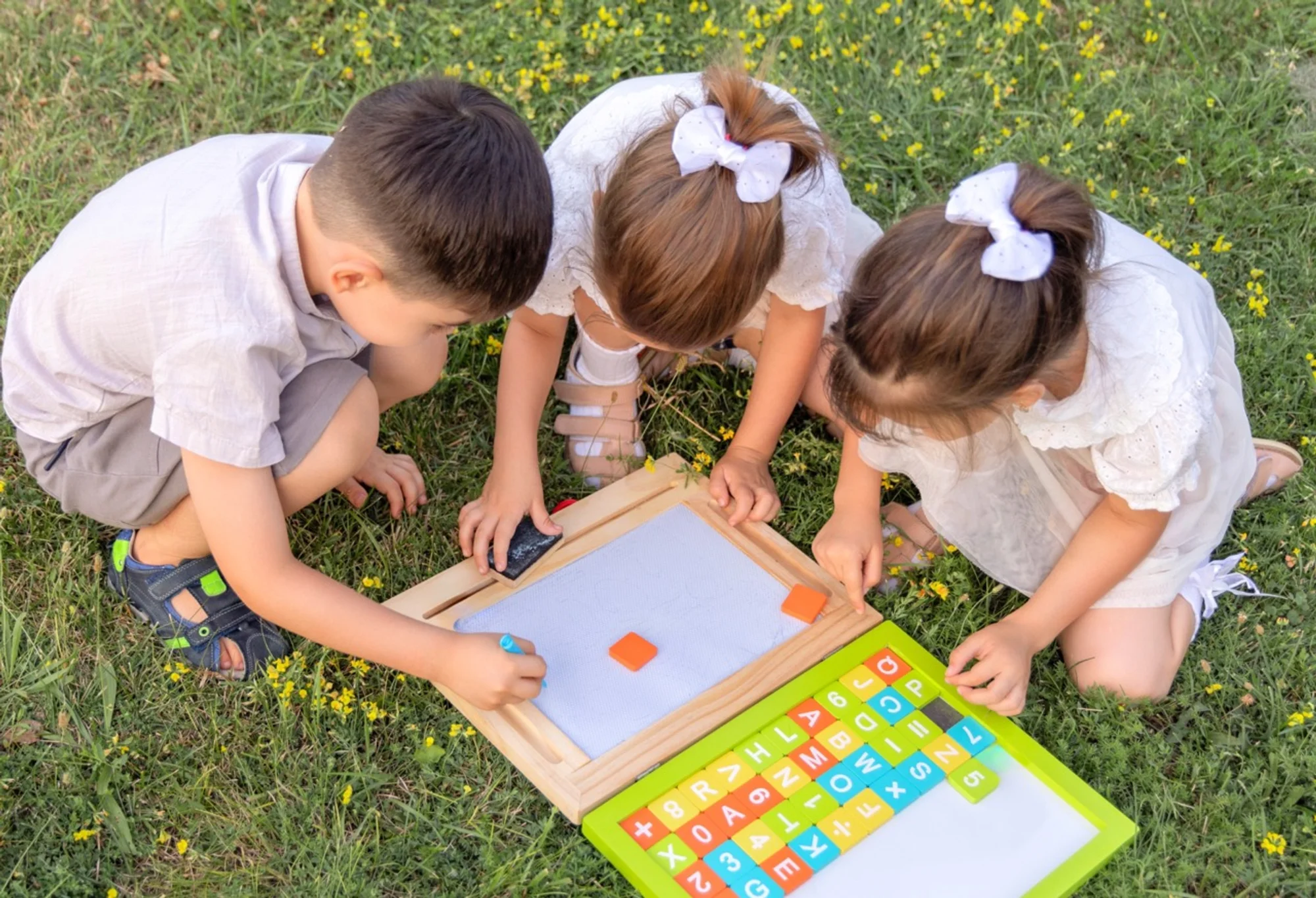
Fresh air and motion help kids focus and build math skills through hands-on exploration.
If your kids have extra energy to burn, take math outside. These outdoor active math games combine sunshine, movement, and learning, perfect for sidewalks, parks, driveways, or even a patch of grass.
Use chalk, tape, or natural materials like sticks and rocks to build your game setups. The activities you’ll soon discover work well for solo kids or groups and can turn any driveway, park, or sidewalk into a fun math zone.
Use chalk or painter’s tape to write numbers across the driveway or sidewalk.
Then call out a prompt: “Find the number that makes 10 when added to 6!” or “Run to a number divisible by 3!” Your child dashes to the correct number, building math fluency through movement.
This game still works wonderfully even if you play it with one child. You can vary the challenge by switching between number recognition, addition, subtraction, or multiplication.
Want to make it self-directed? Write out a list of challenges on a whiteboard or notebook and let your child call and solve their own problems. You can also time their laps to add a dash of excitement.
This is kinesthetic math at its simplest, quick, energetic, and flexible for all ages and skill levels.
Draw “lily pads” (chalk circles) across the pavement and label each one with a number or math fact.
You might include multiples of a number, answers to specific equations, or fractions.
Call out problems like “Leap to the solution for 3 × 4!” or “Hop to a number greater than 15 but less than 20.”
If you only have one child, you can still play together, either taking turns or letting your child guide the activity.
Or try turning it into a mission: “Can you leap to all the prime numbers in under 30 seconds?”
This game blends movement learning math, with agility, and builds number sense in a fun, full-body way.
This one’s best with a group of kids, perfect for a birthday party or a neighborhood playdate.
Everyone stands in a circle and grabs two hands that are not directly next to them, creating a “knot.” The goal is to untangle the group without letting go.
While not about numbers directly, this game builds spatial reasoning, logic, teamwork, and the kind of problem-solving skills that are key to higher-level math.
If you’re short on kids, you can adapt the idea using ropes or ribbons to create and untangle patterns, helping your child visualize relationships and paths, almost like early graph theory, in action.
This fast-paced, flexible game is ideal for practicing number sense, counting, and basic operations. It combines math with a scavenger-hunt twist, which can be especially attractive for kids who enjoy movement and an element of surprise.
Give your child one or two dice and have them roll. Then challenge them to find that number of objects around the room, yard, or even inside the car.
If they roll a 6 and a 2, they might run off to gather 8 leaves, 8 toy animals, or 8 red things. You can vary the challenge based on what you want to reinforce: counting, adding, or multiplying.
The game is self-paced and easily customizable, so you can play it with only one child. You can even turn it into a timed challenge: “How fast can you find that many blue things?” or “Can you collect your objects in under a minute?”
This is a great example of movement learning math in real time because your child is physically interacting with their environment and reinforcing key concepts through playful repetition. You’re also encouraging categorization, visual scanning, and decision-making, all important thinking skills in math.
📕 You May Also Like: 5 Math Skills Kids Learn From Solving a Rubik’s Cube
At-home games are a great way to build math confidence and curiosity, but lasting progress in math often needs more structure, clarity, and expert guidance. That’s where Mathnasium comes in.
At the core of every Mathnasium learning plan is the Mathnasium Method™, a proven approach that goes beyond memorization. We focus on teaching children how math works and why it makes sense.
Each student begins their Mathnasium journey with a diagnostic assessment that helps us pinpoint exactly what they know and where they need support. From there, we create a personalized learning plan and guide them through it in a fun, supportive group environment, online or in person.
We help students build number sense, sharpen their thinking, and become more confident learners in and out of the classroom. That’s why:
94% of parents report improvement in their child’s math skills and understanding
90% of students see better grades in school
93% of parents notice a more positive attitude toward math
Whether your child is catching up, keeping up, or ready to move ahead, Mathnasium provides the foundation they need to succeed.
Mathnasium of La Jolla is a math-only learning center for K-12 students in San Diego, CA. Trusted by over a million parents, Mathnasium uses personalized learning plans and the proprietary Mathnasium Method™ to help students catch up, keep up, and get ahead on their math journey.
Our specially trained tutors deliver face-to-face instruction in a supportive and fun small-group environment, working with students both in center and online to develop a deep understanding of math, build confidence, and improve academic performance.
Schedule Free Assessment
 (858) 291-8186
 (858) 291-8186











