Spatial skills are the abilities children use to picture objects in their mind, allowing them to understand how things fit together and navigate the space around them. These skills develop through play, so every time you see them stacking blocks, solving puzzles, or building forts, kids are building the tools to make sense of the world around them.
What many parents don’t realize is that these same skills are closely tied to how children learn math. From recognizing patterns to solving multi-step problems, spatial thinking quietly supports nearly every part of mathematical development.
Today, we’ll look at 3 ways spatial skills shape long-term math success and share our tutors’ tips on how you can help nurture them at home.
1. Spatial Thinking Lays the Foundation for Number Sense
Before children can add, subtract, or understand complex equations, they must first develop a feel for how numbers relate to one another. This early intuition, known as number sense, is built on spatial thinking.
Spatial reasoning helps children visualize quantities, compare values, and mentally organize numbers on a continuum. For example, understanding where “8” falls between “5” and “10” on a number line, or recognizing that 42 is larger than 24, requires spatial processing.
According to a UNESCO review, numerical cognition is deeply rooted in spatial processing. Even foundational concepts like place value, which means understanding that the “2” in 24 stands for 20, not just two, depend on a child’s ability to mentally group and position values.
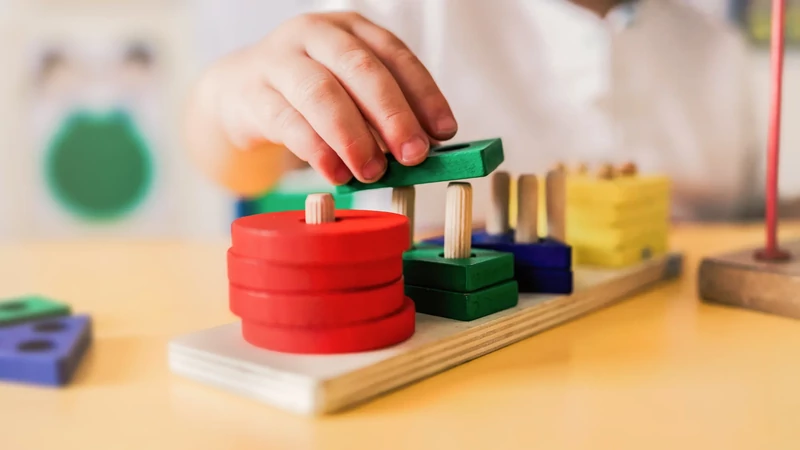
Simple activities like sorting and sequencing help children connect space and quantity through play
Offer your child toys and activities that naturally build spatial and numerical awareness. Sorting objects by size or color, sequencing cards by number, or comparing lengths with blocks are simple, effective ways to connect space and quantity through play.
📕 You May Also Like: How to Use Math Manipulatives Effectively at Home
2. Strong Spatial Skills Support Multi-Step Problem Solving
Solving multi-digit operations or word problems requires more than memorizing math facts. It demands the ability to hold and manipulate visual information, which is something spatial skills directly support.
When students solve a complex problem, they often visualize the steps before writing anything down. They might picture regrouping tens in subtraction, or mentally align place values in multiplication. Students with a more developed spatial reasoning are more likely to complete these mental steps efficiently, leading to greater problem-solving success.
There is consistent evidence that spatial training leads to improved math performance in children and young adults. One study concluded that the relationship may be causal: improving spatial ability may actively lead to better math learning outcomes.
At Mathnasium, we see this play out regularly. Students who demonstrate good spatial awareness tend to plan more effectively and persist through multi-step problems with less frustration.
To connect spatial skills with multi-step problem-solving at home, encourage activities that challenge your child to think in steps. Map-making, basic coding games, construction sets, and puzzles all require children to visualize, plan, and execute, just like solving math problems.
📕 You May Also Like: 3 Surprising Links Between Math and Brain Development
3. Spatial Ability Predicts Success in Geometry and Abstract Math
As students move into upper elementary and middle school, math becomes increasingly abstract. Geometry, algebra, and data representation require learners to think beyond concrete numbers—to imagine shapes rotating, lines intersecting, or variables shifting in equations. Spatial ability makes this kind of reasoning possible.
Geometry, in particular, is built on visual-spatial reasoning. Concepts like symmetry, congruence, and transformations all require students to picture relationships between shapes. Algebra, too, draws heavily on spatial thinking when students interpret graphs or manipulate variables across equations.
Studies by Mix et al. (2012) and Gilligan et al. (2017) found that spatial skills are not only linked to geometry success but are reliable predictors of overall math achievement. These findings suggest that improving spatial ability in early childhood can support long-term growth in abstract mathematical thinking.
In our learning center, we observe that students with better spatial reasoning tend to be more confident when tackling unfamiliar or visual problems. They are quicker to spot patterns and explain their thinking in multiple ways, which are the skills that serve them well in advanced math.
Support your child’s spatial development with activities like drawing symmetrical figures, completing mirror-image challenges, or playing transformation games where they flip and rotate shapes. These playful experiences lay the groundwork for later success in geometry and algebra.
📕 You May Also Like: 5 Morning Routines for Math Success in the New School Year
Simple Ways to Build Spatial Skills at Home
As we mentioned earlier, children start to develop spatial skills as soon as they begin to play. To apply the insights we covered today more mindfully at home, we recommend:
1. Keep Spatial Toys Within Reach
Offer your child regular access to building materials like:
These toys naturally encourage children to experiment with shape, structure, orientation, and design, all critical aspects of spatial reasoning.
2. Use Spatial Language Throughout the Day
Simple verbal cues help children build an internal map of how objects relate to each other. Use phrases like:
Consistent exposure to spatial language helps children connect vocabulary with mental imagery, reinforcing both verbal and visual thinking.
3. Encourage Visual Memory and Description
Ask children to describe or recreate simple shapes, patterns, or structures they’ve seen. Try games like:
-
“Build this shape from memory”
-
“Draw the path we took on our walk”
-
“Can you explain how you built that tower?”
These activities promote visualization and verbal processing—two skills that influence later math problem solving.
4. Include Movement-Based Spatial Games
Games that involve navigating space physically help develop spatial orientation. Try:
-
Obstacle courses with directional cues (over, under, through)
-
Hide-and-seek with clues
-
Treasure hunts using basic maps
When children link movement to mental mapping, they form stronger, more intuitive spatial frameworks.
At Mathnasium, we often build on the spatial strengths students bring from these types of at-home experiences. When children arrive already comfortable thinking in space, they are more prepared to grasp early numeracy, geometry, and multi-step problem solving.
How Mathnasium Builds the Spatial and Mathematical Skills That Last
Spatial thinking shows up long before children start solving equations, but its impact lasts long after. At Mathnasium, we know the impact spatial reasoning has on students’ long-term success in math.
That’s why we go beyond rote learning. Our goal isn’t just to help students complete assignments—it’s to nurture confident, capable math thinkers who understand how numbers work and how to approach problems visually, logically, and flexibly.
We do this through the Mathnasium Method™, our proprietary teaching approach grounded in both research and real-world experience.
Here’s how it works:
-
Granular Personalization: Every student begins with a comprehensive diagnostic assessment that identifies their unique strengths, learning gaps, and goals. Based on the results, we create a personalized learning plan that often includes visual and spatial strategies to support concept mastery.
-
Teaching for Understanding: Our tutors use visual models, hands-on materials, verbal reasoning, and guided questioning to help students understand—not just memorize—math concepts. This approach is especially effective in developing spatial fluency alongside numerical understanding.
-
Focus on Critical Thinking: From number lines and place value to geometry and algebra, we help students build the spatial and logical tools needed to solve unfamiliar problems. Rather than rushing to answers, we teach students how to think through math step by step.
-
The Human Element: Our instructors understand how children learn. We provide face-to-face instruction in a caring, group environment where students feel safe to explore, make mistakes, and grow. This balance of structure and support builds both skills and confidence.
-
Singular Focus on Math: Math isn’t just one of many things we do—it’s the only thing we do. That singular focus allows us to go deeper into how children learn math and how spatial reasoning supports that journey from the earliest stages.
The results speak for themselves:
-
94% of parents report improved math skills and understanding
-
93% report a better attitude toward math
-
90% of students see improved grades in school
At Mathnasium of Cherry Hills, we help students in and near Cherry Hills Village, CO, develop the spatial foundations that make math make sense, so they can succeed not just now, but in the years to come.
📅 Schedule a Free Assessment at Mathnasium of Cherry Hills
Not located near Cherry Hills?
📍 Find a Mathnasium Learning Center Near You


 (720) 474-1878
 (720) 474-1878