Every time a child wrestles with a problem, their brain lays down new pathways that support focus and memory. With steady practice, those pathways grow stronger, giving kids the tools to approach challenges with more confidence.
Today, we share three research-backed ways math supports brain development, with our tutors’ advice on how to use these insights for mindful at-home play and practice.
Surprising Link #1: Math Increases Resilience Through Neuroplasticity
One of the brain’s quiet assets is its ability to change. Scientists call this neuroplasticity. Each time a child works through a math problem, their brain shifts into focus and bolsters their ability to access memory and solve problems.
Brain imaging studies have shown that repeated practice in problem-solving activates the prefrontal cortex, the part of the brain responsible for decision-making, memory, and self-control.
Over time, this practice builds mental flexibility, especially when students are encouraged to work through challenges rather than avoid them. This concept is known as productive struggle.
And the effects spill over!
A child who persists through long division may also stick with a tricky puzzle or keep going after missing a soccer shot.
Math builds reasoning, but it also teaches persistence when things don’t click right away.

Math helps children increase resilience through productive struggle
How to Bolster Neuroplasticity with Math
We usually notice the emotional signs of frustration first: the slammed pencil, the heavy sigh. Those “I’m just not good at math” moments can feel discouraging, but they’re also signs the brain is practicing recovery.
To help children stick with challenging problems and push through the discomfort of math difficulty, parents can create low-pressure math moments and keep practice short and light. Just 5 to 10 minutes of a problem-solving game or math riddle each day is enough to reinforce perseverance without triggering overwhelm.
At Mathnasium of Parker, our instructors build resilience through carefully calibrated challenges. We call it the “just-right” level—not too easy, not too hard.
Mistakes are treated as a normal and necessary part of learning, and each small success is acknowledged. Over time, this approach helps students develop not just math skills, but a mindset that embraces effort, grows from setbacks, and stays steady even when things get tough.
📕 You May Also Like: Why Parents Should Teach Kids to Embrace Math Mistakes
Surprising Link #2: Math Increases the Brain’s “Processing Power”
Every time a child practices math, they activate and strengthen the brain’s ability to process and retain information. This happens through neurotransmitters, chemical messengers like GABA (which stands for “gamma-aminobutyric acid”), which help regulate focus, working memory, and emotional self-control.
A study by neuroscientists at the University of Oxford found that teens who stopped studying math after age 16 showed significantly lower GABA levels in the intraparietal sulcus—a region of the brain associated with reasoning and memory. In contrast, teens who continued studying math had higher GABA levels, and those levels predicted their future math performance nearly 19 months later.
While more research is needed to confirm causation, the findings suggest that regular math engagement supports the brain systems responsible for learning and staying calm under pressure.
Why is this important for families?
When students consistently engage in math, they’re exercising the parts of the brain that support focus, memory, and emotional regulation. This can have a ripple effect that spans from schoolwork to their friendships and everyday decision-making.
📕 You May Also Like: Child Struggling with Math? Know the Signs and How to Help
How to Boost Processing Power with Math
The benefits of math practice don’t require long hours. In fact, short, focused sessions, even 10 to 20 minutes a few times a week, are enough to keep the brain’s learning systems active and sharp.
At Mathnasium of Parker, our instructors use pacing strategies that support concentration and reduce cognitive overload. We break math into manageable steps, celebrate each win, and ensure that success feels possible.
Parents often tell us that math time at home becomes less tense, and that their children seem more focused not just in math, but in school overall.
One parent recently shared: “He used to give up after the first mistake. Now, he’ll pause, reset, and try again. That shift has changed how he approaches everything.”
Surprising Link #3: Math Strengthens the Brain’s Focus and Self-Control
When students engage in problem solving, they activate two powerful brain regions:
-
The prefrontal cortex, which manages focus, self-control, and working memory
-
The intraparietal sulcus, responsible for number sense and spatial reasoning
These areas are part of what neuroscientists call the executive function system which is the part of the brain that helps kids stay on task, resist distractions, and complete multi-step problems.
A Stanford study found that activity in these regions predicted students’ future math performance more accurately than traditional test scores. In short, consistent math engagement helps shape the very systems children use to plan, adjust, and succeed both in school and in everyday life.
That has major implications for how kids respond to challenges. When their executive function is honed, they’re more likely to:
-
Remember instructions without losing focus
-
Shift strategies when their first plan doesn’t work
-
Tackle multi-step tasks, like building a model or writing an essay, without giving up
Challenging and logical subjects like math give students the mental “tools” to stay organized and flexible, especially when things get tough.
How to Strengthen Focus and Flexibility at Home
Unfortunately, a lot of us have grown to associate math with dull practice and bland worksheets. No one, or at least very few, find such practice stimulating, so let’s not expect our children to do so.
Diverse, game-based activities give kids a playful way to build cognitive flexibility.
Try options like:
-
Logic puzzles and riddles
-
Sudoku or KenKen
-
Pattern-based board games
-
Visual-spatial challenges like tangrams
These activities light up the same brain areas as math class, but with the bonus of fun and low pressure.
At Mathnasium of Parker, our tutors combine structured instruction with cognitive warm-ups and real-world problem solving. This helps students strengthen their executive function gradually and confidently.
Parents often say they notice a change, not just in schoolwork, but in how their kids approach everyday tasks like completing routines or adjusting to new situations.
In a world that asks kids to juggle more than ever, math gives them something vital: the ability to think clearly and stay flexible.
Simple Ways to Support Brain Development with Math at Home
The most powerful math moments often happen through brief, enjoyable activities that activate those parts of the brain that support focus, memory, reasoning, and emotional regulation.
Here are a few research-informed ideas you can try at home:
1. Build Working Memory with Card and Dice Games
Games like War, Uno, and Yahtzee help children compare values, make quick decisions, and follow multi-step rules—all of which support working memory and flexible thinking.
You can add an extra challenge by asking your child to keep score mentally and/or combine card values.
2. Strengthen Spatial and Logical Reasoning with Visual Puzzles
Activities like tangrams, building blocks, pattern tiles, and Sudoku stretch the parts of the brain tied to spatial awareness and logical processing.
These games encourage kids to think ahead, recognize symmetry, and adjust when something doesn’t work, which are the skills they use in math and problem solving.
3. Support Math Fluency Through Real-World Routines
Work math into your daily routine in subtle, less obvious ways. Invite your child to help measure ingredients while cooking, split snacks evenly, adjust recipes, or compare prices while shopping.
These hands-on moments reinforce arithmetic, fractions, and estimation in a way that feels natural and meaningful.
4. Encourage Calm Focus with Strategy Games
Games like chess, Rush Hour, and Qwirkle encourage planning, pattern recognition, and adaptability.
When children must consider several steps ahead or change strategy mid-game, they strengthen the same executive functions that help with focus and persistence during schoolwork.
5. Mix Play with Mindful Reflection
After a math-rich activity, take a moment to talk about how it felt.
Asking questions like “What made this tricky?” or “What did you try when it didn’t work?” helps your child reflect on their thinking. This kind of self-awareness—called metacognition—can increase motivation and build long-term learning habits.

How Mathnasium of Parker Helps Kids Thrive
At Mathnasium, we take what brain science tells us about learning and turn it into everyday practice. Our instructors understand that confidence in math grows from encouragement, consistency, and making connections to real life.
We use the Mathnasium Method™, our proprietary teaching approach that combines personalized learning plans with proven instructional techniques to help students truly understand and even enjoy math.
As students begin to close their knowledge gaps and strengthen their foundational skills, math begins to click. They learn new tactics and gradually transform how they think and feel about the subject.
After enrolling at Mathnasium, students see measurable results:
-
94% of parents report an improvement in their child’s math skills and understanding
-
93% of parents report a more positive attitude toward math
-
90% of students show better grades in school
Mathnasium operates over 1,100 centers nationwide, bringing top-rated tutors and our proven method close to your community.
Families based in Parker, Colorado, can join us at Mathnasium of Parker, a trusted, math-only learning center recommended by parents in your neighborhood:
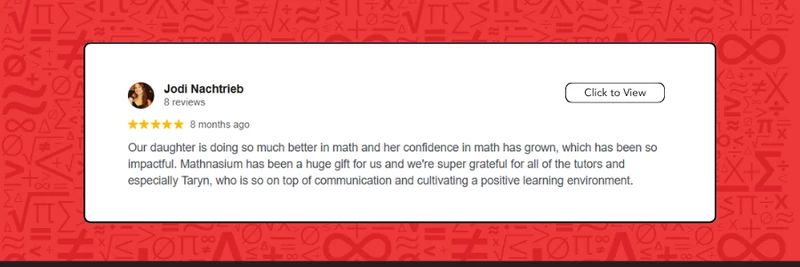
Whether your student is looking to catch up, keep up, or get ahead, schedule a free assessment and enroll at Mathnasium of Parker today!
Schedule a Free Assessment at Mathnasium of Parker, CO
Not near Parker?
📍 Find a Mathnasium Learning Center Near You


 (303) 840-1184
 (303) 840-1184