Prime and composite numbers show up in grades 4 and 5, and they tend to stick around. Students see them again in factors, multiples, fractions, and eventually algebra.
The concept behind them is not complicated, but the two categories look similar enough that students mix them up regularly.
Today, Mathnasium tutors will cover clear definitions of prime and composite numbers, a few worked examples, and a hands-on card-sort activity you and your child can try at home with nothing more than index cards and a pen.

What Is a Prime Number?
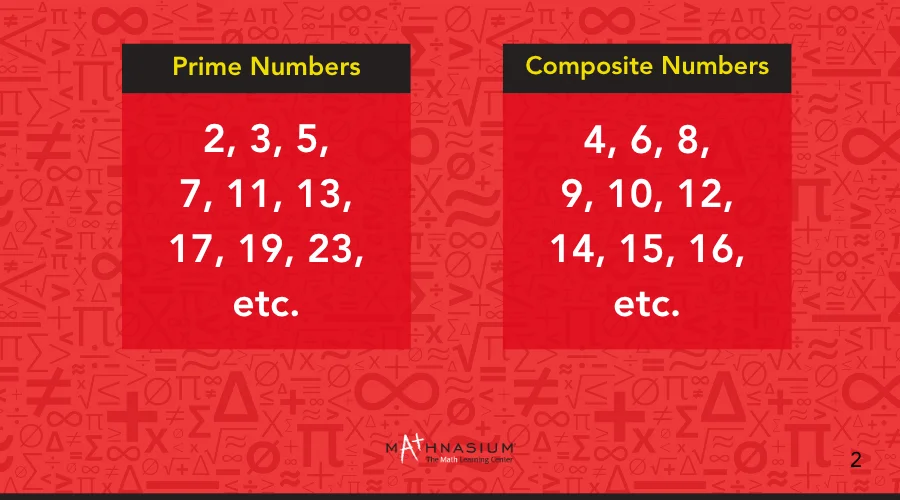
A prime number is a whole number greater than 1 that can only be evenly divided by 1 and itself.
If you try to divide a prime number by any other number, it will leave a remainder.
How does that work exactly? Let's check through a few examples.
-
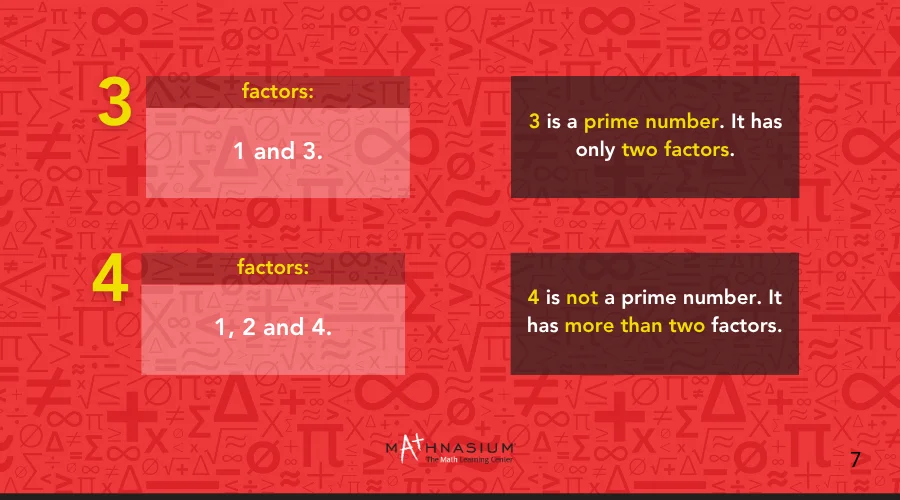
3: Let's try dividing 3 by 2. The only numbers that divide into 3 cleanly are 1 and 3 itself. Try dividing it by 2, and you get a remainder of 1. That makes 3 a prime number.
-
4: What about 4? Divide it by 2, and you get 2, with nothing left over. That means 4 has more than two factors: 1, 2, and 4. More than two factors means 4 is not prime.
-
7: Now let's take 7. Try dividing it by 2, 3, 4, 5, or 6, and you will get a remainder every single time. Just like 3, the only numbers that divide into 7 cleanly are 1 and 7 itself, so 7 is prime.
One number students frequently ask about is 1.
Is 1 a prime number?
The answer is that 1 is not prime. It has only one factor, itself, and the definition of a prime number requires exactly two.
📕 You May Also Like: What Is a Factor in Math? Explain It to a 9-Year-Old
What Is a Composite Number?
A composite number is a whole number greater than 1 that can be evenly divided by more than just 1 and itself.
In other words, composite numbers have extra factors. And the best way to see that is to check a few.
-
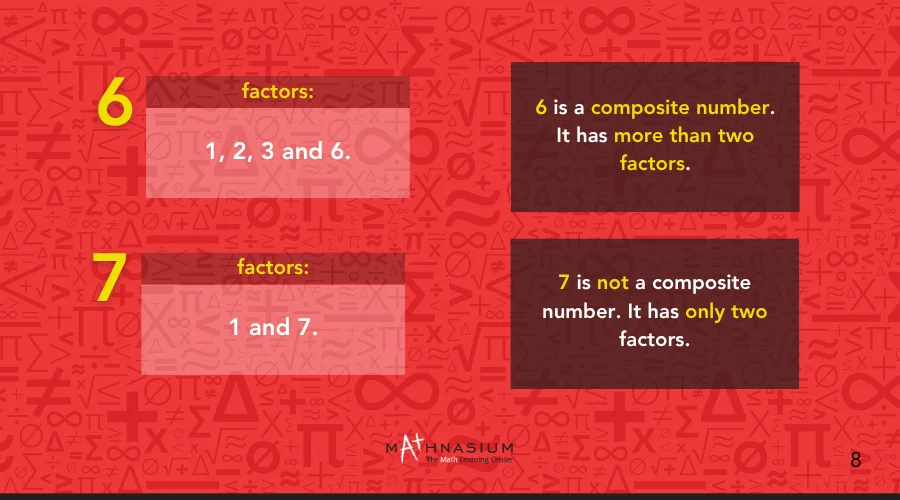
6: Let's try dividing 6 by 2. We get 3, with nothing left over. That means 6 has more than two factors: 1, 2, 3, and 6. That makes 6 a composite number.
-
7: Now let's take 7. Try to divide it by 2, 3, 4, 5, or 6, and you will get a remainder every single time. The only numbers that divide into 7 cleanly are 1 and 7 itself, so 7 is not composite. It is a prime number.
-
9: What about 9? Divide it by 3, and you get 3, with no remainder. So 9 has more than two factors: 1, 3, and 9. More than two factors means 9 is composite, even though it might not look like it at first glance.
There is one more idea to keep in mind here. Every composite number can be broken down into prime numbers multiplied together.
Take 9, which we just confirmed is composite. It equals 3 × 3, and 3 is prime. That breakdown is called prime factorization, and students will meet it again throughout middle school math.
📕 You May Also Like: What Is Prime Factorization? Explain It to a 10-Year-Old
Prime vs. Composite: What's the Difference?
The difference between prime and composite numbers comes down to how many factors a number has.
To tell them apart, we use a simple factor check.
We take the number and try to divide it by whole numbers starting from 2.
If we find even one that divides in cleanly with no remainder, the number is composite. If none of them do, and the only clean divisions are 1 and the number itself, it is prime.
|
Prime |
Composite |
| Factors |
Exactly 2 |
More than 2 |
| Divisible by |
Only 1 and itself |
1, itself, and other numbers |
| Examples |
2, 3, 7, 11, 13 |
4, 6, 9, 12, 15 |
Two numbers sit outside both categories entirely.
-
The number 1 has only one factor, itself, which places it in a class of its own.
-
The number 0 is a special case too, because any number multiplied by 0 gives 0, and the usual factor rules stop working there.
The Card-Sort Activity: Prime or Composite Number?
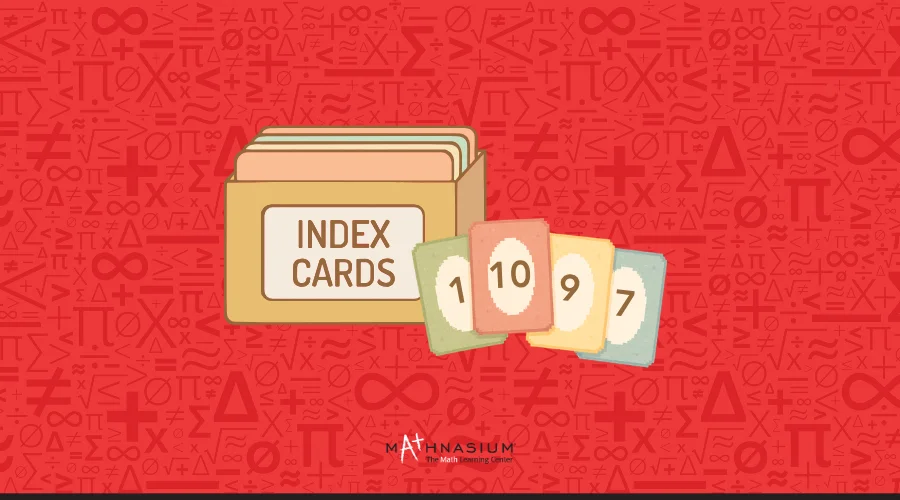
This activity helps your child move from the rule to real practice. All you need is a stack of index cards and a pen.
What you need for this activity is:
To set it up, write one number per card from the list below, mix them up, and place the two header cards on a flat surface as column labels.
Here’s how to play:
-
Your child picks a card from the pile.
-
They try to divide the number by whole numbers starting from 2.
-
If they find a number that divides cleanly with no remainder, the card goes in the Composite column.
-
If they get a remainder every single time, the card goes in the Prime column.
-
They flip the card over and write the full factor list on the back to confirm the answer before moving to the next card.
You can work through the pile together or let your child go independently and compare factor lists at the end.
The numbers to start with are:
2, 4, 7, 9, 11, 15, 17, 20, 23, 25, 29, 36, 41, 49, 51
A heads-up on a few tricky ones:
To stretch further, have your child race against a timer or push into three-digit numbers for an extra challenge.
You can also add a third column to the sort and label it "Neither," then throw 0 and 1 into the pile. Figuring out where those two land makes for a good conversation.
📕 You May Also Like: 8 No-Fuss Ways to Practice Math with Your Kids at Home [Parent Guide]
FAQs About Prime and Composite Numbers
Our tutors have gathered a few common questions students ask as they learn about prime and composite numbers and answered them here.
1. Is 2 prime or composite?
2 is prime. It has exactly two factors, 1 and itself. What makes 2 unusual is that it is the only even prime number. Every other even number can be divided cleanly by 2, giving it at least three factors.
2. Can a number be both prime and composite?
No. Every whole number greater than 1 falls into exactly one of the two categories. A number either has exactly two factors and is prime, or it has more and is composite.
3. How do students know when they have checked enough factors?
Students only need to check up to the square root of the number. For 25, that means they go up to 5. In practice, for the numbers students work with in grades 4 and 5, a quick run through small divisors like 2, 3, 5, and 7 is enough to reach a clear answer.
4. When do students first learn about prime and composite numbers?
Students first encounter prime and composite numbers in grade 4, where they classify numbers in the range of 1 to 100. The concept builds from there into factors, multiples, and prime factorization in grades 5 and 6.
 Mathnasium tutors use personalized learning plans and hands-on techniques to help students make sense of concepts like prime and composite numbers.
How Mathnasium Helps Students Master Any Math Concept
Mathnasium is a math-only learning center empowering K-12 students of all skill levels to learn and master math.
Students come to us at different points in their math journey. Some arrive with gaps in foundational concepts like factors and divisibility. Others are ready to push further into prime factorization and number theory.
Wherever your child is, we build the path forward from that exact point.
At the core of how we do that is the Mathnasium Method™, our proprietary teaching approach.
It starts with a diagnostic assessment, a relaxed interaction that gives us a clear picture of your child's current skills and knowledge gaps.
From there, we build a personalized learning plan tailored to their needs and goals.
With the plan in place, our specially trained tutors deliver face-to-face instruction in a supportive and fun environment.
We use everyday language and a mix of verbal, visual, mental, tactile, and written techniques so concepts land in a way that makes sense to your child.
When something is not landing, we break it down into smaller steps and explain both the how and the why. Gradually, our students develop their own problem-solving skills and critical thinking tools to use in math and beyond.
Fun is a core part of how we work. Our activities are often game-based and hands-on, and we celebrate every step of progress, so confidence grows right alongside skill.
The results speak for themselves:
-
94% of parents report an improvement in their child's math skills and understanding
-
93% of parents report their child's improved attitude toward math after attending Mathnasium
-
90% of students saw an improvement in their school grades
With over 1,100 learning centers across North America, there is likely a Mathnasium close to you.
For families in and near Parker, CO, Mathnasium of Parker is a trusted local center with years of experience helping students build real confidence in math.
Parker families see the results of our math program firsthand.

Whether your child is looking to catch up, keep up, or get ahead, our team is happy to assist!
📅 Schedule a Free Diagnostic Assessment at Mathnasium of Parker
Not near Parker?
📍 Find Mathnasium Learning Centers Near You


 (303) 840-1184
 (303) 840-1184