We learn about inches, measuring things like pencils and notebooks, and miles from road signs and running routes. But ask how many inches fit in a mile, and most students, and even many parents, draw a blank.
That's not a knowledge gap worth feeling bad about. Inches and miles sit at opposite ends of the measurement scale, and the connection between them rarely gets explained clearly.
To address exactly that, Mathnasium tutors walk you through how the two units connect, why the conversion number makes sense, and where this kind of math shows up in real life.

How Many Inches Are in a Mile?
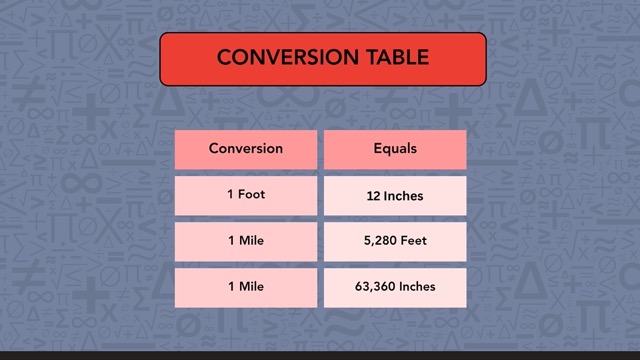
One mile contains exactly 63,360 inches.
That number might seem like it came out of nowhere, but it follows a straightforward chain of conversions that connects the smallest common unit of length to one of the largest:
-
1 foot = 12 inches
-
1 yard = 3 feet = 36 inches
-
1 mile = 1,760 yards = 5,280 feet = 63,360 inches
To get from miles to inches, you multiply the number of miles by 5,280 to get feet, then multiply that result by 12 to get inches. For one mile: 5,280 × 12 = 63,360.
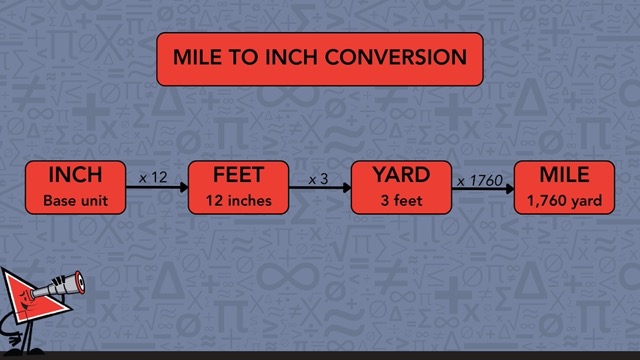
Each step in that chain is a clean multiplication. No rounding-off, no estimating. The numbers work out exactly.
📕 You May Also Like: The Importance of Math in Everyday Life
Why Does This Number Feel So Big?
A mile is a unit we typically experience at speed: driving, cycling, or running.
Inches, on the other hand, are what we use to measure small things like a phone screen or a piece of wood.
Bridging the two requires a number large enough to feel almost unreal at first glance.
63,360 is a hard number to picture on its own. These comparisons put it in perspective:
-
Football field: A standard NFL field is 100 yards long, or 3,600 inches. It would take nearly 17.6 football fields laid end to end to cover one mile.
-
Average stride: A typical walking stride is about 30 inches. Walking one mile means taking roughly 2,112 strides.
-
Dollar bills: A U.S. dollar bill is 6.14 inches long. Lined up end to end, it would take about 10,320 bills to stretch a mile.
-
A child's height: At around 48 inches tall, a child stacked head to toe would need to repeat that height 1,320 times to reach one mile.
Where Do We Actually Use Inches and Miles Together?
More places than you might expect.
Inches and miles sit at opposite ends of the measurement scale. Still, they show up together in a number of everyday and professional contexts. Here are some of the most common ones:
-
Running and fitness tracking: GPS watches and running apps often display distance in miles, but shoe sizing, stride length, and treadmill calibration all work in inches. Coaches converting training data between the two do this kind of math regularly.
-
Road construction and engineering: Engineers designing roads work with blueprints that use inches for precision, while the final distances, such as highway stretches, ramp lengths, and lane widths over long roads, are measured in miles. Both units exist in the same project.
-
Map scales: A map might state that 1 inch equals 10 miles. That's a direct relationship between the two units.
-
Aviation: Runway lengths in the U.S. are officially measured in feet, but visibility conditions are often reported in miles, and aircraft dimensions are given in inches and feet. Pilots and ground crews work across all of these constantly.
-
Space and astronomy: NASA engineers use inches for component precision and miles for distances between objects. The two units coexist in the same calculations.
Recognizing where measurement conversions appear in real life is part of what makes them worth learning.
📕 You May Also Like: How Do Astronauts Use Math in Space? A Journey to the Stars (and Numbers!)
How to Convert Inches to Miles (and Back)
The conversion comes down to two numbers: 12 and 5,280.
To convert inches to miles:
-
Divide by 12 to get feet
-
Then divide by 5,280 to get miles.
Say we want to know how many miles 126,720 inches is.
We’d take those two steps:
To convert miles to inches:
-
Multiply by 5,280 to get feet.
-
Multiply by 12 to get inches.
Suppose we get a question: How many inches is 0.5 miles?
That's all there is to it. The direction of the conversion tells you whether to multiply or divide. Miles to inches means multiplying, inches to miles means dividing.
📕 You May Also Like: Measurement Conversions: A Kid-Friendly Guide
Put Your Conversion Skills to the Test
Ready to put what you've learned to the test? Try our quick challenges.
-
How many inches are in 3 miles?
-
A race track is 95,040 inches long. How many miles is that?
-
A road crew has paved 2.5 miles of highway. How many inches is that?
-
Two towns are 190,080 inches apart. How many miles separate them?
When you're finished, scroll down to the bottom of our guide to check your answers.

Big numbers start with small units. At Mathnasium of Parker, we help students follow that chain all the way through.
How Mathnasium Helps Students Make Sense of Numbers
Mathnasium is a math-only learning center helping K-12 students of all skill levels learn and master math.
Whether students need support with measurement and unit conversions or the underlying skills beneath it, like multiplication, division, or number sense, our way of teaching is for true understanding. This means students don't just memorize the steps; they learn why each step works, how the numbers relate to each other, and how to apply that reasoning independently when we're not in the room with them.
To help students reach that level of understanding, we rely on the Mathnasium Method™. Unlike a one-size-fits-all curriculum, this is a proprietary and time-tested approach designed around students’ individual needs and learning styles.
Here’s how it works.
Each student starts with a diagnostic assessment that identifies precisely where their understanding is strong and where gaps exist. From there, we build a personalized learning plan targeting exactly what each student needs.
Our tutors follow the plan closely, delivering face-to-face math instruction in a supportive setting.
We use natural, everyday language to phrase math concepts and rely on a combination of verbal, visual, mental, tactile, and written techniques to help students truly make sense of what they’re learning.
When students get stuck on the concept, we break it down into manageable bits, showing both the how and the why behind it. Concepts like unit conversion are taught with real-world context, clear step-by-step reasoning, and enough practice to make the process feel natural.
Working with our tutors, students gradually develop valuable critical thinking tools and problem-solving skills to use in math and beyond.
Our environment is designed to be both engaging and fun. Our materials are game-based, and students have the opportunity to earn rewards to keep them motivated as they advance to higher levels of achievement.
The results speak for themselves:
-
94% of parents report an improvement in their child's math skills and understanding
-
93% of parents report a more positive attitude toward math
-
90% of students show better grades in school
We operate over 1,100 learning centers, bringing our proven approach close to your neighborhood.
Families in Parker, Colorado, can find us at Mathnasium of Parker, a trusted local center serving students across the community.
Here’s what one parent had to share about our center:

Whether your child is looking to catch up, keep up, or get ahead, our team is ready to help.
📅 Schedule a Free Assessment at Mathnasium of Parker
Not near Parker?
📍 Find a Mathnasium Learning Center Near You
Pssst! Check Your Answers Here
If you’ve given our exercises a try, check how you did below:
-
3 × 5,280 × 12 = 190,080 inches
-
95,040 ÷ 12 ÷ 5,280 = 1.5 miles
-
2.5 × 5,280 × 12 = 158,400 inches
-
190,080 ÷ 12 ÷ 5,280 = 3 miles


 (303) 840-1184
 (303) 840-1184